


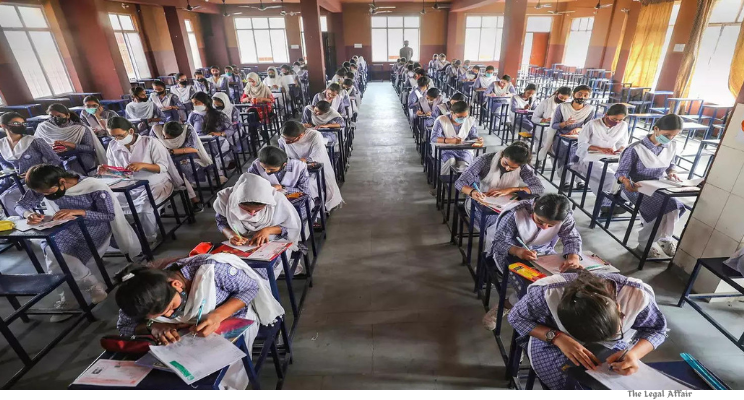
Introduction:
In a crucial hearing on October 15, 2024, the Supreme Court was informed that the Karnataka Government had withdrawn its controversial notification to conduct board-like examinations for Classes 5, 8, and 9 across certain districts in the state. This development follows a contentious legal battle initiated by organizations representing unaided private schools and parents, who challenged the government’s move because it violated students’ rights under the Right to Education (RTE) Act. The Supreme Court previously upheld the Karnataka Government’s decision to hold these exams, yet it allegedly proceeded with public exams in defiance of this stay, prompting fresh concerns about contempt of court. Advocate KV Dhananjay, representing the petitioners, argued that the exams directly violated the Court’s interim order and constituted an unnecessary burden on students. At the same time, Solicitor General Tushar Mehta defended the state’s actions, explaining that the exams were conducted in areas where students were performing poorly.
The legal proceedings began in March when the Karnataka Government issued notifications appointing the Karnataka School Examination and Assessment Board (KSEAB) as the competent authority to conduct these examinations. The petitioners argued that these exams, under the guise of “Summative Assessment-2,” were essentially board exams, akin to the Class 10 CBSE and ICSE exams, which was contrary to Section 30 of the RTE Act, which prohibits board exams until the completion of elementary education. As a result, the petitioners sought judicial intervention to quash the notifications.
After rounds of litigation that saw mixed rulings from the Karnataka High Court, the case reached the Supreme Court, where the bench of Justices Bela M. Trivedi and Satish Chandra Sharma expressed concern over the state’s defiance of judicial orders and its rationale for conducting the exams. The bench noted that the state seemed to be acting out of “ego” and reiterated the Court’s interim order staying the examinations. The case remains ongoing, with the Court scheduled to hear further arguments next week.
Arguments of Both Sides:
Petitioners’ Arguments:
The petitioners, represented by Advocate KV Dhananjay, contended that the Karnataka Government’s decision to conduct board-like exams for Classes 5, 8, and 9 violated both the spirit and the letter of the RTE Act, particularly Section 30, which states that no child shall be required to pass any board examination until the completion of elementary education (Class 8). According to the petitioners, the so-called “Summative Assessment-2” was indistinguishable from a traditional board exam, with centralized question papers, formal grading, and an examination structure similar to that used in higher classes, such as Class 10. They argued that conducting such exams created undue pressure on young students and was against the progressive nature of the RTE Act, which aims to make education more inclusive and stress-free.
Dhananjay further pointed out that the Supreme Court had already granted an interim stay in March, halting the Karnataka Government’s proposal to hold these exams. However, the state government allegedly defied this order by conducting exams in several districts. This blatant disregard for the court’s ruling, Dhananjay argued, amounted to contempt of court, further aggravating the legal situation. He underscored that any declaration of exam results would be particularly problematic, as it would undermine the Court’s authority and exacerbate the stress on students and parents who had believed the exams were halted.
The petitioners also challenged the state’s justification for the exams, noting that these assessments were not merely diagnostic tools to measure academic performance, but full-fledged board exams in all but name. They maintained that even if the students were not formally required to “pass” the exams, the fact that the results would contribute to their overall academic record meant that the exams were essentially mandatory. This, they argued, was a violation of Section 30 of the RTE Act, which expressly forbids such assessments during elementary schooling.
State of Karnataka’s Arguments:
Representing the Karnataka Government, Solicitor General Tushar Mehta defended the state’s decision, arguing that the exams in question were not formal board exams but merely “Summative Assessments” designed to evaluate students’ readiness for higher classes. Mehta emphasized that these assessments were introduced to ensure that students were adequately prepared for the rigours of Class 10 and 12 board exams and to address concerns about declining academic standards in some regions of the state.
Mehta argued that the exams were conducted in areas where the average performance of students was below 50%, necessitating intervention to improve academic outcomes. He also stressed that the government had acted in good faith, withdrawing the notification to conduct the exams before a formal contempt application could be filed. According to Mehta, the exams were intended as a means of “improving the system,” not as a punitive measure against students. He maintained that the results of the exams would not be declared, as per the state’s commitment to comply with the Supreme Court’s interim order.
In response to the Court’s concerns about defiance of its orders, Mehta assured the bench that the state had no intention of harassing students or violating the RTE Act. He reiterated that the exams were not “board exams” in the conventional sense, as students were not required to pass them in order to progress to the next grade. Mehta also pointed out that the primary objection raised by the petitioners was procedural, related to the government’s failure to provide adequate prior notice of the exams, rather than substantive non-compliance with the RTE Act.
Nevertheless, the Court remained unconvinced by the state’s arguments, with Justice Bela Trivedi remarking that the government’s actions suggested an “ego problem.” The Court also questioned the necessity of conducting exams if the results were not going to be declared, implying that the assessments served no meaningful purpose and only added unnecessary stress to students.
Court’s Judgment:
The Supreme Court’s interim order in March 2024 put a stay on the Karnataka Government’s proposal to conduct Board Exams for Classes 5, 8, and 9, emphasizing that these exams appeared to violate the provisions of the RTE Act. Justice Trivedi, who headed the bench, highlighted that Section 30 of the RTE Act prohibits any child from being subjected to board exams until they have completed elementary education, which includes Classes 5 and 8. The Court expressed serious concerns over the government’s insistence on holding such exams, which it believed complicated the education system and went against the very essence of the RTE Act’s goal to provide a stress-free learning environment for children.
When the case came up again in October 2024, the Court was informed that the Karnataka Government had already conducted exams in several districts, despite the stay. This raised concerns about possible contempt of court, as the state’s actions seemed to undermine the Supreme Court’s authority. Advocate KV Dhananjay, representing the petitioners, stressed that this amounted to a violation of the interim order, and any attempt to declare the exam results would further exacerbate the issue.
In response, Solicitor General Tushar Mehta, representing the state, explained that the government had withdrawn the notification for conducting the exams and assured the Court that no results would be declared. Mehta argued that the exams were conducted in good faith to assess students’ performance in districts where the average academic achievement was below 50%. However, the Court was not convinced, with Justice Bela Trivedi remarking that the exams appeared to serve no purpose other than to satisfy the state’s ego.
The bench pointed out that under Section 30 of the RTE Act, no student can be required to pass board exams before completing elementary education. It reiterated that the exams, even if labelled as “summative assessments,” still amounted to board exams because they involved formal assessments by the state education board. This, the Court noted, interfered with statutory provisions and created undue complications for students and their families.
The Court also took issue with the state’s argument that the exams were not mandatory, as students were not required to pass them. It pointed out that if the assessment marks counted towards students’ final academic records, then the exams were effectively board exams, regardless of whether students were formally required to pass. The Court stressed that the government should not introduce unnecessary complexities into the education system, particularly when such measures went against the objectives of the RTE Act.
Conclusion
The Supreme Court maintained its stance that the Karnataka Government’s attempt to conduct board-like exams for Classes 5, 8, and 9 violated the RTE Act and created unnecessary stress for students. It deferred further hearings to the following week, giving the petitioners time to take instructions and decide whether to pursue a contempt application against the state.