


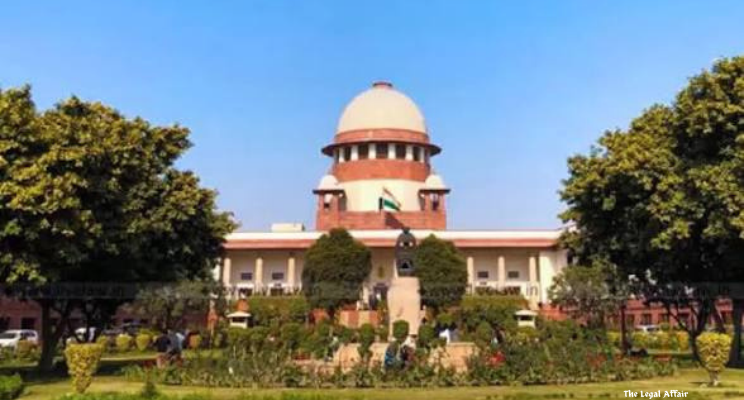
Introduction:
The Supreme Court has set aside the conviction and life sentence imposed on a man for the murder of a woman, holding that the prosecution had failed to establish a complete and unbroken chain of circumstantial evidence connecting him to the crime. The Court clarified that the recovery of ornaments belonging to the deceased, even if allegedly found in the accused’s possession, cannot by itself establish guilt for murder unless there is reliable evidence connecting the recovery with the homicide.
A Bench comprising Justice Prashant Kumar Mishra and Justice Vipul M. Pancholi allowed the criminal appeal challenging the Karnataka High Court’s judgment dated July 9, 2024, which had upheld the appellant’s conviction under Section 302 of the Indian Penal Code, 1860 (IPC), and the sentence of life imprisonment imposed by the Sessions Court. The Supreme Court found that the prosecution’s case suffered from several evidentiary deficiencies concerning the alleged motive, last-seen evidence, discovery of the body and recovery of the ornaments.
The case originated from an incident in 2013, when the body of a woman was discovered stuffed inside an iron drum in Harapanahalli, Karnataka. According to the prosecution, the appellant was involved in an illicit relationship with the deceased and suspected that she was also involved with another man. It was alleged that this suspicion led to a quarrel and that the appellant, acting out of anger, strangled the woman using a plastic strap before taking away her gold and silver ornaments.
The prosecution further alleged that the appellant subsequently led the police to his house, from where the ornaments belonging to the deceased were recovered. These circumstances formed the principal basis of the prosecution’s case, which did not rest on direct eyewitness testimony but on circumstantial evidence.
The Sessions Court had rejected the evidence of two witnesses, PW 13 and PW 14, who were relied upon to establish that the deceased had been last seen with the appellant. Their statements had been recorded by the police after an unexplained delay of 58 days. Despite rejecting this evidence, the Trial Court convicted the appellant for murder primarily on the basis of the alleged recovery of the ornaments. It, however, acquitted him of the charge under Section 201 IPC, relating to causing disappearance of evidence.
The Karnataka High Court subsequently relied upon the last-seen evidence of PW 13 and PW 14 and affirmed the conviction and sentence. Aggrieved by the decision, the appellant approached the Supreme Court.
The appeal required the Supreme Court to examine whether the circumstances relied upon by the prosecution were individually reliable and collectively sufficient to establish guilt beyond reasonable doubt. It also raised important questions concerning the evidentiary value of delayed witness statements, the requirements governing discoveries under Section 27 of the Indian Evidence Act, 1872, and the extent to which recovery of a deceased person’s belongings can support a conviction for murder.
The judgment is particularly significant for reiterating that a conviction based on circumstantial evidence requires more than a collection of suspicious circumstances. Every circumstance relied upon must be firmly established, and the combined effect of the evidence must point conclusively towards the guilt of the accused while excluding reasonable alternative explanations.
Arguments of the Parties:
Appearing for the appellant, Senior Advocate A. Sirajudeen argued that the entire prosecution case rested on circumstantial evidence and that the circumstances relied upon by the courts below did not satisfy the legal standards governing such cases.
The appellant’s counsel relied upon the principles laid down by the Supreme Court in Sharad Birdhichand Sarda v. State of Maharashtra, which requires that the circumstances forming the basis of conviction must be fully established, consistent only with the hypothesis of guilt, conclusive in nature and sufficient to exclude every reasonable hypothesis other than the accused’s guilt.
It was submitted that the prosecution had failed to establish a convincing motive. The alleged illicit relationship between the appellant and the deceased, as well as the suggestion that he suspected her of being involved with another man, had not been proved through reliable personal knowledge. The witnesses relied upon by the prosecution had not directly witnessed the alleged relationship or any quarrel arising from it.
The appellant also challenged the prosecution’s version concerning the discovery of the body. It was argued that the circumstances surrounding its discovery were doubtful and that the prosecution had failed to examine the person who allegedly informed the complainant about the body.
A further submission concerned the High Court’s reliance on the testimony of PW 13 and PW 14 to establish the last-seen circumstance. Counsel argued that the Sessions Court had expressly rejected their evidence because their statements were recorded after an unexplained delay of 58 days. The High Court, while reversing that conclusion, had failed to address the delay or explain why the Trial Court’s assessment was incorrect.
The appellant’s counsel also challenged the alleged recovery of the deceased’s ornaments. Relying upon Sanwat Khan v. State of Rajasthan and Raj Kumar @ Raju v. State (NCT of Delhi), it was argued that the recovery of articles belonging to the deceased may, in appropriate circumstances, support an inference concerning theft or possession of stolen property, but cannot automatically establish that the person possessing those articles committed the murder.
It was further contended that the recovery itself was unreliable because the disclosure statement had not been properly proved, the independent witnesses had not been satisfactorily examined and the seizure proceedings contained material inconsistencies. The prosecution had also failed to establish that the deceased was wearing the ornaments when she was last seen alive with the appellant.
On the other hand, Additional Advocate General Avishkar Singhvi, appearing for the prosecution, defended the conviction and argued that the circumstances established by the investigation were sufficient to connect the appellant with the murder.
The State submitted that the deceased had died a homicidal death and that the prosecution had established a motive arising from the alleged relationship between the appellant and the deceased. It was argued that the appellant had suspected her of having an association with another man and that this personal animosity provided the reason for the crime.
The prosecution also relied upon the recovery of the gold and silver ornaments from the appellant’s residence. According to the State, the appellant had failed to offer a satisfactory explanation for possessing articles belonging to the deceased. It was contended that the theft of the ornaments and the murder formed part of a single transaction and that the recovery therefore supported the prosecution’s case as a whole.
The State sought to sustain the High Court’s reliance on the last-seen evidence and maintained that the circumstances, when considered collectively, established the appellant’s involvement in the crime. It therefore opposed the request to interfere with the conviction and sentence.
Court’s Judgment:
The Supreme Court allowed the appeal and set aside the appellant’s conviction under Section 302 IPC, holding that the prosecution had failed to establish a complete and unbroken chain of circumstantial evidence. The Bench found that the courts below had relied upon circumstances that were either inadequately proved or incapable of conclusively establishing the appellant’s guilt.
The Court examined the prosecution’s case in detail and identified deficiencies concerning the alleged motive, the last-seen evidence, the discovery of the body and the recovery of the ornaments. It concluded that the combined effect of these deficiencies created reasonable doubt and that the conviction could not be sustained merely on the basis of suspicion.
Motive was not established through reliable evidence
The Court first considered the alleged motive, which was said to arise from the appellant’s relationship with the deceased and his suspicion that she was involved with another man.
The Bench observed that motive assumes particular importance in cases based entirely on circumstantial evidence. Although motive is not invariably an indispensable requirement for conviction where other evidence conclusively establishes guilt, its absence or failure of proof becomes significant when the prosecution relies upon circumstances to establish the accused’s involvement.
The Court found that both the Sessions Court and the High Court had erred by treating general knowledge of an alleged illicit relationship as proof of a motive to commit murder.
The deceased’s nephew, PW 5, admitted during cross-examination that he had not personally witnessed any illicit relationship between the appellant and the deceased. He also acknowledged that he had merely suspected the appellant in connection with her death. Similarly, the deceased’s husband, PW 7, admitted that he had no personal knowledge of the alleged affair.
More importantly, none of the prosecution witnesses testified that the appellant suspected the deceased of being involved with another man or that a quarrel had taken place between them on that account.
The Court therefore found that the alleged motive was based on conjecture rather than established evidence. It held that an assumption about the existence of a relationship could not automatically be converted into proof that the accused had a reason to commit murder.
The Bench observed that the prosecution had failed to establish the specific circumstances said to have generated hostility between the appellant and the deceased. Consequently, the alleged motive could not be treated as a reliable link in the chain of circumstantial evidence.
Last-seen evidence and unexplained delay in recording statements
The Court next examined the evidence of PW 13 and PW 14, who were relied upon to establish that the deceased had last been seen with the appellant.
The Sessions Court had rejected their testimony because their statements under Section 161 of the Code of Criminal Procedure, 1973, were recorded after an unexplained delay of 58 days. The Trial Court had specifically found that their evidence was not reliable enough to support the last-seen theory.
The High Court, however, relied upon their testimony while affirming the conviction. The Supreme Court found that the High Court had failed to address the substantial delay or provide any convincing reason for reversing the Trial Court’s finding.
The Bench held that where the delay in recording witness statements remains completely unexplained, the last-seen circumstance cannot be treated as conclusively established.
The Court also referred to the principle laid down in Kanhaiya Lal v. State of Rajasthan, reiterating that the circumstance of the accused being last seen with the deceased does not, by itself, establish guilt. There must be proximate and independent corroborative material connecting the accused with the commission of the crime.
The last-seen theory is relevant because the interval between the accused and the deceased being seen together and the discovery of the death may help establish a connection. However, it cannot operate as an independent substitute for proof of guilt. Its evidentiary value depends upon the surrounding circumstances and the existence of reliable corroboration.
In the present case, the unexplained delay in recording the statements weakened the reliability of the witnesses, while the prosecution had failed to provide sufficient independent material to reinforce their version.
The Supreme Court therefore held that the High Court was not justified in relying upon the last-seen evidence without dealing with the Trial Court’s reasons for rejecting it.
Doubts concerning the discovery of the body
The Bench also examined the prosecution’s account of how the body was discovered.
It noted that the informant who had allegedly conveyed information about the body to the complainant, PW 1, was neither traced nor examined during the trial. This omission assumed significance because the prosecution’s account of the discovery depended upon the information allegedly provided by that unidentified person.
The Court further observed that neither the inquest report nor the post-mortem report recorded any trace or stain of limestone on the deceased’s clothing or person, despite the circumstances forming part of the prosecution’s version of the discovery.
These inconsistencies created doubt about the reliability of the prosecution’s account concerning the discovery of the body.
The Court did not treat the deficiencies as isolated technical irregularities. Instead, it considered whether the prosecution’s version, when examined against the documentary and oral evidence, was sufficiently reliable to form part of a chain pointing towards the appellant’s guilt.
The absence of the alleged informant and the lack of supporting material in the medical and inquest records weakened the prosecution’s narrative and added to the doubts already arising from the other circumstances.
Recovery of ornaments and requirements under Section 27 of the Evidence Act
A substantial part of the judgment concerned the alleged recovery of the deceased’s gold and silver ornaments from the appellant’s house.
The prosecution treated the recovery as a crucial circumstance linking the appellant to the murder. However, the Supreme Court found serious deficiencies in the evidence relating to the seizure and the alleged disclosure statement.
One of the three panch witnesses to the seizure was not examined. PW 23 did not mention the presence of that witness, while neither PW 12 nor PW 23 testified to the disclosure statement allegedly made by the appellant.
The Bench observed that, in the absence of independent evidence supporting the disclosure, the essential requirements of Section 27 of the Indian Evidence Act, 1872, had not been satisfied.
Section 27 creates a limited exception to the general rule restricting the admissibility of confessions made to police officers or while in police custody. It permits the admission of so much of the information received from an accused in custody as distinctly relates to a fact discovered in consequence of that information.
The provision does not make an entire police-recorded confession admissible. Its operation is confined to the portion of the information that has a direct connection with the discovery. The prosecution must therefore establish the circumstances of the disclosure and the discovery in accordance with the statutory requirements.
In the present case, the Court found that the evidence did not satisfactorily establish the alleged disclosure statement or the circumstances surrounding the recovery.
PW 12 had admitted that the contents of the seizure proceedings were dictated by the investigating officer. He also stated that he did not know the house from which the trunk was retrieved. These admissions raised doubts about the reliability and independence of the seizure documentation.
The Court also took note of the testimony of PW 23, the appraiser, who admitted that he was a regular police witness. His signature had also been struck out without any explanation.
Considering these circumstances together, the Bench found that the recovery could not be treated as a sufficiently reliable circumstance establishing the appellant’s guilt.
Failure to establish that the deceased possessed the ornaments before her death
The Court identified another important gap in the prosecution’s case: the failure to establish that the deceased was actually wearing the recovered ornaments when she was last seen alive with the appellant.
PW 13 and PW 14, whose evidence was relied upon for the last-seen circumstance, had not mentioned any jewellery worn by the deceased. PW 8, her son, had left a day before the incident, while PW 10 and PW 11 did not testify that they had seen her leaving with the appellant.
The Court therefore found that the prosecution had not established a reliable connection between the ornaments recovered from the appellant’s house and the jewellery allegedly worn by the deceased immediately before her death.
It also considered the possibility that, given the alleged relationship between the appellant and the deceased, some of her belongings might naturally have been kept at his residence. This possibility weakened the inference that possession of the ornaments necessarily indicated involvement in the murder.
Further, PW 13 admitted that the police had informed him on the day after the incident that the deceased’s earrings and gold articles had already been found at the appellant’s residence. This statement was inconsistent with the prosecution’s proposed timeline of recovery and created additional doubt about the sequence of events.
The Court also noted that the prosecution had not established any independent motive for stealing the jewellery. Its principal allegation was that the murder arose out of personal animosity connected with the alleged relationship. There was no clear evidentiary foundation demonstrating that theft of the ornaments was the motive for the killing.
Recovery of stolen property cannot automatically establish murder
The Supreme Court relied upon Sanwat Khan v. State of Rajasthan, as reaffirmed in Raj Kumar @ Raju v. State (NCT of Delhi), to explain the limited evidentiary value of unexplained possession of articles belonging to a deceased person.
Under Illustration (a) to Section 114 of the Indian Evidence Act, 1872, a court may presume that a person found in possession of stolen goods soon after theft is either the thief or has received the goods knowing them to be stolen, unless a satisfactory explanation is provided.
However, such a presumption does not automatically establish that the person committed the murder of the individual from whom the property was allegedly taken.
The Court emphasised that the prosecution must establish a cogent connection between the theft or robbery and the homicide before the recovery can be used to infer guilt for murder.
In the present case, no charge under Sections 379, 392 or 404 IPC had been framed against the appellant. More importantly, the prosecution had failed to establish through reliable evidence that the alleged theft of the ornaments and the murder formed part of one continuous transaction.
The Bench observed:
“Therefore, in the present case, in the absence of cogent evidence showing that the robbery/theft and murder formed part of the same transaction, we are of the view that such recovery, by itself, cannot be stretched to infer guilt of the appellant for murder under Section 302 IPC,”
The Court thus rejected the approach of treating the recovery of the ornaments as sufficient proof of murder. Even if possession of the articles raised suspicion, it could not fill the gaps in the prosecution’s case concerning motive, last-seen evidence and the circumstances of the homicide.
Circumstantial evidence must establish guilt beyond reasonable doubt
The Court ultimately assessed the evidence as a whole in light of the principles governing circumstantial cases.
It reiterated the importance of the principles laid down in Sharad Birdhichand Sarda v. State of Maharashtra, which require that the circumstances relied upon must be fully established, must be consistent only with the hypothesis of guilt, must be conclusive in nature and must exclud every reasonable hypothesis other than the accused’s guilt.
The prosecution c