


Introduction:
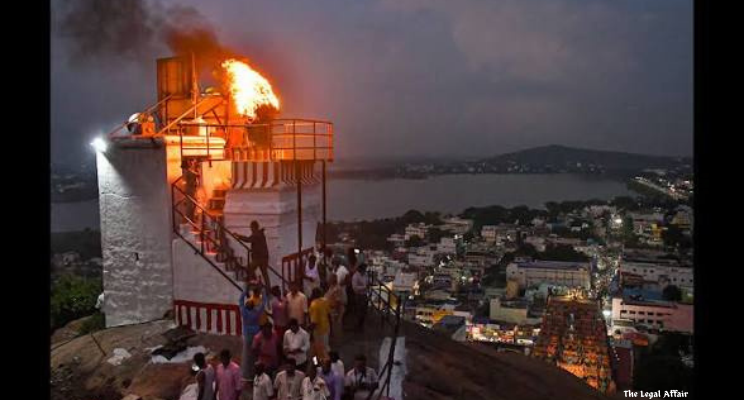
The Supreme Court on November 17 heard arguments advanced by the State of Tamil Nadu seeking an interim stay on the Madras High Court’s direction permitting the lighting of the traditional Karthigai Deepam lamp at a stone pillar, popularly known as the ‘Deepa Thoon’, situated atop the Thiruparankundram hill in Madurai district, approximately 50 metres from the Sikandar Badhusah Dargah. The dispute concerns the customary place for lighting the ceremonial temple lamp during the Karthigai Deepam festival and raises important questions concerning the recognition of religious customs, the evidentiary burden required to establish a customary practice, the jurisdiction of constitutional courts in religious matters, and the need to maintain communal harmony while protecting legally established religious rights.
A Bench comprising Justice Aravind Kumar and Justice Vipul Pancholi heard the matter for more than one and a half hours. The State approached the Supreme Court seeking urgent interim relief, emphasising that the Karthigai Deepam festival, observed during the Vrishchikam month, falls on November 24 this year. According to the State, unless the High Court’s direction is stayed, the lamp would have to be lit at the disputed location on the festival day, potentially altering a practice that had allegedly continued for several decades.
The controversy originated from writ petitions filed before the Madurai Bench of the Madras High Court by individuals seeking permission to light the Karthigai Deepam at the Deepa Thoon situated on Thiruparankundram hill. The principal contention of the petitioners was that lighting the ceremonial lamp at the hilltop was part of the temple’s religious tradition and that the stone pillar was the appropriate location for performing the ritual.
The State Hindu Religious and Charitable Endowments (HR&CE) Department, which administers the Arulmigu Subramaniya Swamy Temple situated at the foothills, opposed the request. It maintained that the established practice was to light the ceremonial lamp near the Uchi Pillaiyar Temple and that there was no recognised custom requiring the lamp to be lit at the Deepa Thoon. The State also questioned the historical character of the stone pillar, contending that it was a survey stone erected during British rule rather than a traditional religious structure.
Justice G.R. Swaminathan, while considering the writ petitions, accepted the petitioners’ request and permitted the lighting of the lamp at the disputed pillar. The Single Judge reasoned that the proposed ritual would not interfere with the rights of the Dargah and that preventing devotees from performing the religious observance would adversely affect their rights. The Court subsequently became concerned with the State administration’s failure to implement the direction, resulting in contempt proceedings. In those proceedings, Justice Swaminathan directed that the ritual be carried out with protection from Central Industrial Security Force (CISF) personnel.
The State challenged the developments before a Division Bench of the Madras High Court. In January 2026, the Division Bench upheld the Single Judge’s original directions as well as the orders passed in the contempt proceedings. It rejected the State’s apprehension that permitting the lamp to be lit at the Deepa Thoon would necessarily create a law-and-order problem. The Division Bench also observed that the temple management had a responsibility to preserve and protect religious traditions. Further, it did not accept the State’s argument that the disputed pillar was merely a survey stone erected by the British authorities.
Aggrieved by the High Court’s decision, the State of Tamil Nadu approached the Supreme Court through a Special Leave Petition. The State sought to prevent the implementation of the High Court’s directions, particularly in view of the approaching Karthigai Deepam festival.
The controversy therefore places before the Supreme Court a significant question concerning the distinction between an established religious custom and a claim based on general religious practice. While the petitioners rely on the religious significance of lighting the lamp at the hilltop, the State maintains that the specific location of the ritual has historically been different. The matter also involves the relationship between judicial protection of religious practices, the evidentiary requirements for establishing customary rights, and the preservation of an existing arrangement pending adjudication.
Arguments of the Parties:
Appearing for the State of Tamil Nadu, Senior Advocate Jaideep Gupta strongly opposed the implementation of the Madras High Court’s directions and submitted that the petitioners had failed to establish any recognised or historically continuous custom of lighting the Karthigai Deepam at the Deepa Thoon. He argued that the existence of a general practice of lighting lamps at hilltops in Tamil Nadu could not, by itself, establish a legally enforceable customary right to perform the ritual at the particular disputed location.
Gupta took the Supreme Court through earlier decisions of the Madras High Court in which requests for lighting the lamp at the Deepa Thoon had been rejected. According to him, these judicial developments demonstrated that the petitioners could not rely merely on broad assertions concerning religious tradition without establishing the specific custom they sought to enforce.
He particularly relied upon the statements of the temple priests and sthanikars, who had explained that, according to the Agama traditions followed by the temple, the ceremonial lamp was traditionally lit near the Uchi Pillaiyar Temple. Their statements, he submitted, were relevant in determining the actual religious practice followed by the temple over the years.
The senior counsel emphasised that the petitioners had not produced sufficient material to establish that lighting the lamp at the Deepa Thoon was an essential or established part of the temple’s customary observance. He contended that a court could not issue a writ of mandamus directing the performance of a particular religious practice unless the petitioners first demonstrated the existence of a corresponding legal right and an enforceable obligation on the part of the authorities.
In support of this position, Gupta submitted that courts ordinarily exercise restraint when a temple’s established religious practice is supported by the persons responsible for conducting its rituals. He observed that where the temple itself maintained that a particular ritual had historically been performed at a specific location, the judiciary should be cautious before directing a departure from that practice.
“If the temple says this is the practice, normally the Courts will not interfere,” he submitted.
Gupta also challenged the reasoning adopted by the High Court that the general practice of lighting temple lamps on hilltops supported the petitioners’ claim. He argued that such a general observation could not substitute for concrete evidence establishing the existence of a customary right at the Deepa Thoon. According to him, the relevant question was not whether lamps were generally lit at hilltops in Tamil Nadu, but whether this particular temple had historically followed that practice at the disputed pillar.
Senior Advocate Shekhar Naphade, appearing for the HR&CE Commissioner, supported the State’s request for interim protection. He questioned the High Court’s interpretation of the expression ‘hilltop’ and argued that the geographical position of the Dargah had not been adequately considered. According to him, the highest portion of the hill was occupied by the Dargah, and therefore, the High Court’s observation that the lamp should be lit at the hilltop was factually and legally problematic.
Naphade further argued that the existing arrangement should not be disturbed while the Supreme Court was examining the challenge to the High Court’s decision. He questioned the necessity of changing a practice that had allegedly continued for approximately a century and submitted that preserving the existing position would be the most reasonable course until the appeal was finally decided.
His argument was primarily based on the need to maintain continuity and avoid disturbing an arrangement that had existed for a considerable period. He suggested that the Supreme Court should prevent any irreversible or contentious change during the pendency of the proceedings, particularly because the festival date was approaching.
Tamil Nadu’s Additional Advocate General Prashanto Chandra Sen supplemented the submissions made on behalf of the State. He drew the Bench’s attention to earlier Madras High Court decisions rejecting similar requests for lighting the lamp at the disputed location. On this basis, he argued that the latest proceedings were barred by the principle of res judicata, since the issue had allegedly been considered and rejected in earlier judicial proceedings.
The principle of res judicata, embodied in Section 11 of the Code of Civil Procedure, 1908, generally prevents courts from reopening an issue that has already been directly and substantially decided between the same parties by a competent court in proceedings where the matter was finally adjudicated. Sen sought to invoke this principle to question the maintainability of the renewed claim.
Senior Advocate Gopal Sankaranarayanan, appearing for the District Collector, also made submissions supporting the State’s position and its request for interim relief.
On the other side, Senior Advocate Huzefa Ahmadi, appearing for the Sikandar Badhusah Dargah, made brief submissions opposing the High Court’s direction. He contended that the decision had effectively introduced a new religious practice rather than merely protecting an existing one. According to him, permitting the lamp to be lit at the Deepa Thoon would amount to creating a practice that had not previously been established at the disputed site.
The respondents supporting the High Court’s order, however, maintained their claim that the religious observance at the hilltop deserved judicial protection. Their position was that the proposed lighting of the lamp would not interfere with the Dargah’s rights and that the temple’s traditional religious observances should not be prevented without sufficient justification.
The central disagreement between the parties thus concerned whether the lighting of the lamp at the Deepa Thoon represented an established customary practice deserving legal protection or whether the petitioners were seeking judicial recognition of a new practice at a location where the ritual had not traditionally been performed.
Court’s Judgment:
As of November 17, the Supreme Court had not delivered its final decision on the State’s request for interim relief. The Bench of Justice Aravind Kumar and Justice Vipul Pancholi heard the competing submissions for more than one and a half hours and decided to continue the hearing on the following day at 2 PM. Consequently, the proceedings remain at the stage of consideration of the State’s challenge, and no final conclusion can yet be attributed to the Supreme Court regarding the validity of the High Court’s directions.
Nevertheless, the submissions made before the Bench bring several important legal principles into focus, particularly those concerning customary religious practices, the scope of judicial review, the requirements for issuing a writ of mandamus, and the doctrine of res judicata.
One of the principal legal questions arising from the dispute concerns the nature and proof of a customary religious practice. A custom, to receive legal recognition, ordinarily requires evidence demonstrating that it has been followed with sufficient continuity, certainty and consistency over a considerable period. A mere assertion that a particular practice is religiously desirable or generally followed elsewhere does not automatically establish a legally enforceable customary right.
The State’s argument is founded substantially on this distinction. It maintains that the petitioners have relied on the general practice of lighting lamps at hilltops without producing adequate evidence that the Deepa Thoon was historically used for the same purpose by the temple. The statements of the temple priests and sthanikars have therefore been presented as important evidence of the location where the ritual was traditionally conducted.
The issue is significant because the existence of a religious festival and the existence of a customary right to perform a particular ritual at a specific place are not necessarily identical legal questions. Even if the performance of Karthigai Deepam is an established religious observance, the precise location at which it must be performed may require separate examination based on historical practice, religious traditions and available evidence.
Another important aspect concerns the scope of the constitutional remedy of mandamus. Under Article 226 of the Constitution, High Courts possess wide powers to issue writs, including directions in the nature of mandamus, for the enforcement of fundamental rights and other legal rights. However, the exercise of this jurisdiction ordinarily requires the petitioner to establish an enforceable legal right and a corresponding public duty on the part of the authority against whom relief is sought.
In the present dispute, the State argues that the petitioners have failed to establish the necessary legal foundation for seeking a direction compelling the authorities to permit the lamp to be lit at the disputed pillar. Its position is that the High Court could not direct the temple administration to adopt a particular location for the ritual without first determining whether such a customary right actually existed.
The opposing position, reflected in the High Court’s earlier decision, is that the devotees’ religious observance deserved protection and that the proposed lighting of the lamp would not interfere with the rights of the Dargah. The Supreme Court will therefore have to consider the competing claims in light of the evidence concerning the religious practice and the legal rights asserted by the parties.
The dispute also raises questions concerning the appropriate level of judicial intervention in matters involving temple rituals and Agama traditions. The State has argued that the statements of the priests and temple functionaries should receive due consideration because they are directly connected with the performance of religious ceremonies. This argument highlights the importance of examining established religious practices before issuing directions that may alter the manner in which rituals are traditionally performed.
At the same time, judicial scrutiny cannot be excluded merely because a dispute involves religious institutions. Where an allegation arises that public authorities have acted unlawfully or failed to protect an established legal right, constitutional courts retain the power to examine the legality of the administrative action. The crucial question is whether the relief sought is supported by legally established rights and sufficient evidence.
The State has also relied upon the doctrine of res judicata, invoking Section 11 of the Code of Civil Procedure, 1908. The principle is intended to prevent repeated litigation over issues that have already been finally decided by a competent court. Its underlying objective is to ensure certainty in judicial decisions, prevent inconsistent findings and protect parties from being subjected to repeated proceedings concerning the same controversy.
However, the applicability of this principle would depend upon the nature of the earlier proceedings, the precise issues decided, the identity of the parties or persons claiming through them, and whether the earlier adjudication attained the necessary finality. Merely referring to previous judicial decisions would not, by itself, establish that the subsequent proceedings are barred. The Court would have to examine the relevant circumstances before accepting the State’s contention.
The question of maintaining the status quo also assumes considerable importance. Naphade’s submission that an arrangement continuing for nearly a century should not be disturbed during the pendency of the proceedings reflects the broader principle that interim orders should ordinarily preserve the subject matter of litigation and prevent unnecessary complications before the dispute is finally resolved.
Interim relief, however, is not granted automatically. Courts generally consider whether the applicant has established a prima facie case, whether the balance of convenience supports the requested protection, and whether refusing interim relief would result in irreparable injury. In the present matter, the approaching Karthigai Deepam festival makes the timing of the decision particularly significant. The State has specifically pointed out that the festival will be celebrated on November 24 and that the High Court’s direction would have to be implemented at the disputed location unless stayed.
The competing concerns also extend beyond the immediate question of ritual practice. The location of the Deepa Thoon, its proximity to the Dargah and the potential implications of conducting the ceremony at the disputed site make the issue sensitive from an administrative and public-order perspective. While the High Court had previously concluded that lighting the lamp would not create a law-and-order problem, the State has approached the Supreme Court seeking reconsideration of the direction before the festival takes place.
The earlier proceedings before the Madras High Court are also relevant to understanding the dispute. Justice G.R. Swaminathan had permitted the lighting of the lamp at the Deepa Thoon after accepting the petitioners’ claim that the ritual would not interfere with the Dargah’s rights. When the administration did not implement the direction, contempt proceedings followed, during which the Single Judge directed that the ritual be performed with CISF protection.
The subsequent Division Bench proceedings resulted in the affirmation of the Single Judge’s original directions. The Division Bench also rejected the State’s contention that the pillar was merely a British-era survey stone and observed that the temple administration had a responsibility to protect its traditions.
The State’s challenge before the Supreme Court therefore involves not merely the physical location of a ceremonial lamp but also the legal basis on which the High Court recognised the claimed religious practice. The Supreme Court is being asked to examine whether the petitioners established an enforceable customary right, whether the High Court correctly assessed the available material, and whether the earlier judicial decisions have any bearing on the maintainability of the subsequent proceedings.
Importantly, the Supreme Court’s hearing on November 17 should not be mistaken for a final adjudication of these issues. The Bench has heard the State, the HR&CE Commissioner, the District Collector and the Dargah’s submissions, but the hearing is scheduled to continue on November 18 at 2 PM.
The final outcome will determine whether the High Court’s directions permitting the lighting of the Karthigai Deepam at the disputed Deepa Thoon will remain operative or whether the State will receive the interim protection it has sought. Until the Supreme Court passes an order, the competing submissions remain arguments advanced by the respective parties rather than findings conclusively accepted by the Court.
The proceedings are particularly significant because they require the Court to balance the protecion of religious traditions with the legal requi