


Introduction:
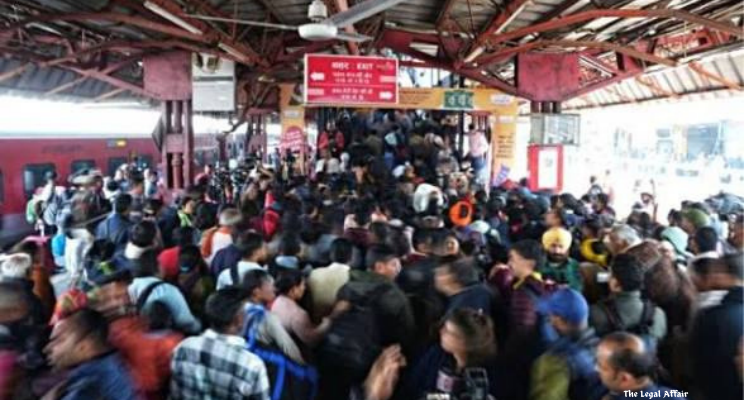
The Delhi High Court has directed the Railway authorities to strictly implement the existing Standard Operating Procedures (SOPs) and circulars governing crowd management at railway stations, emphasising that merely framing policies is not sufficient unless they are effectively enforced on the ground. Highlighting the tragic stampede at New Delhi Railway Station on February 15, 2025, the Court observed that accountability, advance preparation and proper documentation of safety arrangements are essential to preventing similar incidents in the future.
Justice Amit Mahajan issued the directions while hearing a petition filed by Govind Kumar Dhuriya and others in connection with the stampede, which claimed 18 lives and left 15 people injured. The petitioners had approached the Court seeking measures to improve crowd management at railway stations and prevent passengers from being exposed to dangerous overcrowding during periods of exceptionally high footfall.
The incident occurred at New Delhi Railway Station when a sudden rush of passengers towards Platform No. 16 reportedly followed an announcement concerning a special train to Prayagraj. The resulting crowd movement led to a stampede, causing multiple casualties and injuries. The tragedy brought renewed attention to the difficulties faced by railway authorities in managing large gatherings, particularly during festivals, religious events and other occasions when thousands of passengers converge at major railway stations.
The petitioners stated that they had booked tickets to travel from New Delhi to Prayagraj by the Magadh Express, which was scheduled to depart at 9:05 PM. They claimed that they had reached the station at approximately 8 PM but were unable to board the train because of severe overcrowding on the platforms and foot-overbridge. One of the petitioners was a person with disability, making the situation particularly difficult in view of the congestion and the challenges associated with accessing the platform.
According to the petitioners, they were present at the station when the sudden movement of passengers towards Platform No. 16, following the announcement of a special train to Prayagraj at around 10 PM, resulted in the stampede. Their petition initially sought several forms of relief, including compensation for those affected, refund of ticket fares, action against officials responsible for the incident and directions for preparing a comprehensive crowd management plan.
However, during the course of the proceedings, the petitioners narrowed the scope of their request. Their counsel informed the Court that they were pressing only the prayer seeking an effective action plan and appropriate SOPs for managing large crowds at railway stations. They expressly clarified that they were not pursuing claims for refund or compensation for themselves.
The Union of India, in response, placed before the Court an additional affidavit explaining the measures adopted by the Railway Board to address situations involving unusually high passenger footfall. The affidavit referred to several policies and circulars issued after the stampede, including provisions for advance planning, passenger holding areas, access control, surveillance systems and coordination between railway officials and security agencies.
The central question before the High Court was therefore not whether the Railway Board should formulate an entirely new policy, but whether the existing framework was being translated into effective arrangements at railway stations. The Court examined the measures disclosed by the respondents and considered whether the authorities had demonstrated adequate implementation rather than merely announcing future plans.
The ruling reinforces an important aspect of public safety administration: preventive policies can serve their intended purpose only when the officials responsible for executing them are made accountable for their implementation. In the context of railway stations, where large crowds can gather within a short period, the absence of advance preparation or coordinated supervision can have serious consequences.
Arguments of the Parties:
The petitioners, represented by their counsel, initially approached the High Court seeking a range of directions following the February 15, 2025 stampede. Their concerns arose from their own experience at New Delhi Railway Station, where they claimed that overcrowding prevented them from boarding their scheduled train and exposed passengers to an unsafe situation.
They stated that they had purchased tickets for the Magadh Express, scheduled to leave for Prayagraj at 9:05 PM, and had reached the station around 8 PM. Despite arriving well before the scheduled departure, they were allegedly unable to access the train because of the heavy crowd on the platforms and foot-overbridge.
The petitioners also referred to the presence of a person with disability among them, highlighting the difficulties that passengers with special mobility requirements may face when railway stations become severely congested. Their account placed particular emphasis on the sudden movement of passengers towards Platform No. 16 after an announcement concerning a special train to Prayagraj.
Initially, the petitioners sought compensation for persons affected by the tragedy, reimbursement of ticket fares, action against officials allegedly responsible and the formulation of a comprehensive crowd management mechanism. These prayers reflected their concern that the incident should not be treated as an isolated occurrence but should lead to institutional changes capable of preventing similar tragedies.
However, as the matter progressed, their counsel clarified that they were no longer pressing the monetary reliefs or seeking a refund of their own ticket fares. Instead, they confined their request to the formulation and implementation of an effective action plan and SOP for handling large passenger gatherings at railway stations.
This clarification was significant because it narrowed the dispute to a matter of public administration and passenger safety. The petitioners were primarily seeking a preventive framework that would ensure that railway authorities anticipated large gatherings, regulated passenger movement and made appropriate arrangements before congestion reached dangerous levels.
The Union of India opposed the need for fresh policy directions by relying on an additional affidavit filed pursuant to the Court’s earlier directions. The respondents submitted that the Railway Board had already introduced a structured framework for managing events expected to attract large numbers of passengers. According to the Railways, the existing circulars and policies addressed several of the concerns raised in the petition.
The respondents specifically referred to a Railway Board letter dated May 1, 2025, titled “Strategic Preparedness for Events with High Passenger Footfall”. The framework was intended to ensure that railway divisions anticipated major gatherings and prepared arrangements well in advance rather than responding only after overcrowding had developed.
Under this framework, each railway division was required to identify upcoming events, including festivals, melas, recruitment examinations, sporting events and other occasions likely to attract substantial passenger numbers. The expected crowd was to be assessed at least three weeks before the event.
The affidavit further explained that the Senior Divisional Commercial Manager and the Senior Divisional Security Commissioner were required to jointly prepare an action plan. The proposed arrangements were to address crowd management, operation of special trains, deployment of additional security personnel, availability of ticket counters and ticket-checking arrangements.
The respondents also relied on the Railway Board’s policy dated May 30, 2025, which contemplated several additional measures for managing passenger movement. These included establishing holding areas outside railway stations, regulating access to platforms, installing CCTV cameras, setting up monitoring rooms, providing communication equipment and deploying senior officers to coordinate arrangements.
The Railways informed the Court that holding areas were proposed at 76 railway stations with high passenger traffic. These facilities were intended to prevent passengers from gathering uncontrollably on platforms and other restricted areas while waiting for their trains.
With specific reference to New Delhi Railway Station, the respondents submitted that a Holding Area, also described as a Yatri Suvidha Kendra, had been commissioned on the Ajmeri Gate side on October 11, 2025. The facility was stated to have the capacity to accommodate approximately 7,000 passengers.
The respondents highlighted the infrastructure available at the facility, including 22 ticket counters, 25 Automatic Ticket Vending Machines, CCTV cameras, luggage scanners, door-frame metal detectors and a dedicated control room. These facilities, according to the Railways, demonstrated that steps had been taken to improve passenger management and security at one of the country’s busiest railway stations.
The affidavit also referred to the exceptionally high passenger footfall recorded at New Delhi Railway Station. The respondents informed the Court that the station had handled 3,29,527 passengers on October 24, 2025. This figure was relied upon to demonstrate the scale of the operational challenge and the importance of having infrastructure capable of managing large passenger gatherings.
The Railways’ overall position was that the Railway Board had already recognised the need for better preparedness and had issued detailed instructions to the divisions. It relied on the existing policies and the newly commissioned holding facility to demonstrate that measures were being undertaken to address the problem.
The competing submissions thus presented two distinct concerns. While the petitioners sought an effective and comprehensive mechanism to prevent overcrowding and protect passengers, the respondents maintained that the Railway Board had already established a policy framework and had begun implementing several measures. The Court was required to assess whether the material placed before it demonstrated actual implementation sufficient to address the concerns raised by the tragedy.
Court’s Judgment:
Justice Amit Mahajan observed that the Railway Board had already issued several SOPs and circulars dealing with the management of large passenger gatherings. These instructions covered advance planning for high-footfall events, creation of holding areas, regulation of access to platforms, CCTV monitoring, restrictions relating to waiting lists and the dissemination of passenger information.
The Court recognised that the Railway authorities had established a framework intended to deal with situations involving unusually high passenger numbers. However, it was not satisfied merely by the existence of these policies. The additional affidavit, according to the Court, largely described measures that were proposed to be implemented in the future. Apart from the holding facility established at New Delhi Railway Station, the respondents had not demonstrated substantial implementation of the stated arrangements on the ground.
This distinction between policy formulation and practical enforcement formed the foundation of the Court’s reasoning. A detailed circular may prescribe the responsibilities of different officers and identify the arrangements required during crowded events, but its existence alone cannot ensure passenger safety. The effectiveness of such a framework depends on whether the prescribed measures are actually undertaken at the relevant railway station and whether the officials responsible for them are held accountable.
The Court referred to the February 15, 2025 incident as a reminder that the real test of crowd management lies in the manner in which arrangements are executed before and during a crowded event. It observed that the tragedy demonstrated the importance of ensuring that the measures already prescribed by the Railway Board were not treated as merely administrative instructions.
The Court stated, “The incident of 15.02.2025 shows that what ultimately matters is how these measures are implemented on the ground before and during each crowded event. There must also be accountability, and a proper record must be maintained of the steps taken in each case.”
The observation highlights two essential elements of effective crowd management. The first is operational preparedness, which requires the authorities to identify likely crowd movements, assess passenger numbers and ensure that suitable arrangements are in place before the arrival of large gatherings. The second is accountability, which requires the authorities to maintain a verifiable record of the measures actually undertaken.
The Court also considered whether it should direct the Railway authorities to formulate an entirely new SOP. It declined to issue such a direction, observing that the formulation of policy falls within the domain of the executive. The Court therefore refrained from substituting its own policy framework for the administrative decisions of the Railway Board.
However, the Court’s decision not to direct the creation of a fresh SOP did not mean that the existing system was sufficient without further supervision. Rather, it emphasised that the Railway authorities were required to implement their own instructions strictly and ensure that the arrangements prescribed under the existing framework were followed in practice.
Accordingly, the Court directed the respondents to strictly implement the SOPs and circulars already issued by the Railway Board, including those dated May 1, 2025, May 30, 2025, July 2, 2025, November 28, 2025 and December 16, 2025. The direction makes clear that the authorities cannot treat these instructions as optional or merely prospective measures. They must be put into operation whenever the circumstances covered by the policies arise.
The Court also introduced a specific requirement for advance supervisory review before events expected to attract large passenger gatherings. It directed that a senior officer nominated by the competent authority must review the arrangements at least one week before every such event.
This review is to be conducted in coordination with the Delhi Police and other concerned agencies. The requirement recognises that crowd management at a major railway station cannot always be handled by railway officials in isolation. Passenger movement, security deployment, traffic arrangements and emergency response may involve several public authorities, making coordination essential.
The involvement of the Delhi Police and other agencies is intended to ensure that the arrangements are assessed collectively rather than through separate and potentially disconnected administrative processes. A coordinated review can help identify gaps in security deployment, passenger access, movement between platforms and the management of crowds outside station premises.
The Court further directed the nominated senior officer to prepare a written report recording the arrangements made and the steps taken for the particular event. This requirement gives practical effect to the Court’s emphasis on accountability. Instead of relying only on general assurances that adequate preparations were made, the authorities must maintain a written account of the measures undertaken.
The direction also creates an identifiable administrative responsibility. By requiring a senior officer to review the arrangements and prepare a report, the Court has sought to ensure that responsibility for preparedness does not remain diffused among different departments or officials. The written report is expected to reflect the steps taken in anticipation of the event and the arrangements put in place to manage the expected passenger footfall.
In addition, the Court directed that the report and all connected records be properly maintained and kept ready for production before the appropriate authority or Court in the event of any untoward incident. This requirement is important because records can help establish whether the authorities anticipated the crowd, conducted the required review and implemented the prescribed safety measures.
Proper documentation also makes it possible to examine whether any failure occurred at the planning stage or during actual execution. Where an incident takes place despite the existence of detailed policies, the relevant records can assist in determining whether the prescribed precautions were followed and whether any lapse in implementation contributed to the situation.
The Court’s directions therefore seek to establish a system in which advance planning, inter-agency coordination, senior-level supervision and written accountability operate together. Rather than requiring the Railway Board to prepare another policy document, the Court has focused on ensuring that the existing instructions produce measurable action.
The Court also cautioned that the respondent authorities would be held liable in the event of non-compliance with its directions. This warning reinforces the seriousness of the obligations imposed and makes clear that the authorities cannot disregard the implementation requirements after having placed their policies before the Court.
The ruling does not prescribe a new technical model for controlling passenger movement, nor does it replace the Railway Board’s existing administrative framework. Instead, it strengthens the obligation to follow the framework already in place. Its emphasis is on ensuring that safety instructions are translated into actual arrangements and that the authorities can demonstrate what they did when a large gathering was expected.
The decision is particularly significant in view of the scale of passenger movement at major railway stations. Stations such as New Delhi regularly handle substantial numbers of passengers, and the number may increase considerably during festivals, religious gatherings, examinations and other major events. In such circumstances, crowd management requires more than additional infrastructure. It also depends on accurate assessment, timely planning, controlled access, adequate personnel and coordination among agencies.
By requiring a senior officer to conduct a review at least one week before an anticipated high-footfall event, the Court has sought to make advance supervision a concrete administrative responsibility. The requirement of a written report and preservation of supporting records further ensures that preparedness can be examined after the event rather than remaining an unverified claim.
Ultimately, the Delhi High Court disposed of the petition by issuing directions for strict implementation of the existing Railway Board SOPs and circulars, advance review of arrangements, preparation of written reports and preservation of relevant records. The Court declined to order the formulation of a fresh policy but made it clear that effective implementation and accountability were indispensable.
The ruling sends a clear message that passenger safety cannot depend merely on the existence of administrative guidelines. The authorities responsible for railway operations must ensure that those guidelines are followed whenever large crowds are expected. The February 2025 stampede serves as a reminder of the consequences that can follow when crowd management fails, and the Court’s directions seek to ensure that the lessons from that tragedy are reflected in the everyday functioning of the railway administration.