


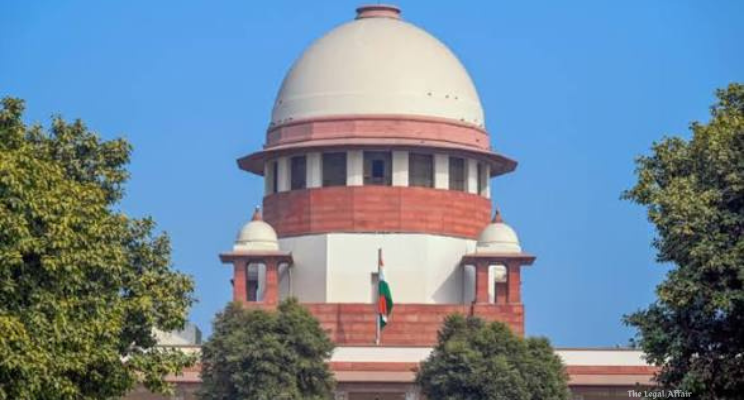
Introduction:
The present case, Narayan v. State of Madhya Pradesh, decided by the Supreme Court of India, addresses an important question concerning the scope and applicability of bail conditions under the Bharatiya Nagarik Suraksha Sanhita. The bench comprising Justice J.K. Maheshwari and Justice Atul S. Chandurkar examined whether the stringent conditions prescribed under Section 480(3) of the BNSS can be imposed in cases involving non-bailable offences punishable with imprisonment of less than seven years.
The appellant-accused was initially granted bail by the Madhya Pradesh High Court in connection with an offence under the Madhya Pradesh Excise Act, 1915, involving alleged possession of illicit liquor. However, the High Court later cancelled the bail on the ground that the accused had violated bail conditions by allegedly committing a similar offence during the bail period.
The Supreme Court was called upon to determine whether such cancellation was legally sustainable, especially when the initial imposition of conditions itself was under challenge. The Court’s ruling provides critical clarity on the interpretation of bail provisions under the BNSS and reinforces the principle that procedural safeguards must align strictly with statutory limits.
Arguments on Behalf of the Appellant:
The appellant contended that the High Court committed a fundamental legal error by imposing conditions under Section 480(3) of the BNSS in the first place. It was argued that the statutory framework clearly limits the applicability of such conditions to offences punishable with imprisonment of seven years or more, or to specific categories of offences enumerated under particular chapters of the statute.
The counsel emphasized that the alleged offence under the Madhya Pradesh Excise Act carried a maximum punishment of only three years, thereby falling outside the ambit of Section 480(3). Consequently, the imposition of conditions such as refraining from committing similar offences or other restrictive obligations was legally impermissible.
Building upon this, the appellant argued that if the initial imposition of conditions was itself invalid, any subsequent finding of violation of those conditions could not form a legitimate basis for cancellation of bail. In essence, an illegal condition cannot be enforced, and its breach cannot attract penal consequences.
The appellant further submitted that the High Court’s reasoning—that the accused had a “propensity to commit crime”—was speculative and unsupported by a proper legal foundation. It was argued that bail cancellation must be based on legally sustainable grounds such as misuse of liberty, tampering with evidence, or interference with the administration of justice, and not merely on allegations of involvement in a subsequent offence.
Additionally, the defence highlighted that the principles governing bail must be interpreted in favour of personal liberty, a cornerstone of criminal jurisprudence. The appellant urged the Court to adopt a strict interpretation of statutory provisions and prevent their expansion beyond legislative intent.
Arguments on Behalf of the State:
The State, on the other hand, supported the High Court’s decision to cancel bail, arguing that the accused had clearly misused the liberty granted to him. It was contended that the accused, after being released on bail, was again found in possession of a substantial quantity of illicit liquor, thereby demonstrating a repeated pattern of unlawful conduct.
The State argued that such conduct justified the imposition and enforcement of conditions aimed at preventing recurrence of offences. According to the prosecution, the purpose of bail conditions is to ensure that the accused does not engage in similar criminal activities while on bail, and the violation of such conditions undermines the integrity of the justice system.
Further, the State contended that courts possess inherent powers to impose conditions in the interest of justice, even in cases where the statutory language may not explicitly mandate them. It was submitted that the High Court acted within its discretionary jurisdiction in imposing conditions and subsequently cancelling bail upon their breach.
The prosecution also stressed that the accused’s conduct posed a threat to public order and regulatory enforcement under the excise laws. Therefore, the High Court was justified in taking a stringent view and revoking bail to prevent further violations.
Court’s Judgment:
The Supreme Court carefully examined the statutory framework of Section 480 of the BNSS and the factual matrix of the case. The Court began by analyzing the language of Section 480(3), which specifically provides for the imposition of certain conditions when a person accused of an offence punishable with imprisonment extending to seven years or more, or offences falling under specified chapters, is released on bail.
The Court observed that the provision is clearly conditional and limited in scope, and cannot be applied indiscriminately to all non-bailable offences. The legislative intent, as reflected in the wording of the statute, is to impose stricter conditions only in cases involving more serious offences.
In the present case, the Court noted that the alleged offence under the Madhya Pradesh Excise Act carried a maximum punishment of three years, which is significantly below the threshold of seven years prescribed under Section 480(3). Therefore, the High Court erred in invoking this provision while granting bail.
The Supreme Court unequivocally held that:
- The conditions under Section 480(3) are not applicable to offences punishable with imprisonment of less than seven years.
- Any such conditions imposed in violation of the statutory framework are legally unsustainable.
Having established that the imposition of conditions itself was invalid, the Court proceeded to examine the legality of the bail cancellation order. It held that since the conditions were not legally enforceable, their alleged violation could not serve as a valid ground for cancelling bail.
The Court emphasized a fundamental principle of law: an illegality at the inception cannot be cured by subsequent proceedings. In other words, if the foundation of a decision is flawed, all consequential actions based on that foundation are equally untenable.
Addressing the State’s argument regarding the accused’s involvement in a subsequent offence, the Court clarified that while such conduct may be relevant in certain contexts, it cannot justify cancellation of bail solely on the basis of violation of conditions that were never validly imposed.
The Court further noted that bail cancellation must be based on legally recognized grounds, such as:
- Interference with the investigation or trial,
- Tampering with evidence,
- Influencing witnesses, or
- Absconding or misuse of liberty in a manner affecting the administration of justice.
Mere registration of another case, without more, does not automatically warrant cancellation of bail, particularly when the legal framework for imposing restrictive conditions has not been properly followed.
In a significant observation, the Court stated that the High Court’s approach effectively expanded the scope of Section 480(3) beyond what the legislature intended. Such judicial overreach, the Court cautioned, must be avoided to preserve the balance between individual liberty and societal interests.
Accordingly, the Supreme Court set aside the High Court’s order cancelling bail and allowed the appeal. The appellant was granted the benefit of bail, free from the improperly imposed conditions under Section 480(3) of the BNSS.