


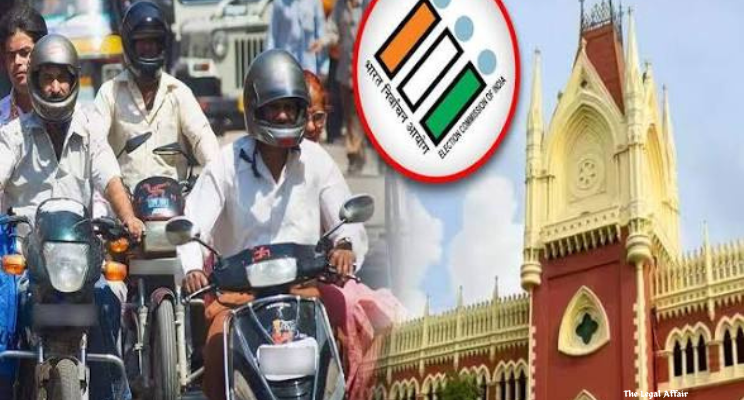
Introduction:
The present case arose before the Calcutta High Court in the backdrop of electoral regulations imposed ahead of the second phase of the West Bengal elections scheduled for 29th April 2026. The matter reflects a classic constitutional tension between the need to ensure free and fair elections and the protection of individual freedoms guaranteed under the Constitution.
The dispute began with a writ petition filed by Ritankar Das challenging the orders issued by the Chief Electoral Officer, West Bengal, acting under the authority of the Election Commission of India. These orders imposed restrictions on motorcycle movement, including a ban on pillion riding and certain forms of bike usage during a specific pre-poll period, namely from Polling Day minus two (P-2) until the conclusion of polling.
The petitioner contended that such restrictions were excessive, lacked statutory backing under the Representation of the People Act, 1951, and infringed upon fundamental rights. The single bench initially ruled in favour of the petitioner, striking down the blanket restrictions imposed by the Election Commission.
However, this decision was challenged before a division bench presided over by Justice Shampa Sarkar. Upon reconsideration, the division bench modified the single bench order, introducing a nuanced approach that partially restored restrictions—specifically banning bike rallies and group biking—while not endorsing a complete prohibition on individual motorcycle use.
This judgment is significant as it delineates the permissible scope of administrative control during elections and underscores the judiciary’s role in maintaining equilibrium between civil liberties and democratic processes.
Arguments on Behalf of the Petitioner:
The petitioner, Ritankar Das, challenged the restrictions imposed by the Election Commission as being arbitrary, disproportionate, and unconstitutional. It was argued that the blanket nature of the restrictions—covering motorcycle riding and pillion travel—amounted to an unreasonable infringement on the fundamental rights guaranteed under Article 19 of the Constitution, particularly the right to move freely throughout the territory of India.
The petitioner emphasized that motorcycles are a common and essential mode of transport for a large section of the population in West Bengal. A complete or near-complete restriction on their use, especially without adequate justification, would cause undue hardship to citizens, including daily commuters, workers, and small business operators.
Further, it was contended that the Election Commission’s orders lacked a clear statutory foundation. The petitioner pointed out that neither the Representation of the People Act, 1951 nor any other relevant legislation explicitly authorizes such sweeping restrictions on personal mobility. In the absence of specific legal provisions, the imposition of such measures would amount to executive overreach.
The petitioner also argued that the concept of “free and fair elections,” though crucial, cannot be invoked as a blanket justification for curtailing fundamental rights. Any restriction imposed in the name of maintaining electoral integrity must satisfy the test of reasonableness and proportionality. According to the petitioner, the Election Commission failed to demonstrate how a complete ban on motorcycle riding or pillion travel was necessary to achieve its objectives.
Additionally, it was submitted that less restrictive alternatives were available. For instance, targeted measures such as increased police surveillance, monitoring of suspicious activities, and regulation of organized rallies could effectively address concerns without infringing upon individual freedoms.
The petitioner relied on constitutional principles and judicial precedents emphasizing that restrictions on fundamental rights must be narrowly tailored and supported by compelling state interests. It was argued that the impugned orders did not meet these standards and were therefore liable to be struck down.
Arguments on Behalf of the Election Commission of India:
The Election Commission of India defended its orders by highlighting its constitutional mandate to ensure free and fair elections, a cornerstone of democratic governance. It argued that the restrictions were imposed after careful consideration of ground realities and were aimed at preventing electoral malpractices, intimidation, and undue influence during the sensitive pre-poll period.
The Commission contended that bike rallies and group motorcycle movements are often used as tools for political mobilization, which can sometimes escalate into coercion or create an atmosphere of fear among voters. In certain instances, such activities may also be linked to the distribution of inducements or other unlawful practices.
It was further argued that the pre-poll period, especially the days immediately preceding polling, is highly sensitive and requires strict regulation to maintain a level playing field. The restrictions were therefore preventive in nature and intended to uphold the integrity of the electoral process.
The Commission also relied on its broad powers under the Constitution and election laws to issue directions necessary for the conduct of elections. It asserted that these powers include the authority to impose reasonable restrictions on activities that could potentially disrupt the electoral process.
Challenging the single bench’s order, the Commission submitted that the complete removal of restrictions could have serious consequences, including an increase in unlawful activities and disturbances during the election period. It argued that the judiciary should accord due deference to the expertise and judgment of the Election Commission in matters relating to election management.
The Commission, however, indicated its willingness to accept a calibrated approach that distinguishes between individual use of motorcycles and organized group activities, suggesting that the latter posed a greater risk to electoral fairness.
Court’s Judgment:
The division bench of the Calcutta High Court, led by Justice Shampa Sarkar, undertook a careful examination of the competing interests at stake. The Court acknowledged the importance of both protecting fundamental rights and ensuring the integrity of the electoral process.
At the outset, the Court recognized that the Election Commission plays a vital role in safeguarding free and fair elections and is vested with significant powers to regulate the conduct of elections. However, it also emphasized that these powers are not absolute and must be exercised within the bounds of the Constitution and applicable laws.
The Court agreed with the petitioner to the extent that a blanket restriction on all motorcycle usage, including individual riding and pillion travel, would be excessive and disproportionate. Such a sweeping measure would unnecessarily infringe upon the daily lives of citizens and could not be justified without strong and specific reasons.
At the same time, the Court found merit in the Election Commission’s concerns regarding bike rallies and group biking, which could potentially be used for political mobilization in a manner that disrupts electoral fairness. The Court observed that such activities, particularly in the immediate pre-poll period, may create an environment of intimidation or undue influence, thereby affecting the free exercise of voting rights.
Balancing these considerations, the division bench adopted a middle path. It modified the single bench’s order by reinstating restrictions on bike rallies and group motorcycle movements, while allowing individual use of motorcycles to continue without undue interference.
The Court thus held that:
Blanket prohibitions on individual motorcycle riding and pillion travel are unwarranted and disproportionate.
However, restrictions on organized activities such as bike rallies and group biking are justified in the interest of maintaining electoral integrity.
This nuanced approach reflects the principle of proportionality, ensuring that restrictions are limited to what is necessary to achieve the intended objective. The Court effectively distinguished between ordinary personal use and activities that have a higher potential to impact the electoral process.
The judgment also underscores the importance of judicial oversight in preventing excessive use of administrative powers, while simultaneously respecting the functional autonomy of constitutional bodies like the Election Commission.
By modifying rather than entirely setting aside the restrictions, the Court demonstrated a balanced and pragmatic approach, ensuring that neither fundamental rights nor electoral integrity are compromised.