


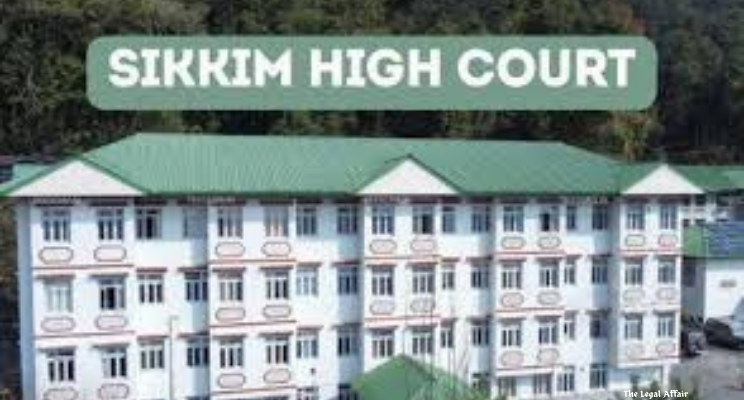
Introduction:
The Sikkim High Court has reaffirmed that the freedom of speech and expression guaranteed under Article 19(1)(a) of the Constitution protects public discussions and consultations on sensitive constitutional questions. The Court has held that merely inviting people to participate in a public consultation concerning the constitutional legality of a proposed Darjeeling–Sikkim unification cannot, by itself, constitute the offence of promoting enmity between different groups under Section 196 of the Bharatiya Nyaya Sanhita, 2023 (BNS).
Justice Bhaskar Raj Pradhan delivered the significant ruling while allowing two petitions filed by members and organisers associated with Gorkha Seva Sena, seeking the quashing of an FIR, chargesheet and consequential criminal proceedings initiated against them. The Court held that expressing or inviting public participation in a discussion on a constitutional issue, even one capable of generating strong public reactions, cannot automatically be treated as an attempt to create hatred, disharmony or ill-will between communities.
The case arose from an invitation issued by Gorkha Seva Sena for a programme titled ’50th Sikkim State Day Celebration and Constitutional Consultation’. The event was scheduled to take place on June 15, 2025, at Town Hall, Naya Bazar, Kurseong, West Bengal. According to the invitation, the programme was intended to facilitate a civic dialogue concerning the “Constitutional Legality of Darjeeling-Sikkim Unification”.
The proposed consultation concerned a politically and constitutionally sensitive subject involving the relationship between Darjeeling and Sikkim. While the organisers intended to invite members of the public to express their views on the constitutional validity of the proposed unification, the invitation allegedly generated concerns regarding its possible implications for public harmony and the sentiments of people residing in the two regions.
On June 6, 2025, an FIR was registered following a complaint submitted by the Principal Secretary to the Chief Minister of Sikkim. The complaint alleged that the organisers had used the official logo and theme of the Sikkim Government without obtaining authorisation. According to the complainant, such use could create the impression that the State Government had officially endorsed the proposed programme and its subject matter.
The complaint further alleged that the invitation had the potential to provoke hostility between the people of Sikkim and Darjeeling and disturb public order. Consequently, criminal proceedings were initiated against the organisers under various provisions of the Bharatiya Nyaya Sanhita, including Section 196, which deals with promoting enmity between different groups on specified grounds. Allegations were also raised under the Emblems and Names (Prevention of Improper Use) Act, 1950, concerning the alleged unauthorised use of government symbols.
Following the investigation, a chargesheet was filed against the organisers, and consequential criminal proceedings were initiated before the competent court.
Aggrieved by the registration of the FIR and the continuation of criminal proceedings, the petitioners approached the Sikkim High Court through two separate petitions seeking the quashing of the FIR, chargesheet and all consequential proceedings.
The principal legal question before the High Court was whether an invitation to participate in a public consultation on the constitutional legality of a proposed regional unification could satisfy the ingredients of Section 196 BNS. The Court was also required to consider the extent to which the constitutional protection of free expression safeguards controversial public discussions and whether the alleged unauthorised use of a government logo could independently justify the prosecution under the provision relating to promoting enmity.
The judgment assumes particular significance because it addresses the boundary between constitutionally protected expression and criminal liability for promoting hostility between groups. It reinforces the principle that disagreement with an opinion, or the possibility that a particular subject may generate controversy, cannot by itself become a sufficient basis for invoking criminal law.
Arguments of the Parties:
Petitioners’ Arguments:
The petitioners, who were members and organisers associated with Gorkha Seva Sena, approached the Sikkim High Court challenging the legality of the criminal proceedings arising from the invitation to the proposed public consultation.
In the first petition, the petitioners were represented by Senior Advocate N. Rai, assisted by advocates Tara Devi Chettri, Niyashi Rai and Sohitya Kala Limboo. In the connected petition, the petitioner was represented by Advocate Abhinav Kant Jha.
The petitioners challenged the registration of the FIR and the subsequent filing of the chargesheet on the ground that the allegations did not disclose the essential ingredients of the offences invoked against them.
Their principal contention concerned Section 196 of the Bharatiya Nyaya Sanhita, 2023. They maintained that the invitation was intended to encourage public participation in a constitutional consultation and did not contain any material that could reasonably be interpreted as promoting enmity, hatred or ill-will between different communities.
The petitioners’ case was that the programme was designed to facilitate discussion on the constitutional legality of a proposed unification between Darjeeling and Sikkim. The subject was undoubtedly sensitive, but the organisers were seeking opinions and views on a constitutional question rather than encouraging hostility between the inhabitants of the two regions.
They argued that inviting individuals to participate in a consultation cannot automatically be equated with making statements intended to disturb public harmony. A public discussion may involve competing opinions, disagreements and criticism, but such exchanges are an essential feature of democratic functioning.
The petitioners also relied upon the constitutional protection available under Article 19(1)(a), which guarantees freedom of speech and expression to citizens. They contended that the right to express opinions includes the freedom to initiate discussions on matters of public importance, including constitutional and political questions that may be controversial.
According to their case, criminal prosecution could not be sustained merely because the subject of the proposed consultation was capable of generating disagreement or strong reactions among sections of society.
The petitioners therefore sought the exercise of the High Court’s inherent jurisdiction to prevent the continuation of criminal proceedings that allegedly lacked the necessary legal foundation.
Their challenge also covered the chargesheet and consequential proceedings pending before the Sessions Judge, Gangtok. They requested that the entire criminal process be quashed because the allegations, even if accepted as stated, did not establish the commission of the alleged offences.
Respondents’ Arguments:
The State of Sikkim opposed the petitions through Additional Public Prosecutor Yadev Sharma.
The prosecution case originated from the complaint submitted by the Principal Secretary to the Chief Minister of Sikkim. The complaint raised concerns regarding the nature of the invitation circulated by Gorkha Seva Sena and its potential consequences.
One of the principal allegations was that the organisers had used the official logo and theme of the Sikkim Government without obtaining the necessary authorisation. The State’s concern was that such use could give members of the public the impression that the programme was being organised or officially supported by the Government.
The complaint further alleged that the proposed consultation concerning Darjeeling–Sikkim unification could provoke enmity between the people of the two regions and adversely affect public order.
The prosecution had consequently invoked various provisions of the BNS, including Section 196, along with allegations relating to the alleged improper use of the Government’s emblem under the Emblems and Names (Prevention of Improper Use) Act, 1950.
The State’s position was therefore based on the alleged implications of the invitation, particularly the possibility that the programme could create misunderstanding regarding the Government’s official position and generate tension between different groups.
However, during the hearing before the High Court, the State’s counsel acknowledged that there was no material to proceed against the accused in respect of most of the offences alleged in the FIR.
As a result, the principal issue requiring consideration was whether the invitation issued by Gorkha Seva Sena could attract criminal liability under Section 196 BNS.
The State’s concerns regarding the alleged unauthorised use of the official government logo nevertheless remained a separate matter. The High Court was required to distinguish between the allegation concerning the use of the emblem and the allegation that the invitation itself promoted enmity between groups.
This distinction became central to the Court’s eventual decision, as it examined whether the contents and purpose of the invitation satisfied the statutory requirements of the offence under Section 196.
Court’s Judgment:
After examining the allegations, the statutory provisions and the constitutional principles governing freedom of expression, the Sikkim High Court allowed both petitions and quashed the FIR, chargesheet and consequential criminal proceedings pending before the Sessions Judge, Gangtok.
Justice Bhaskar Raj Pradhan held that inviting members of the public to participate in a consultation concerning the constitutional legality of Darjeeling–Sikkim unification could not, by itself, attract Section 196 of the Bharatiya Nyaya Sanhita, 2023.
The Court emphasised that a democratic society must allow individuals and groups to express their opinions on matters of public importance, even where those opinions are unpopular or capable of generating disagreement.
Scope of Section 196 of the Bharatiya Nyaya Sanhita:
The Court primarily examined Section 196 BNS, which criminalises the promotion of enmity between different groups on specified grounds, including religion, race, place of birth, residence, language, caste or community, as well as acts prejudicial to the maintenance of harmony between such groups.
The provision is intended to prevent conduct that promotes hostility, hatred or disharmony between different groups and threatens the peaceful coexistence of communities.
However, the Court made it clear that the provision cannot be invoked merely because a statement, invitation or discussion concerns a subject that may be controversial or generate disagreement.
For criminal liability to arise under Section 196, the material relied upon must satisfy the essential ingredients of the offence. The mere possibility that people may disagree with a particular opinion or that a discussion may attract public attention does not automatically establish the commission of a criminal offence.
In the present case, the invitation sought public participation in a consultation concerning the constitutional legality of the proposed Darjeeling–Sikkim unification. The Court found that such an invitation, considered by itself, did not establish an attempt to promote enmity between the people of the two regions.
The Bench distinguished between encouraging a public discussion on a constitutional question and deliberately promoting hostility between different groups. These are fundamentally different forms of conduct and cannot be treated as legally equivalent.
Freedom of Speech Under Article 19(1)(a) Protects Public Debate:
A significant part of the judgment concerned the constitutional protection afforded to freedom of speech and expression under Article 19(1)(a) of the Constitution.
The Court observed that a healthy democracy must provide space for competing opinions and differing viewpoints. The right to express an opinion cannot depend upon whether that opinion is acceptable to the majority or whether it is likely to be welcomed by every section of society.
Justice Bhaskar Raj Pradhan emphasised that unpopular views must be answered through contrary opinions rather than automatically being subjected to criminal prosecution.
The Court observed:
“History reveals that the constitutional provisions have been tested time and again in the Indian context over the last 76 years and each time it has withstood any aberrations. Debates and deliberations during a public consultation seeking views of constitutional legality of what one group of people perceive may be the right course of action, as opposed to the contrary view of another group regarding the alleged proposed Darjeeling-Sikkim Unification, ought not to provoke such extreme sentiments as to attract the mischief of section 196 BNS.”
The Court further referred to the Supreme Court’s observation:
“In a healthy democracy, the views, opinions or thoughts expressed by an individual or group of individuals must be countered by expressing another point of view. Even if a large number of persons dislike the views expressed by another, the right of the person to express the views must be respected and protected.”
This observation highlights an important constitutional principle: the protection of free expression is particularly relevant when an opinion is unpopular or disputed.
A democratic society cannot function effectively if individuals are permitted to express only those opinions that are agreeable to the majority. The right to disagree, question and initiate discussions on public issues forms an essential part of democratic participation.
The Court’s reasoning also establishes that the appropriate response to a controversial constitutional proposal is ordinarily to engage with it through reasoned discussion and counterarguments.
In the present case, the proposed consultation concerned the constitutional legality of a possible unification. The Court held that individuals were entitled to deliberate upon such a question, and the mere act of inviting public participation could not be treated as an offence under Section 196 BNS.
Reliance on Supreme Court Judgment in Imran Pratapgadhi v. State of Gujarat:
The High Court relied upon the Supreme Court’s decision in Imran Pratapgadhi v. State of Gujarat, reported in (2026) 1 SCC 721, while examining the scope of Section 196 BNS and the standards applicable when determining whether particular words or expressions amount to promoting enmity.
The principles emerging from the Supreme Court’s decision were particularly relevant because criminal provisions concerning public expression must be interpreted carefully so that legitimate speech is not unnecessarily subjected to prosecution.
The High Court referred to the Supreme Court’s emphasis on assessing the effect of spoken or written words through the perspective of reasonable, strong-minded and courageous individuals rather than persons who are excessively sensitive or inclined to perceive criticism as a threat.
The Court reproduced the relevant observation:
“When an offence punishable under Section 196 BNS is alleged, the effect of the spoken or written words will have to be considered based on standards of reasonable, strong-minded, firm and courageous individuals and not based on the standards of people with weak and oscillating minds. The effect of the spoken or written words cannot be judged on the basis of the standards of people who always have a sense of insecurity or of those who always perceive criticism as a threat to their power or position.”
The application of this standard is important because the assessment of criminal liability cannot be based solely upon subjective reactions, personal sensitivities or the possibility that some individuals may dislike a particular expression.
Instead, the Court must objectively examine the nature, meaning and effect of the words or conduct in question.
The standard also prevents criminal law from becoming a mechanism for suppressing legitimate criticism or disagreement. If every controversial opinion could be treated as promoting enmity merely because someone finds it objectionable, the constitutional protection of free expression would become considerably weakened.
Applying the principles laid down by the Supreme Court, Justice Pradhan concluded that the invitation issued by Gorkha Seva Sena did not contain material sufficient to attract Section 196 BNS.
The Court observed that the constitutional legality of a proposed unification was a subject capable of public debate. One group might support the idea, while another might oppose it. However, the existence of competing viewpoints did not, without more, establish the promotion of hatred or hostility between the groups.
Constitutional Consultation Cannot Automatically Be Treated as Promotion of Enmity:
The Court next applied the above principles to the specific contents and purpose of the invitation.
It found that the programme was intended to invite members of the public to participate in a consultation concerning the constitutional legality of Darjeeling–Sikkim unification.
The invitation, by itself, did not establish that the organisers intended to create hatred, hostility or ill-will between the people of Sikkim and Darjeeling.
The Bench emphasised that constitutional questions may legitimately be examined through public consultations and discussions. Even where a proposal is sensitive or controversial, the possibility of disagreement cannot become a sufficient ground for criminal prosecution.
The Court observed that a contrary viewpoint may ultimately prove clearer, better reasoned and legally more persuasive. Such an outcome is possible only when different opinions are permitted to be expressed and debated.
The judgment therefore reinforces the distinction between the expression of a constitutional or political opinion and conduct that actually satisfies the statutory ingredients of promoting enmity.
The Court ultimately concluded:
“Therefore, an invitation, by itself, for a public consultation for constitutional legality of Darjeeling and Sikkim Unification would not attract the provision of section 196 of BNS.”
This finding formed the foundation for quashing the criminal proceedings under the relevant provision.
Unauthorised Use of Government Logo Separately Disapproved:
Although the Court protected the organisers’ right to invite public participation in a constitutional consultation, it did not approve every aspect of the manner in which the programme was publicised.
The High Court specifically expressed disapproval of the alleged unauthorised use of the official logo of the Sikkim Government.
Justice Bhaskar Raj Pradhan described such use as prima facie mischievous, indicating that the organisers could not casually use official government symbols in a manner that might create confusion regarding the Government’s involvement or endorsement of the programme.
However, the Court drew a clear distinction between the alleged misuse of the Government’s logo and the alleged offence of promoting enmity under Section 196 BNS.
The unauthorised use of an official emblem did not automatically transform the invitation into an act promoting hostility between different groups.
The Court clarified that the State Government remained at liberty to take appropriate action in accordance with law regarding the alleged unauthorised use of its official emblem.
This aspect of the judgment is important because it demonstrates that protection of freedom of expression does not mean that every inependent legal requirement can be disregarded. Organisers of public programmes must st