


Introduction:
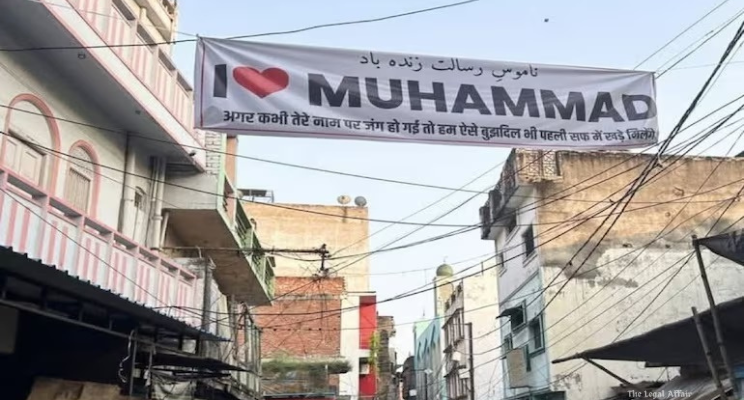
In a recent judgment reaffirming the limits of judicial jurisdiction and the true essence of public interest litigation (PIL), the Delhi High Court dismissed a petition that sought a free and fair investigation into three FIRs registered in Uttar Pradesh and Uttarakhand concerning individuals who displayed posters reading “I Love Muhammad” during Milad-un-Nabi, the festival commemorating the birth and passing of Prophet Muhammad (PBUH). The Division Bench comprising Chief Justice D.K. Upadhyaya and Justice Tushar Rao Gedela held that the petitioner had no genuine public interest in the matter and that the Delhi High Court lacked territorial jurisdiction to issue directions concerning FIRs registered in other states. The Court further noted that those accused of any offence in the FIRs had adequate remedies under the law to seek appropriate relief from the competent courts.
The petition was filed by Shujaat Ali, a public-spirited individual, who alleged that the police authorities in Uttar Pradesh and Uttarakhand had registered false and communal-biased FIRs against individuals who merely expressed their religious devotion peacefully by displaying posters on the occasion of Milad-un-Nabi. The petitioner contended that such actions by the police amounted to criminalisation of peaceful religious expression and violated the constitutional rights to freedom of speech, religion, and equality. However, the Delhi High Court, in a reasoned order, observed that the petition did not disclose any element of public interest and that the petitioner was, in effect, seeking to espouse the cause of private individuals who had been named in the FIRs. The Court held that this was not the function of a PIL, and accordingly dismissed the plea.
Arguments on Behalf of the Petitioner:
The learned counsel appearing for the petitioner, Mr. Shujaat Ali, submitted that the filing of FIRs by the police authorities in Uttar Pradesh and Uttarakhand against persons who had displayed posters reading “I Love Muhammad” was a gross misuse of power, influenced by communal bias. He argued that the accused persons had merely participated in a religious celebration — Milad-un-Nabi, a significant event in Islam marking the birth and passing of the Prophet — and had done so peacefully, without causing any public disturbance or breach of law and order. The counsel argued that the registration of criminal cases in such circumstances was an attempt to suppress the legitimate religious expression of a community and reflected institutional discrimination by state authorities.
The petitioner contended that the registration of false FIRs against individuals engaged in peaceful religious activity violated the fundamental rights guaranteed under Articles 14, 19, 21, and 25 of the Constitution of India, encompassing the right to equality, freedom of speech and expression, protection of life and liberty, and the freedom of religion. The petitioner also alleged that the FIRs were motivated by communal prejudice and had the potential to inflame inter-religious tensions.
It was further argued that the Delhi High Court, in its capacity as a constitutional court, possessed the jurisdiction to ensure that constitutional rights were not violated, irrespective of the territorial boundaries of state governments. The petitioner invoked the doctrine of public interest litigation, arguing that the matter concerned the broader issue of communal harmony and the right of citizens to practice and propagate religion without fear of police persecution. The petitioner also claimed that the accused persons were being targeted selectively for their religious expression, while similar expressions by members of other communities went unpunished.
He urged the Court to issue directions to the Union Government, Uttar Pradesh Police, and Uttarakhand Police to conduct a free and fair probe into the matter and to restrain the authorities from taking coercive action against those who displayed the posters. The petitioner also requested the Court to issue guidelines to prevent police misuse of power in cases involving religious expression to safeguard secularism and ensure equal protection under the law.
Arguments on Behalf of the Respondents:
The learned counsel appearing for the respondents — representing the Government of NCT of Delhi, State of Uttar Pradesh, State of Uttarakhand, and Union of India — opposed the maintainability of the petition, asserting that the Delhi High Court had no territorial jurisdiction to entertain the plea since the FIRs were registered outside the territory of Delhi. They argued that under Article 226(1) of the Constitution, the writ jurisdiction of the High Court is confined to matters where the cause of action arises within its territorial limits. Since the alleged incidents occurred entirely within the states of Uttar Pradesh and Uttarakhand, and the FIRs were registered there, no part of the cause of action arose within the National Capital Territory of Delhi.
The respondents further contended that the petition lacked bona fide public interest and was an abuse of the process of PIL jurisdiction. They submitted that the Public Interest Litigation mechanism is designed to address issues affecting the general public at large — such as environmental protection, human rights violations, or systemic injustice — and not to champion the cause of private individuals who already have specific legal remedies available under the criminal justice system. The respondents argued that the accused persons in the FIRs could seek appropriate reliefs, including anticipatory bail, quashing of FIR, or protection of rights, before the respective High Courts of the concerned States under Article 226 or Section 482 of the Criminal Procedure Code (CrPC).
The counsel further argued that allowing such PILs in matters involving criminal cases filed in other states would set a dangerous precedent, enabling any person to approach any High Court in the country to challenge criminal proceedings outside its jurisdiction. This, they asserted, would lead to judicial anarchy and forum shopping, undermining the federal structure of the judiciary. The respondents also pointed out that the petitioner had no personal knowledge or direct involvement in the incidents that led to the registration of FIRs, and therefore, lacked the locus standi to maintain the present petition.
Court’s Observations and Judgment:
After hearing the submissions of both sides, the Division Bench of Chief Justice D.K. Upadhyaya and Justice Tushar Rao Gedela proceeded to dismiss the Public Interest Litigation. The Court began by observing that the scope of public interest litigation has been judicially circumscribed by the Supreme Court in a series of judgments, which hold that PILs cannot be used as a substitute for private litigation. The Court observed that in the instant case, the petitioner had failed to demonstrate any element of public interest or systemic injustice warranting the Court’s intervention.
The Bench noted that the three FIRs in question were registered in the States of Uttar Pradesh and Uttarakhand, and therefore, no part of the cause of action had arisen within the territorial jurisdiction of the Delhi High Court. The Court categorically held that it could not issue any directions in relation to criminal proceedings pending before authorities in other States, as doing so would amount to encroachment upon the jurisdiction of other High Courts. The judges reiterated the constitutional principle that the territorial jurisdiction of a High Court under Article 226 is confined to the geographical limits of the State or Union Territory for which it has been established.
In its order, the Court remarked:
“The High Court of Delhi cannot pass directions in relation to FIRs registered in other States. The petitioner has not demonstrated any element of public interest in the present matter. The individual accused persons named in the FIRs are at liberty to seek recourse to legal remedies as available under law before competent forums.”
The Court further observed that mere allegations of communal bias or misuse of power by the police, without substantiating material, cannot form the basis of a PIL seeking judicial intervention in criminal matters. The Bench emphasized that the criminal justice system provides adequate safeguards, including judicial scrutiny at multiple stages, to ensure fairness and prevent misuse. Therefore, any person aggrieved by the registration of an FIR could approach the appropriate High Court of the concerned State or the Supreme Court, but not invoke the PIL jurisdiction of a High Court lacking territorial connection.
Reiterating the sanctity of judicial boundaries and the true nature of PILs, the Court warned against frivolous or misplaced petitions that undermine judicial time meant for genuine causes of public concern. The Bench clarified that while freedom of religion and expression are constitutionally guaranteed rights, their alleged violation in specific criminal cases cannot be the subject of a PIL when individual legal remedies exist.
Accordingly, the Court dismissed the petition, holding that it was not maintainable and devoid of bona fide public interest.