


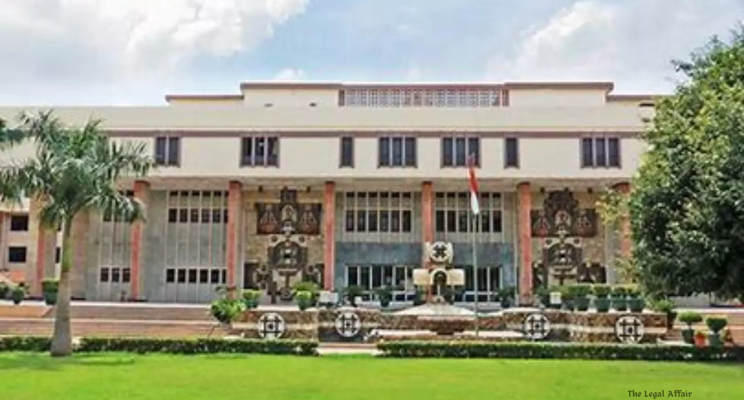
Introduction:
The Delhi High Court, in a significant ruling on procedural mandates in disciplinary actions, has held that a chargesheet issued without the mandatory prior approval of the competent Disciplinary Authority under Rule 14(3) of the CCS (CCA) Rules, 1965 is void ab initio (invalid from the start) and non-existent in law.1 Furthermore, the Court ruled that such a foundational defect cannot be rectified by subsequent ratification.2 The decision was delivered by a Division Bench comprising Justice Navin Chawla and Justice Madhu Jain in the matter of Union of India Through Secretary & Ors. vs. S K Jasra (W.P.(C) 2742/2024).3 The case involved a Joint Director in the Ministry of Defence (Respondent, represented by Avneesh Garg, Pavitra Singh and Iptisha, Advs.) against whom a chargesheet had been issued for violating Rule 3(1)(iii) of the CCS (Conduct) Rules, 1964, based on allegations of sexually inappropriate behaviour raised by a Peon in the same directorate.4 The Union of India (UOI), the Petitioner, (represented by Vijay Joshi and Shubham Chaturvedi, Advs.) challenged the Central Administrative Tribunal (CAT)’s decision which had concluded that the original chargesheet was legally invalid due to the lack of approval from the competent Disciplinary Authority, the Raksha Rajya Mantri. The High Court affirmed the Tribunal’s finding, leading to the dismissal of the UOI’s petition.
Background Facts and Procedural History:
The disciplinary proceedings commenced against the Joint Director following complaints of sexual misconduct. An inquiry was conducted, and the charge was eventually proved. The Disciplinary Authority (DA) initially imposed a minor penalty of withholding salary increases. The Director challenged this first penalty order before the Central Administrative Tribunal (CAT), which set aside the penalty and remanded the matter back to the DA. Upon remand, the DA passed a second penalty order, imposing a more severe punishment: reduction in rank from Joint Director to Deputy Director. The Director challenged this enhanced punishment.
During the prolonged legal process, the Director discovered, through an RTI application, a crucial flaw: the original chargesheet initiating the entire proceeding lacked the mandatory prior approval of the competent Disciplinary Authority, i.e., the Raksha Rajya Mantri.5 Armed with this information, the Director raised this fundamental legal challenge before the Tribunal. The CAT agreed with the Director’s contention, concluding that the chargesheet was legally invalid from the very beginning. Aggrieved by the quashing of the entire proceeding, the Union of India challenged the Tribunal’s decision before the Delhi High Court.
Arguments on behalf of the Petitioners (Union of India):
The Union of India (UOI) challenged the Tribunal’s decision on both procedural and substantive grounds, asserting that the chargesheet was valid.
- Delay in Raising the Plea (Estoppel and Waiver): The UOI contended that the Director received information regarding the lack of approval via RTI in September 2019 but failed to raise this plea before the Tribunal in the earlier proceedings. They implicitly argued that principles of estoppel or constructive res judicata should apply, preventing the Director from raising the issue at a later stage after two penalty orders had been passed.
- Substantive Approval for Initiation: The UOI argued that a detailed note of the case was submitted for the Disciplinary Authority’s approval to initiate disciplinary proceedings, which was duly granted.6 They submitted that the form and contents of the chargesheet implicitly had approval, even if the formal final issuance order was signed by a lower functionary.7
- Procedural Annotations: The UOI pointed out that the chargesheet was signed by a lower functionary with the annotation “By order and in the name of the President,” suggesting procedural correctness in the issuance.8
- Reliance on MHA Memo: The UOI placed reliance on a Government of India MHA Memo dated 16.04.1969, arguing that in cases where the Disciplinary Authority is the Hon’ble President (or a Minister acting on his behalf), once the initiation of proceedings is approved, there is no need to show the file again for issuing formal orders.9 This was an attempt to bypass the strict requirement of Rule 14(3).
Arguments on behalf of the Respondent (S K Jasra):
The Director vigorously defended the Tribunal’s decision, focusing on the strict interpretation of the statutory rules.
- Violation of Statutory Rules: The Director contended that the chargesheet lacked the mandatory approval of the Competent Authority (the Raksha Rajya Mantri) in violation of Rules 14(3) and 14(5) of the CCS (CCA) Rules, 1965.10 This defect rendered the entire chargesheet void ab initio.
- Fallacious Annotation and Concealment: The Director submitted that the annotation “By order and in the name of the President” was “fallacious” because the required approval was demonstrably absent.11 He further argued that the UOI’s failure to disclose this lack of approval constituted “concealment,” which negated the application of procedural bars like estoppel or res judicata.
- Invalidity Cannot Be Waived: The Director relied on the Supreme Court judgment in State of Orissa and Ors. vs. Brundaban Sharma and Anr to contend that the validity of an order that is void-ab-initio can be questioned in any proceeding at any stage, thereby countering the UOI’s argument on delay and res judicata.12
Court’s Judgement and Rationale:
The Delhi High Court thoroughly examined the issue of procedural compliance and the fundamental requirement of obtaining the Disciplinary Authority’s approval. The Court dismissed the UOI’s petition, finding no error in the Tribunal’s decision.
1. Chargesheet Approval is Mandatory and Distinct
The High Court heavily relied on the Supreme Court judgment in B.V. Gopinath and Sunny Abraham vs. Union of India and Anr. It was re-emphasized that the power to approve and issue a chargesheet vests exclusively with the Disciplinary Authority.
The Court held that the approval to start proceedings and the approval to issue the chargesheet are separate and distinct steps, and both must be complied with.
The term “cause to be drawn up” in Rule 14(3) was clarified: it means the DA may direct a subordinate to draft the charges, but the Disciplinary Authority must give the final approval to the chargesheet itself before its issuance.
Since the chargesheet was issued without the approval of the Raksha Rajya Mantri (the competent authority), the Court unequivocally held that the chargesheet was non-existent in the eyes of law.13
2. Statutory Rules Override Memorandums:
The Court outrightly rejected the UOI’s reliance on the MHA Memo dated 16.04.1969. It clarified that memorandums cannot override statutory rules, particularly Rule 14(3) of the CCS (CCA) Rules, 1965. The procedural annotation ‘By order and in the name of the President’ (under the Authentication Rules of 2002) only specifies who may sign orders on the President’s behalf; it does not override the core requirement of Rule 14(3) for the competent authority’s prior approval of the chargesheet itself.
3. Void Ab Initio Cannot Be Ratified or Protected:
The Court emphatically ruled on the consequences of the fundamental defect:
A chargesheet which is non-existent in law cannot be later ratified by a post facto approval.
Furthermore, the Court agreed with the Director that procedural principles cannot validate an initially void order. Relying on the Supreme Court judgment in Ashok Leyland Ltd. vs. State of T.N. and Anr, the bench confirmed that orders without jurisdiction are invalid and cannot be supported by procedural principles like estoppel or res judicata. The entire disciplinary proceeding, having begun on an invalid chargesheet, collapses automatically.
4. Conclusion:
Finding that the chargesheet lacked proper authority and that the entire proceeding was fundamentally flawed, the Delhi High Court concluded that the Tribunal’s decision to quash the proceedings was correct and required no interference. Accordingly, the writ petition filed by the Union of India was dismissed.14