


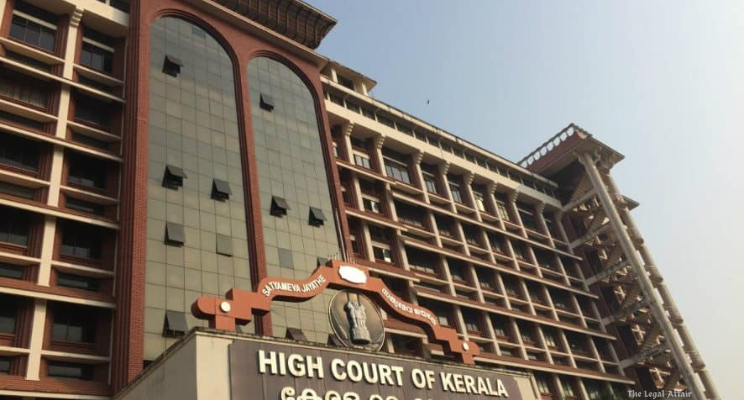
Introduction:
The Kerala High Court has clarified a crucial aspect of the Securitisation and Reconstruction of Financial Assets and Enforcement of Security Interest Act, 2002 (SARFAESI Act), holding that the term “debt due” for the purpose of the mandatory pre-deposit under the proviso to Section 18(1) must include not only the amount claimed in the Section 13(2) demand notice but also the interest accruing thereafter up to the date of filing the appeal. Justice Mohammed Nias C P delivered this judgment in the case of Mini Zakir v M/S Phoenix Arc Private Limited (OP(DRT) 183/ 2025). The petitioner, Mini Zakir (represented by Zakeer Hussain, K A Sanjeetha, and Aby George), challenged the order of the Debt Recovery Appellate Tribunal (DRAT) which had rejected her application for the waiver of the pre-deposit and consequently dismissed her statutory appeal. The dispute arose after the bank clubbed the petitioner’s liability (originating from her housing loans of ₹50 lakhs and ₹35 lakhs) with the liability of a private limited company (which had availed a ₹2.5 crore overdraft and where her husband was a Director). Following the company’s default, the financial asset was assigned to the first respondent, leading to a demand notice for ₹3,64,68,465/-. The DRAT directed the petitioner to deposit ₹1,57,63,026 (40% of the amount claimed in the possession notice), a direction challenged by the petitioner on the ground that accruing interest should not be part of the “debt due.”
Arguments on behalf of the Petitioner (Mini Zakir):
The petitioner’s contention focused on a strict and narrow interpretation of “debt due” under the SARFAESI Act, specifically for the purpose of the pre-deposit requirement.
- Exclusion of Post-Notice Interest: The core argument was that the interest accrued after the date of issuance of the notice under Section 13(2) of the SARFAESI Act should not be considered when calculating the ‘debt due’ for the purpose of the pre-deposit mandated by Section 18(1). The Section 13(2) notice establishes the liability at a specific point in time, and subsequent interest should be separated for pre-deposit calculation.
- Reliance on Judicial Precedent: The petitioner implicitly relied on the line of judicial authority, such as the Madras High Court’s decision in Sivakumar Textiles v DRAT, where the “debt due” was interpreted to refer only to the amount claimed in the Section 13(2) notice, excluding future interest.
Arguments on behalf of the Respondents (M/S Phoenix Arc Private Limited & Others):
The respondents, including the assignee of the financial asset (represented by Nidhi Sam Johns, Lijo Joseph, and others), argued for a broad interpretation that aligns the debt calculation with the borrower’s actual liability on the date of the appeal.
- Statutory Definition Includes Interest: The respondents contended that the definition of “debt” under Section 2(ha) of the SARFAESI Act, when read with Section 2(g) of the Recovery of Debts and Bankruptcy Act, 1993, inherently includes interest. Therefore, the entire liability, including accrued interest, should be considered.
- Liability Continues Till Discharge: It was argued that the borrower’s liability is a continuing one that persists until the debt is fully discharged. Consequently, the entire liability as on the date of filing the appeal must be considered when calculating the “debt due” for the pre-deposit.
- Binding Apex Court Precedent: The respondents strongly asserted that the issue was no longer res integra (an unsettled legal question) as the Supreme Court had already decided the matter in Sidha Neelkanth Paper Industries Pvt Limited v Prudent ARC Ltd (2023 SCC Online SC 12). This Supreme Court ruling held that “debt due” included the entire liability claimed by the secured creditor, thereby encompassing the accrued interest.
Court’s Judgement and Rationale:
Justice Mohammed Nias C P’s judgment prioritized the binding Supreme Court precedent, providing clarity on the calculation of the pre-deposit amount under the SARFAESI Act.
1. Analysis of Conflicting Precedents:
The High Court acknowledged the existence of two lines of judicial authority presented by the parties:
One line (e.g., Sivakumar Textiles) confining “debt due” only to the amount in the Section 13(2) notice, excluding future interest.
Another line (e.g., M/s MRB Roadconst. Pvt. Ltd) interpreting “debt due” to include continuing interest.
2. Reliance on Supreme Court’s Mandate:
The Court found the conflict resolved by the recent pronouncement of the Apex Court. It observed that the Supreme Court, in Sidha Neelkanth Paper Industries Pvt. Ltd. v ARC Ltd, has conclusively held that for the mandatory pre-deposit under Section 18(1), the “debt due” must include not merely the sum mentioned in the Section 13(2) notice but also the interest accrued till the date of the filing of the appeal. The rationale is that the borrower’s liability is continuing till the full discharge of the debt.
The bench noted:
“The judgment of the Apex Court in Sidha Neelkanth (supra) does not exclude such interest; rather, when read as a whole, it supports the computation of “debt due” as on the date of appeal, encompassing both principal and accrued interest.”
This observation clarifies that the Supreme Court’s mandate overrides the earlier conflicting High Court decisions.
3. Final Conclusion on “Debt Due”:
Based on the binding precedent and a logical interpretation of the continuous nature of debt liability, the Kerala High Court concluded:
The term ‘debt due’ under the proviso to Section 18(1) of the Act necessarily includes the interest accruing even after the issuance of notice under Section 13(2) of the Act.
4. Upholding the DRAT Order:
The Court then examined the DRAT’s order. The DRAT had directed the petitioner to deposit ₹1,57,63,026, which was calculated as 40% of the total liability (the amount demanded in the possession notice). Since the amount directed to be deposited by DRAT was less than the mandatory minimum of 50% of the total liability as required under Section 18(1), the Court held that the order of DRAT was legal and did not warrant interference.
The High Court, therefore, dismissed the original petition.