


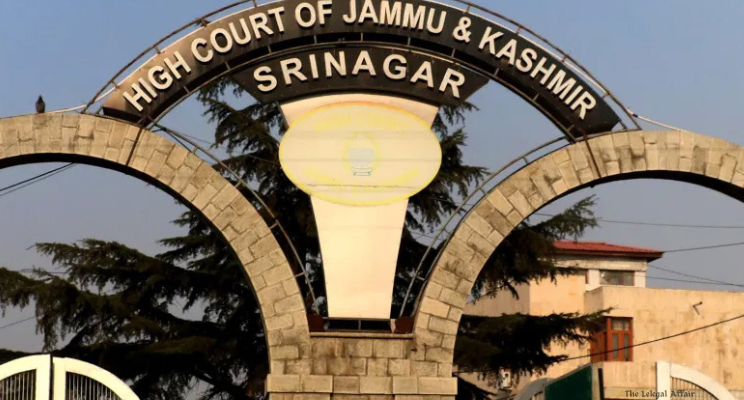
Introduction:
In a significant judgment addressing the entitlement of government employees to salary during unauthorized higher studies, the Jammu and Kashmir High Court in Union Territory of Jammu & Kashmir & Others v. Dr. Anju Kumari & Another (WP(C) No.2399/2025) delivered a crucial ruling on the interpretation of Article 44-A of the Jammu and Kashmir Civil Service Regulations, 1956. The Division Bench comprising Justice Sanjeev Kumar and Justice Sanjay Parihar held that employees pursuing postgraduate courses without official deputation or prior permission cannot claim salary and allowances under Article 44-A. The case involved two medical professionals, appointed as Assistant Surgeons and Medical Officers in the Health Department, who continued their postgraduate studies after appointment without joining their duties physically. When their salary for the study period was withheld, they approached the Central Administrative Tribunal (CAT), which ruled in their favor. However, the High Court overturned the Tribunal’s decision, clarifying that Article 44-A applies only when the government deputes an employee for short-term, job-related training—not for self-chosen higher education. This case sets a precedent for regulating unauthorized absences in government service, especially within the health sector where doctors often enroll in postgraduate courses without obtaining requisite permissions.
Arguments of the Petitioners (UT of Jammu & Kashmir):
The petitioners, represented by Raman Sharma, Additional Advocate General, argued that the respondents’ conduct amounted to a clear case of unauthorized absence from duty. They contended that both respondents had performed the mere ritual of submitting joining reports but never actually assumed their assigned posts. Instead, they continued their postgraduate studies at Government Medical College, Jammu, without any formal permission or deputation from the employer. Such conduct, according to the petitioners, could not entitle them to receive salary or allowances during the period of their absence. They emphasized that the respondents’ actions violated the basic service norms which require government servants to physically join and discharge their official duties upon appointment.
The petitioners further argued that the Central Administrative Tribunal had erred in its interpretation of Article 44-A of the Jammu and Kashmir Civil Service Regulations, 1956. The said Article applies exclusively to cases where a government servant is deputed by the State for specific training or instructive courses relevant to the employee’s current official duties. It does not, they argued, extend to cases where employees voluntarily pursue higher or specialized studies unrelated to their immediate work, especially without the prior approval of the competent authority. The petitioners highlighted that the proviso to Article 44-A itself clearly excludes courses of higher studies or specialized professional training lasting beyond eight weeks from its ambit.
To strengthen their case, the petitioners referred to the High Court’s earlier decision in Union Territory of J&K v. Javed Iqbal, wherein it was categorically held that Article 44-A entitles government servants to salary only for training or instruction connected to their current job and not for extended higher studies undertaken independently. They also argued that both respondents were on probation at the time of their unauthorized absence, which rendered them ineligible for study leave under Rules 61 and 62 of the Jammu and Kashmir Civil Service (Leave) Rules, 1979. Consequently, their absence could not be regularized as study leave, making their claim for salary legally untenable.
Additionally, the petitioners contended that extending the benefit of salary in such cases would set a dangerous precedent, leading to administrative chaos. Allowing employees to continue higher education without permission while drawing salaries would defeat the purpose of maintaining discipline and accountability in public service. They asserted that the respondents’ conduct demonstrated deliberate negligence and disregard for official duties, amounting to abandonment of service. Therefore, the Tribunal’s direction to release salary for the period of unauthorized absence was wholly unsustainable and contrary to law.
Arguments of the Respondents (Dr. Anju Kumari & Another):
On the other hand, the respondents, represented by Senior Advocate Abhinav Sharma and Advocate Abhirash Sharma, defended the order of the Central Administrative Tribunal, asserting that the Tribunal had correctly applied Article 44-A of the Jammu and Kashmir Civil Service Regulations. They contended that their postgraduate studies were undertaken in government institutions—Government Medical College, Jammu—and that their training was inherently connected to their duties as medical officers. Therefore, they were entitled to pay and allowances during the said period.
The respondents argued that the government’s refusal to release their salary was arbitrary, discriminatory, and violative of the principles of equality enshrined in Article 14 of the Constitution. They claimed that other similarly situated doctors, who had pursued postgraduate studies in the same circumstances, had been paid their salary and allowances. The denial of the same benefit to them amounted to unequal treatment among equals. The respondents also pointed out that their joining reports had been duly submitted through official channels—the Principal of GMC Jammu and the Deputy Commissioner of Leh respectively—which, according to them, amounted to formal assumption of duty.
Further, they maintained that their postgraduate training directly enhanced their professional competence, thereby contributing to better healthcare delivery within the public health system. The respondents stressed that their studies were not in contradiction to their official duties but rather an extension of their medical profession, aimed at specialization and public benefit. They claimed that Article 44-A should be interpreted liberally to include such training undertaken within state institutions, especially when it ultimately serves the public interest.
They also argued that the government had, by its conduct, acquiesced to their academic pursuits. The fact that the authorities granted extension for joining the Directorate of Health Services to one of the respondents in 2014 suggested that the department was aware of and tacitly permitted their ongoing studies. Therefore, the subsequent denial of salary was not only unjustified but also in violation of the doctrine of legitimate expectation. The respondents thus requested the High Court to uphold the Tribunal’s order and direct the release of their salary and allowances for the period of postgraduate training.
Court’s Analysis and Judgment:
The Division Bench of the Jammu and Kashmir High Court meticulously analyzed the legal framework governing the issue, particularly Article 44-A of the Jammu and Kashmir Civil Service Regulations, 1956, and the relevant Leave Rules of 1979. The Court noted that Article 44-A grants entitlement to pay and allowances to government servants deputed for training or instructive courses only when such training is officially sanctioned by the government and directly related to the employee’s current duties. The provision was intended to ensure that employees who are temporarily assigned to job-related training do not suffer financial loss during that period.
The Bench emphasized that the proviso to Article 44-A clearly excludes from its scope any course involving higher studies or specialized professional training exceeding eight weeks in duration. Such long-term or higher academic pursuits, according to the Court, fall within the domain of study leave, not deputation. Therefore, only when a government employee is officially deputed by the employer to undergo a training program linked to their present position can they claim salary during that period. Voluntary or self-sponsored higher studies, even if undertaken in a government institution, do not confer any such entitlement.
The Court observed that both respondents were already pursuing postgraduate courses at the time of their appointment as Assistant Surgeons and Medical Officers in the Health Department. They neither physically joined their assigned posts nor obtained formal permission or deputation from the employer to continue their studies. Their mere submission of joining reports through the Principal or Deputy Commissioner did not amount to actual assumption of duty. In fact, their absence from work for over a year while pursuing studies constituted unauthorized absence from service.
The Bench held that the Central Administrative Tribunal had erred in extending the benefit of Article 44-A to the respondents without considering its express limitations. The Tribunal’s interpretation, according to the Court, was inconsistent with the language and intent of the provision. The Court further relied on the precedent set in Union Territory of J&K v. Javed Iqbal, where it was categorically ruled that Article 44-A applies only to short-term, job-related training and not to extended higher studies. The same reasoning applied squarely to the present case.
The High Court also referred to the provisions of the Jammu and Kashmir Civil Service (Leave) Rules, 1979. Under Rules 61 and 62, study leave may be granted to permanent government employees to pursue higher studies in public interest, subject to specific conditions and prior approval. However, the respondents, being probationers at the time, were not even eligible to apply for such leave. Their absence, therefore, remained entirely unauthorized. The Court made it clear that absence without permission cannot be converted into study leave or treated as duty for any purpose, including salary entitlement.
In its judgment, the Bench also underscored the need for administrative clarity and accountability. It observed that the Health Department must establish a proper mechanism to regulate cases where government employees, especially doctors, pursue higher studies. Such regulation is necessary to prevent abuse of the system and ensure that only those officially permitted are entitled to benefits during their study period. The Court directed the government to frame comprehensive guidelines for deputation and study leave so that future disputes of this nature are avoided.
In conclusion, the Court held that the respondents’ pursuit of postgraduate studies without official permission amounted to unauthorized absence from service. They could not invoke Article 44-A of the Civil Service Regulations to claim salary for that period. The order of the Central Administrative Tribunal directing the release of salary was therefore quashed. The writ petition filed by the Union Territory of Jammu & Kashmir was allowed, and the Tribunal’s judgment was set aside. The Court also advised the government to consider initiating disciplinary proceedings against employees who abandon service or remain absent without authorization in the guise of higher studies.
Through this judgment, the High Court reaffirmed the importance of maintaining administrative discipline and clarified the limits of salary entitlement during study periods. It reiterated that Article 44-A cannot be misused to justify payment to employees who voluntarily absent themselves from duty without prior approval. The decision thus not only provides clarity on the interpretation of the regulation but also serves as a deterrent against unauthorized academic pursuits by public servants.