


Introduction:
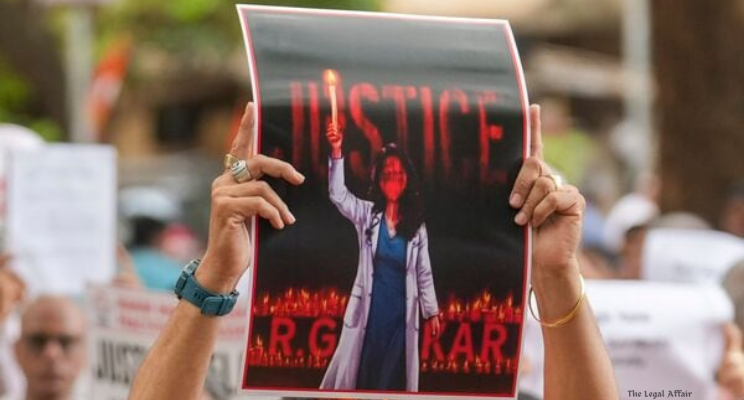
The tragic case of a post-graduate trainee doctor’s alleged rape and murder at RG Kar Medical College and Hospital in Kolkata has escalated to the highest echelons of India’s judiciary. In a rare move, the Supreme Court has taken suo motu cognisance of the case, which has shocked the nation and led to widespread public outcry. The matter will be heard by a bench comprising Chief Justice of India DY Chandrachud, Justices JB Pardiwala, and Manoj Misra on August 20, 2024. The case, titled “In Re: Alleged Rape and Murder of Trainee Doctor in RG Kar Medical College Hospital, Kolkata and related issues,” has brought significant attention to the handling of the investigation by local police and the subsequent transfer of the case to the Central Bureau of Investigation (CBI) by the Calcutta High Court.
The case took a tragic turn on August 9, 2024, when the lifeless body of a young trainee doctor was discovered in the seminar room of RG Kar Medical College Hospital. The initial investigation by the Kolkata Police led to the arrest of a civic volunteer, but the case quickly became mired in controversy. Concerns about the integrity and effectiveness of the investigation prompted the victim’s parents and other concerned individuals to approach the Calcutta High Court, seeking a transfer of the case to a central agency for an impartial probe.
Arguments:
For the Victim’s Family:
The family of the victim, represented by legal counsel, argued that the investigation by the Kolkata Police was marked by gross negligence and a lack of transparency. They pointed out that despite the gravity of the crime, the police initially registered a case of unnatural death, raising serious doubts about the intent and seriousness of the investigation. The family expressed deep apprehension that if the investigation continued under the local police, it could derail, leading to the destruction of crucial evidence and allowing the perpetrators to escape justice.
One of the key points raised was the apparent indifference of the hospital administration, particularly the principal, who failed to lodge a formal complaint despite the victim being a doctor at the same institution. The family’s legal team emphasized that this omission by the hospital authorities was not just surprising but also highly suspicious, further fueling their concerns about the integrity of the investigation.
The family also highlighted the lack of significant progress in the investigation even days after the crime was reported. They argued that the local administration seemed more interested in covering up the incident than in bringing the culprits to justice. The family’s plea was straightforward: they sought the extraordinary relief of transferring the investigation to the CBI, a central agency known for its impartiality, to ensure that justice was served and public confidence restored.
For the State:
The State of West Bengal, represented by the legal team of the Kolkata Police, defended the ongoing investigation and refuted allegations of negligence or bias. They argued that the arrest of the civic volunteer was the result of a prompt and diligent investigation, and further leads were being pursued. The State’s counsel asserted that the local police were fully committed to uncovering the truth and bringing the guilty parties to justice.
The State also contended that the registration of a case of unnatural death was standard procedure in cases where the cause of death was not immediately clear. They argued that the investigation was being conducted in accordance with the law and that there was no evidence to suggest any attempt to derail or cover up the investigation. The State’s legal team also expressed concerns about the transfer of the case to the CBI, arguing that it could disrupt the ongoing investigation and delay justice.
Furthermore, the State questioned the necessity of involving a central agency when the local police were already making progress. They pointed out that such transfers should only be considered in exceptional circumstances where there is clear evidence of bias or failure, neither of which was present in this case. The State’s counsel urged the court to allow the local police to continue their investigation without interference, assuring that every effort was being made to bring the truth to light.
Court’s Judgment:
The Calcutta High Court, after hearing arguments from both sides, expressed its dissatisfaction with the investigation conducted by the Kolkata Police. The bench, comprising Chief Justice TS Sivagnanam and Justice Hiranmay Bhattacharya, noted several concerning aspects of the case, including the registration of a case of unnatural death and the failure of the hospital administration to lodge a complaint. The court found these omissions particularly disturbing, given the seriousness of the crime and the fact that the victim was a doctor at the same hospital.
The High Court observed that there had been no significant progress in the investigation, which only reinforced the apprehensions of the victim’s family. The bench noted that the administration appeared to be more aligned with the interests of the hospital authorities than with the victim and her family, which was unacceptable in a case of this nature. The court emphasized that justice must not only be done but must also be seen to be done, and in this case, the investigation had failed to inspire public confidence.
In light of these observations, the High Court concluded that it was in the interest of justice to transfer the investigation to the Central Bureau of Investigation (CBI). The court stated that the CBI, with its proven track record of impartial investigations, would be better positioned to handle the case, given the serious concerns about the local investigation. The court’s decision was guided by the principle of ensuring that justice is delivered in a fair and transparent manner, without any interference or bias.
The High Court’s order was met with mixed reactions. While the victim’s family and supporters welcomed the decision, seeing it as a step towards justice, the State expressed its disappointment, arguing that the local police had been unjustly undermined. However, the court made it clear that its decision was driven by the need to ensure an impartial and thorough investigation, which was paramount in such a serious case.
Following the High Court’s order, the Supreme Court took suo motu cognisance of the matter, indicating the gravity of the situation. The apex court’s intervention underscores the importance of this case, not just for the victim and her family but for the broader issues it raises about the handling of sensitive criminal investigations and the role of state versus central agencies in ensuring justice.
The Supreme Court’s decision to hear the matter on August 20, 2024, will be closely watched, as it will likely set a precedent for how similar cases are handled in the future. The case highlights the challenges faced by victims and their families in securing justice, particularly in cases where there are allegations of bias or negligence by local authorities. The Supreme Court’s involvement is seen as a significant development, reflecting the judiciary’s commitment to upholding the rule of law and ensuring that justice is served.
Conclusion:
The tragic case of the alleged rape and murder of a trainee doctor at RG Kar Medical College Hospital has not only shocked the nation but also brought to light critical issues related to the handling of criminal investigations by local authorities. The Calcutta High Court’s decision to transfer the investigation to the CBI, followed by the Supreme Court’s suo motu cognisance, underscores the importance of ensuring impartial and effective investigations in such serious cases. As the nation awaits the Supreme Court’s hearing on August 20, 2024, the case continues to raise questions about the role of state versus central agencies in delivering justice. The outcome of this case will likely have far-reaching implications for the handling of similar cases in the future, reinforcing the need for transparency, accountability, and public confidence in the criminal justice system.