


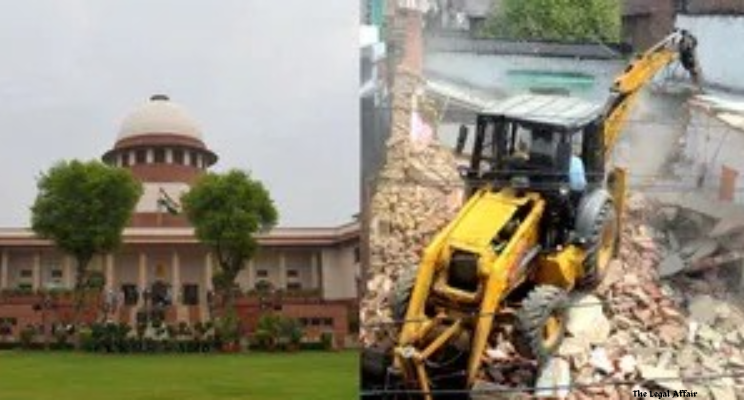
Introduction:
In a significant ruling, the Supreme Court censured Uttar Pradesh authorities for unauthorized demolitions carried out during a road widening project in Maharajganj District. The case, originally registered in 2020 as a suo motu writ petition based on a complaint by journalist Manoj Tibrewal Aakash, revealed severe procedural lapses and alleged retaliatory actions by authorities. A bench comprising Chief Justice DY Chandrachud, Justice JB Pardiwala, and Justice Manoj Misra held that the state acted without legal basis, violating fundamental rights by demolishing residential homes without due process. The court’s firm stance emphasizes the importance of adherence to lawful procedures before seizing private property for public projects, underscoring both citizens’ rights and state accountability.
Uttar Pradesh State’s Argument:
The State defended its actions by claiming that the petitioner and others had encroached on public land, justifying the demolitions as necessary for road expansion. The State contended that the petitioner’s property encroached approximately 3.7 square meters into public land. However, they admitted that instead of serving formal written notices, announcements were made through public address systems and drums, a practice the State argued was consistent with local customs for notifying residents. Additionally, State representatives emphasized that road widening projects are essential for public interest, seeking to frame the demolitions as legally justifiable and unavoidable.
The State insisted that it had taken sufficient steps to inform residents, albeit through public announcements rather than written notices, and argued that this traditional approach should be viewed as fulfilling the requirement for notice. Additionally, the State justified its lack of detailed encroachment data by claiming that demarcating each property would be time-consuming and impractical, hindering the progress of public infrastructure projects. The defence argued that compensation claims should not be pursued in this court but through alternative legal channels.
Petitioner’s Argument:
Represented by Senior Advocate Siddharth Bhatnagar and Advocate Shubham Kulshreshtha, the petitioner claimed that the demolitions were not only illegal but also retaliatory. Aakash, a journalist, alleged that the demolitions occurred as retribution for his reporting on local government misconduct. The petitioner’s counsel emphasized that demolitions proceeded without any written notice, a clear breach of due process. They argued that informing residents through public announcements was insufficient and high-handed, and pointed to the arbitrary, overnight nature of the demolition, which left families with no time to vacate or salvage their belongings.
The petitioner further presented findings from a National Human Rights Commission (NHRC) report, which stated that only a small part of Aakash’s property—3.7 square meters—was encroaching on public land. The report criticized the complete demolition of the home for such a minor encroachment, recommending interim compensation and disciplinary action against responsible officers. The petitioner’s side urged the Court to hold the state accountable for violating constitutional rights and to order adequate compensation, alleging that authorities used the guise of a road-widening project to punish dissenting voices.
Court’s Response and Judgment:
After hearing arguments from both parties, the Supreme Court strongly condemned the conduct of Uttar Pradesh authorities, describing the demolitions as “high-handed” and “lawless.” CJI DY Chandrachud led the bench in expressing disapproval of the State’s approach, criticizing the use of bulldozers without proper notice as a violation of due process. He questioned how the authorities could justify razing entire houses for minor encroachments, emphasizing that procedural fairness is a fundamental aspect of legal governance, especially in property matters that affect citizens’ lives and livelihoods.
Justice Pardiwala joined in condemning the practice of notification through public announcement, stressing that notice for demolition should be provided formally in writing to give affected families reasonable time to respond. He pointed out that using a loudspeaker or drums to announce imminent demolitions does not constitute adequate or lawful notice, as residents had no opportunity to contest the action or make alternate arrangements. He added that demolishing properties overnight without allowing residents time to remove personal belongings displayed a flagrant disregard for human rights.
The bench also highlighted the inadequacy of the State’s documentation, noting that authorities failed to provide detailed demarcations of encroachment, property lines, or information on land acquisition. Without clarity on the precise encroachments and road expansion requirements, the Court found the demolitions entirely unjustified. Justice Misra underscored the need for comprehensive inquiries before executing demolitions, noting that due diligence was lacking in this case.
The Court relied heavily on the NHRC’s findings, which confirmed that only a minimal portion of Aakash’s property was encroaching on public land. Given that the NHRC deemed this minor encroachment insufficient grounds for complete demolition, the Court ruled that the State’s actions were disproportionate and unlawful. The Court took particular issue with the potential retaliatory motives alleged by Aakash, although it refrained from making any direct conclusions regarding these accusations.
In a landmark order, the Supreme Court directed the State to pay punitive compensation of Rs 25 lakhs to the petitioner as an interim relief. The Court clarified that this amount does not preclude the petitioner from seeking additional remedies through other legal avenues. In addition to the monetary compensation, the Court instructed the Chief Secretary of Uttar Pradesh to conduct an internal inquiry into the actions of officers and contractors involved in the demolitions. The Court mandated that disciplinary and punitive measures be taken against any personnel found responsible for these unauthorized demolitions.
The judgment also outlined essential guidelines for future road-widening projects, mandating that all states and Union Territories adhere to strict procedural standards before initiating demolitions. The Court emphasized the need for written notice, detailed encroachment assessments, and respect for residents’ rights in all land acquisition and property removal processes. A copy of the judgment was ordered to be circulated nationwide to prevent similar instances of administrative overreach.