


Introduction:
The Supreme Court of India has directed the Delhi Police to place on record the prohibitory orders issued under Section 163 of the Bharatiya Nagarik Suraksha Sanhita, 2023 (BNSS), which were used to restrict public gatherings and demonstrations in Delhi during the preceding two weeks. The Court has also directed law enforcement agencies to preserve CCTV footage and other digital evidence relating to the protests. These directions assume significance in the context of allegations of excessive police action, restrictions on peaceful assembly, and the exercise of preventive powers under the criminal procedure framework.
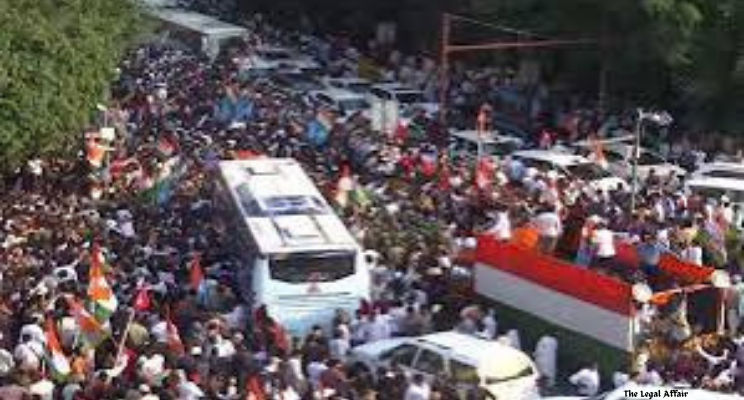
A bench comprising Chief Justice of India Surya Kant and Justice Joymalya Bagchi was hearing multiple petitions arising from the protests held in Delhi on October 10, 2026, against Chief Election Commissioner Gyanesh Kumar and the Election Commission of India’s Special Intensive Revision (SIR) of electoral rolls. The proceedings raised questions concerning the legality and scope of prohibitory orders, the treatment of protesters and journalists, and the constitutional limits of police powers to prevent or control public gatherings.
Among the matters before the Court was a writ petition challenging the constitutional validity of Section 172 of the BNSS. The provision governs compliance with lawful police directions and authorises officers, in specified circumstances, to detain or remove persons who resist or disregard such directions. The petitioner contends that the provision grants excessive discretion to police officers without prescribing sufficient safeguards against arbitrary detention.
The controversy originated in the proposed demonstration at Jantar Mantar, where organisers sought to protest against the Chief Election Commissioner in connection with the SIR exercise. The Delhi Police refused permission for the proposed demonstration, citing the late submission of the application and alleged violations during an earlier protest. Subsequently, prohibitory orders were imposed across the New Delhi district, restricting assemblies of five or more persons, processions, demonstrations, picketing and dharnas without prior written permission.
The dispute subsequently expanded beyond the question of permission for a particular demonstration. Several petitions alleged that protesters, students, activists, lawyers, journalists and political representatives had been detained or prevented from reaching the protest site. According to the petitioners, some individuals were intercepted far from Jantar Mantar, while others were allegedly removed from trains. Questions were also raised regarding restrictions imposed outside the immediate protest area and allegations concerning the gathering and disruption at the Supreme Court premises on October 12, when Rahul Gandhi and other Opposition leaders reportedly marched towards the Court Registry to file a petition challenging the SIR exercise.
The proceedings therefore brought together issues concerning preventive policing, constitutional freedoms, accountability for alleged excesses, and the obligation of public authorities to justify restrictions imposed on citizens. The Court’s directions regarding production of the Section 163 orders and preservation of digital evidence form an important part of its examination of these issues. However, the directions should not be mistaken for a final determination that the police action was unlawful or that the challenged statutory provision is unconstitutional.
Arguments of the Parties:
Petitioners’ Arguments:
The petitioners questioned the legal basis, necessity and proportionality of the restrictions imposed by the Delhi Police during the protests. Their principal concern was that prohibitory orders had been enforced without adequate transparency and that the authorities had not placed the relevant orders before the Court despite the controversy surrounding the restrictions. They maintained that the legality of preventive police action could not be meaningfully examined without access to the actual orders, the reasons recorded for issuing them, and the geographical and temporal limits within which they operated.
Senior Advocate Menaka Guruswamy pointed out that the affidavit submitted by the Delhi Police Commissioner did not contain the orders issued under Section 163 of the BNSS. She also highlighted the absence of information concerning the number of persons detained during the demonstrations against Chief Election Commissioner Gyanesh Kumar and the Election Commission’s SIR exercise. According to the submissions recorded during the hearing, the absence of these details made it difficult to assess the extent of the restrictions and the manner in which the police had implemented them.
Senior Advocate Kapil Sibal similarly submitted that the lawyers appearing in the matter had not seen the relevant prohibitory order. The concern was not merely procedural. Where the State relies on an order restricting public assembly to justify preventive action, the order itself becomes central to determining whether the action was authorised by law, whether the restrictions were supported by relevant circumstances, and whether their scope was justified by the situation confronting the authorities.
The petitioners’ challenge to Section 172 of the BNSS raised a broader constitutional objection. Section 172(1) requires individuals to comply with lawful directions issued by police officers in the discharge of their duties under Chapter XII of the Sanhita, which concerns preventive action by the police. Section 172(2) authorises an officer to detain or remove a person who resists, refuses, ignores or disregards such a direction, with the person either being taken before a Magistrate or released as soon as possible, subject to the statutory framework and the provision’s requirement concerning petty cases.
The petitioner contends that the language of Section 172 is excessively broad and leaves the decision to detain a person substantially dependent on the individual police officer’s assessment of the circumstances. According to the challenge, the provision does not adequately require the officer to demonstrate a reasonable apprehension that a cognizable offence is likely to occur before exercising the power. It is further argued that the absence of sufficiently specific requirements concerning recorded reasons and independent judicial scrutiny increases the possibility of arbitrary or disproportionate action.
The petitioners maintain that the statutory power must be examined against the guarantees contained in Articles 14, 19 and 21 of the Constitution. Article 14 protects equality before the law and guards against arbitrary State action. Article 19 protects specified fundamental freedoms, including the freedoms of speech and expression and peaceful assembly, subject to constitutionally permissible restrictions. Article 21 provides that no person shall be deprived of life or personal liberty except according to procedure established by law.
According to the petitioners, a statutory provision that permits detention or removal on the basis of broadly framed police directions must contain meaningful safeguards to prevent its use against lawful dissent. They argue that compliance with police directions cannot be treated as an unrestricted obligation when the directions themselves may be disputed or when their enforcement interferes with constitutionally protected activity. The petition therefore seeks a declaration that Section 172 is unconstitutional, alleging that its operation is inconsistent with the constitutional requirements of fairness, reasonableness and non-arbitrariness.
The petitioners also relied on the circumstances surrounding the October 10 protest to demonstrate the practical implications of the challenged powers. They alleged that large numbers of people, including students, activists, lawyers, journalists and political leaders, were detained or prevented from proceeding to Jantar Mantar. The allegation that certain individuals were intercepted far from the demonstration site, including persons removed from trains, was presented as a reason to scrutinise the geographical reach and proportionality of the police action.
The preservation of CCTV footage and other electronic material was also significant from the petitioners’ perspective. Such evidence may help establish where individuals were intercepted, whether force or coercion was used, how police directions were communicated, and whether the action taken corresponded to the restrictions actually imposed. Preserving the material would prevent potentially relevant evidence from being lost before the parties and the Court could examine the allegations.
Respondents’ Arguments:
The Delhi Police defended its actions by relying on the preventive powers available under the BNSS and the circumstances in which the demonstrations were proposed. In its affidavit before the Supreme Court, the police referred to the previous conduct of the organisers and the possibility that the demonstrations could disrupt public order. The authorities maintained that preventive restrictions were necessary to address the risk of disorder in the national capital.
The police had denied permission for the proposed October 10 demonstration organised by the Cockroach Janta Party (CJP), citing the late submission of the application and alleged violations during an earlier demonstration. The authorities’ position was that the decision had to be assessed in light of the relevant circumstances and the responsibilities of the police to maintain public order, rather than solely from the perspective of the organisers’ desire to assemble.
The respondents also referred to the particular sensitivity of New Delhi, including the movement of high-profile diplomatic visitors and the organisation of international conferences. The affidavit reportedly mentioned the 18th BRICS Summit as part of the broader security context. According to the police, several police stations had issued orders under Section 163 extending beyond the immediate area of Jantar Mantar because of the potential implications for public order and security.
The police further submitted that directions had subsequently been issued to remove such orders in compliance with the Supreme Court’s directions dated October 11. This submission indicated that the authorities were responding to the Court’s earlier intervention concerning the restrictions. Nevertheless, the existence of subsequent directions to remove certain orders did not, by itself, resolve every question concerning the legal basis, implementation or consequences of the restrictions previously imposed.
At the hearing, Solicitor General Tushar Mehta was asked to ensure that the relevant Section 163 orders were placed on record through further affidavits by the authorities. The Court’s direction provided an opportunity for the State to place the actual documents before the bench so that the legality and scope of the restrictions could be assessed on the basis of the orders themselves rather than competing descriptions of their contents.
The State’s broader justification rests on the principle that public authorities have a responsibility to prevent violence, serious disruption and threats to public tranquillity. Preventive measures may be necessary in appropriate circumstances, particularly where credible risks arise in connection with large gatherings or sensitive public events. However, the existence of that responsibility does not eliminate the need to demonstrate that the measures adopted were legally authorised, supported by relevant circumstances and confined to what was reasonably necessary.
The constitutional challenge to Section 172 must also be distinguished from the police’s defence of the particular restrictions imposed in Delhi. The respondents’ reliance on preventive powers and public-order considerations does not, by itself, settle whether Section 172 contains adequate safeguards. Equally, the allegations concerning the manner in which the provision was applied do not automatically establish that the provision is unconstitutional in every possible application. The Court must consider the statutory language, its legal context, the nature of the power conferred and the constitutional limitations governing its exercise.
Court’s Judgment:
The Supreme Court, while hearing the connected petitions, directed the Delhi Police to place on record the prohibitory orders issued under Section 163 of the BNSS during the preceding two weeks. It also directed all law enforcement agencies to preserve CCTV footage and other digital material relating to the protests. These directions are significant because they address two essential requirements in examining allegations of unlawful police action: access to the legal instruments relied upon by the authorities and preservation of evidence capable of establishing what occurred during the demonstrations.
During the hearing, Justice Joymalya Bagchi observed that the lawyers were “arguing against a ghost”, referring to the complaint that the Section 163 orders had not been produced before the Court. The observation highlighted the difficulty of examining the legality of restrictions when the actual orders forming their legal foundation are unavailable. Without examining the relevant documents, the Court and the parties cannot adequately assess the terms of the restrictions, the circumstances in which they were issued, or their application to particular individuals and locations.
Following the submissions of Senior Advocates Menaka Guruswamy and Kapil Sibal, Justice Bagchi asked Solicitor General Tushar Mehta to ensure that the promulgated orders were placed on record in the further affidavits filed by the authorities. This direction is an important procedural step towards enabling judicial scrutiny of the police’s actions. It does not, however, amount to a finding that the orders were invalid or that their enforcement necessarily violated fundamental rights.
The Court’s direction must be understood in the context of the legal framework governing preventive restrictions on public assembly. Section 163 of the BNSS empowers an Executive Magistrate, a District Magistrate, a Sub-divisional Magistrate or another duly empowered Executive Magistrate to issue written orders in urgent cases of nuisance or apprehended danger, subject to the statutory conditions. Such orders may be necessary where immediate preventive action is required to prevent danger to human life, health or safety, a disturbance of public tranquillity, a riot, an affray or other harm recognised by the provision.
Section 163 succeeds Section 144 of the Code of Criminal Procedure, 1973. Although the statutory provision has changed with the introduction of the BNSS, the central legal concern remains the same: preventive powers must be exercised within the limits prescribed by law. An order restricting gatherings cannot be justified merely by referring generally to security concerns. Its legality must be examined with reference to the statutory requirements, the circumstances necessitating urgent action, the scope of the restrictions and the authority responsible for issuing it.
In the present proceedings, the production of the orders is particularly important because the Delhi Police reportedly imposed restrictions across parts of the New Delhi district, prohibiting gatherings or assemblies of five or more persons, processions, demonstrations, picketing and dharnas without prior written permission. The police justified the measures by referring to the conduct of the organisers, the possibility of disruption and the security requirements associated with the national capital. The Court’s direction will enable the relevant documents to be examined against these explanations.
A central principle in this area of law is that preventive action must have a demonstrable legal basis and cannot become a substitute for unrestricted administrative discretion. The power to impose restrictions on public gatherings serves a legitimate public purpose, but its exercise must remain subject to constitutional scrutiny. The existence of a perceived risk does not automatically justify every restriction, irrespective of its duration, geographical reach or effect on peaceful activities.
The Supreme Court has previously addressed the constitutional limits of restrictions imposed in the name of public order. In Anuradha Bhasin v. Union of India (2020), the Court emphasised the importance of proportionality, publication of restrictive orders and judicial review in the context of restrictions on internet access and movement in Jammu and Kashmir. The judgment reaffirmed that orders restricting fundamental rights must be accessible and amenable to legal scrutiny. Although the factual circumstances in that case differed from the Delhi protest proceedings, its principles are relevant to the broader question of transparency and accountability in the exercise of preventive powers.
Similarly, in Babulal Parate v. State of Maharashtra (1961), the Supreme Court considered the constitutional validity of Section 144 of the former Code of Criminal Procedure and recognised the preventive purpose of the provision. The decision must be read alongside the constitutional limitations governing the exercise of such powers and subsequent judicial developments concerning their application. The preventive character of a power does not mean that its exercise is immune from scrutiny.
Another relevant authority is Madhu Limaye v. Sub-Divisional Magistrate, Monghyr (1970), in which the Supreme Court examined the scope and constitutional validity of Section 144 CrPC. The Court recognised the importance of preventive action in situations involving apprehended danger while also underscoring that the power must be exercised in accordance with the statutory framework. These precedents illustrate that the legal system accommodates preventive restrictions but does not treat them as unlimited authority to curtail public freedoms.
The Court’s second major direction concerned the preservation of CCTV footage and other digital evidence relating to the protests. This requirement is crucial in proceedings involving allegations of detention, obstruction, excessive force or interference with peaceful assembly. Electronic evidence may provide an objective record of police deployment, the movement of protesters, the location of interceptions and the sequence of events. It may also help distinguish between lawful preventive measures and conduct alleged to have exceeded the authority conferred by law.
Preservation of evidence is particularly important where allegations involve large numbers of individuals and several locations. Written affidavits and competing accounts may provide different versions of the same incident, whereas CCTV footage and other contemporaneous digital records may assist the Court in testing those accounts. Such material can also become relevant to determining whether individuals were detained in accordance with the law and whether the police acted within the geographical and substantive limits of the applicable orders.
The direction to preserve electronic material should not be confused with a final finding that police excesses occurred. It is an evidentiary safeguard designed to ensure that potentially relevant information remains available while the allegations are considered. Nor does preservation alone establish the authenticity or admissibility of every recording. Those questions, where disputed and material, must be addressed in accordance with the applicable evidentiary and procedural rules.
The Court also issued notice on the wri petition challenging the constitutional v