


Introduction:
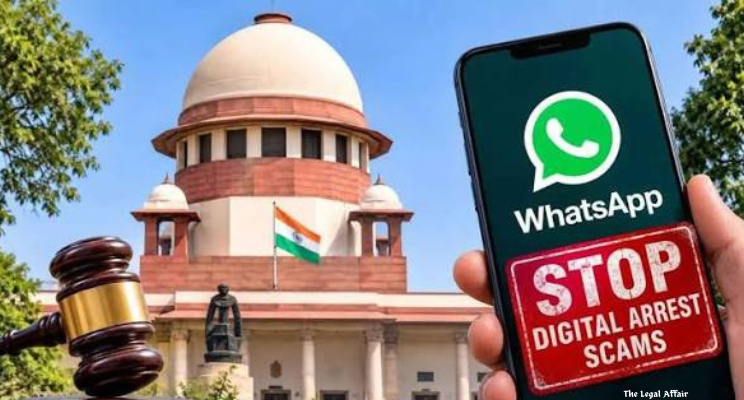
The increasing incidence of digital arrest scams and other forms of cyber-enabled financial fraud has emerged as a serious challenge to India’s digital security framework. Fraudsters are increasingly impersonating police officers, investigating agencies, government officials and other law enforcement authorities to intimidate unsuspecting individuals into transferring money under the threat of arrest, criminal prosecution or other legal consequences. Recognising the seriousness of the situation and the need for coordinated institutional action, the Supreme Court of India has directed WhatsApp LLC, a Meta company, and other concerned intermediaries to place before it the preventive measures they propose to undertake to curb digital arrest scams and related cybercrimes.
A Bench comprising Chief Justice of India Surya Kant, Justice Joymalya Bagchi and Justice V. Mohana issued the directions while hearing the suo motu proceedings titled In Re: Victims of Digital Arrest Related to Forged Documents, along with connected matters. The Court specifically directed the intermediaries to submit their proposals not only before the Supreme Court but also simultaneously before the Indian Cyber Crime Coordination Centre (I4C), the nodal agency responsible for coordinating efforts to combat cybercrime in India.
The latest directions form part of the Supreme Court’s continuing efforts to develop a comprehensive institutional response to the growing threat of digital arrest frauds. The Court has been monitoring the issue for several months and has consistently emphasised that preventing cybercrime cannot be the responsibility of law enforcement agencies alone. Financial institutions, digital communication platforms, regulatory authorities and government departments must work together to identify suspicious activities, prevent fraudulent transactions and ensure that victims receive appropriate remedies.
Digital arrest scams generally involve fraudsters contacting individuals through telephone calls, video calls or messaging applications while falsely claiming to represent police departments, the Central Bureau of Investigation, the Enforcement Directorate or other government authorities. Victims are often informed that their identity documents, bank accounts or other personal details have been connected with serious criminal activities. The fraudsters then create an atmosphere of fear by threatening immediate arrest, interrogation or legal proceedings unless the individuals comply with their demands. In several instances, victims are persuaded to transfer substantial amounts of money to accounts controlled by the perpetrators.
The misuse of digital communication platforms has further complicated the problem. Messaging applications can be exploited to circulate forged documents, impersonate public authorities, establish contact with potential victims and coordinate fraudulent activities. Consequently, the Supreme Court has recognised the importance of requiring intermediaries to take meaningful preventive measures rather than merely responding after fraudulent accounts have already caused financial losses.
The proceedings have also witnessed significant directions concerning the responsibilities of banks and other financial institutions. In February 2026, the Supreme Court initiated measures to address the growing number of digital arrest scams and directed the concerned authorities to take coordinated action. A subsequent status report submitted by the Union Government outlined the steps undertaken pursuant to those directions.
The report also referred to action taken by WhatsApp against accounts allegedly connected with digital arrest scams and impersonation of law enforcement agencies. According to the information placed before the Court, WhatsApp had banned approximately 9,400 accounts identified as being linked to such fraudulent activities following an investigation. Although this action demonstrated the platform’s efforts to address misuse, the Supreme Court considered it necessary to seek a more comprehensive and clearly defined preventive strategy from WhatsApp and other intermediaries.
The Court’s intervention therefore extends beyond the removal or suspension of suspicious accounts. It seeks to establish a coordinated framework involving technology platforms, financial institutions, the RBI, State authorities and specialised cybercrime agencies to strengthen prevention, detection, investigation and victim compensation.
Arguments of the Parties:
The proceedings arise from a suo motu examination of the increasing number of victims affected by digital arrest scams and forged documents. The case summary does not set out the detailed individual submissions advanced by every petitioner, respondent or intermediary. Accordingly, the competing institutional concerns can be understood from the directions issued by the Court and the measures placed before it, without attributing specific arguments to parties that are not recorded in the available case material.
The central concern underlying the proceedings is the inadequacy of existing preventive mechanisms in responding to increasingly sophisticated cyber-enabled financial frauds. Victims of digital arrest scams frequently face not only financial losses but also severe psychological distress arising from threats, intimidation and the false impression that they are dealing with legitimate law enforcement authorities.
The need for stronger accountability on the part of digital intermediaries forms an important aspect of the proceedings. Messaging platforms provide communication infrastructure through which fraudsters can approach individuals, circulate fabricated government documents and impersonate public officials. The Supreme Court’s direction requiring WhatsApp and other intermediaries to submit proposals indicates that the Court expects these platforms to examine how their existing systems can be strengthened to detect suspicious accounts and prevent their misuse.
The intermediaries have consequently been required to apprise the Court of the measures they propose to undertake and submit the same proposals to I4C. This requirement places emphasis on cooperation between private technology platforms and specialised government agencies. It also provides an opportunity to examine whether technological interventions, improved reporting mechanisms and coordinated information-sharing arrangements can help identify fraudulent activities at an earlier stage.
The concerns surrounding the role of financial institutions constitute another significant dimension of the proceedings. Banks are often the channels through which the proceeds of cyber fraud are transferred, withdrawn or distributed across multiple accounts. By the time a victim realises that the communication was fraudulent, the money may already have been transferred through several accounts, making recovery difficult.
In this context, the Supreme Court has emphasised the need for banks to identify unusual transactions, particularly those inconsistent with a customer’s established banking history. The Court has also considered the possibility of temporarily suspending suspicious transactions, notifying the nearest police station and physically verifying reported transactions to determine their genuineness.
The regulatory responsibility of the Reserve Bank of India has therefore assumed considerable importance. The Court has directed the RBI to develop an appropriate Standard Operating Procedure for financial institutions, incorporating mechanisms for temporary debit restrictions, grievance redressal and restoration of money lost through cyber fraud. The Court has further emphasised that financial institutions should not escape responsibility where their failure to exercise the necessary due diligence contributes to the commission of fraud.
From the governmental side, the proceedings have also highlighted the need for effective coordination between the Centre, States and Union Territories. Cybercrime frequently involves multiple jurisdictions, with perpetrators, victims, bank accounts and digital infrastructure operating from different geographical locations. This creates practical difficulties in registering complaints, investigating transactions and identifying the individuals responsible.
The Court has accordingly sought information from State and Union Territory law enforcement agencies concerning FIRs registered in digital arrest scam cases, the progress of investigations and suggestions for preventing, detecting and prosecuting such offences.
The Union Government’s status report has placed before the Court the steps taken following its earlier directions. The participation of the Attorney General for India, the Solicitor General and other counsel representing the concerned authorities reflects the wide institutional involvement required to address the problem.
Thus, the principal issue before the Court is not confined to determining the responsibility of one particular intermediary or financial institution. Rather, the proceedings concern the development of a coordinated national framework in which every relevant institution performs its role in preventing cyber-enabled financial fraud and protecting affected individuals.
Court’s Judgment:
The Supreme Court’s latest directions represent a continuation of its comprehensive judicial monitoring of digital arrest scams and related cybercrimes. The Bench comprising Chief Justice Surya Kant, Justice Joymalya Bagchi and Justice V. Mohana recognised that the growing misuse of digital communication platforms requires proactive intervention and cannot be effectively addressed through isolated enforcement measures.
The most significant direction in the present hearing concerns WhatsApp and other concerned intermediaries. The Court directed these platforms to inform it of the measures they propose to undertake to prevent digital arrest scams and related cybercrimes. Importantly, the intermediaries have also been directed to submit their proposals simultaneously to the Indian Cyber Crime Coordination Centre.
The Court observed:
“WhatsApp LLC (A Meta Company) and other concerned intermediaries are also directed to apprise this Court of the measures they propose to undertake to prevent the digital arrest scams and related cybercrimes. They shall also simultaneously submit their proposals to the I4C.”
This direction reflects the Court’s expectation that digital platforms should adopt a more active approach towards preventing the misuse of their services. Merely responding to complaints or removing fraudulent accounts after substantial harm has occurred may not be sufficient to address the scale and sophistication of the problem.
The requirement to submit proposals to I4C is equally significant. It creates an institutional link between private intermediaries and the government’s specialised cybercrime coordination mechanism. Such cooperation can assist in developing more effective procedures for identifying fraudulent accounts, sharing relevant information and responding to emerging patterns of cybercrime.
The Court’s attention was also drawn to the Union Government’s status report, which recorded the action taken pursuant to the earlier directions issued in February 2026. The report indicated that WhatsApp had banned approximately 9,400 accounts associated with digital arrest scams and impersonation of law enforcement agencies following an investigation.
While the banning of these accounts constitutes an important enforcement measure, the Court’s latest direction demonstrates that the objective is to move towards a more systematic preventive framework. The intermediaries must explain what additional measures they intend to introduce to reduce the possibility of such accounts being created, operated or repeatedly used for fraudulent purposes.
Directions concerning the RBI and banking institutions
Another important aspect of the Supreme Court’s continuing intervention concerns the role of financial institutions in preventing cyber-enabled financial fraud.
In August 2026, the Bench issued a series of directions requiring the Reserve Bank of India to adopt a Standard Operating Procedure for banks dealing with accounts and transactions suspected to be connected with cyber fraud. The proposed framework was expected to address temporary debit holds, grievance redressal and a mechanism for restoring money lost by victims.
The objective behind these measures is to ensure that suspicious financial transactions can be identified and stopped before the money is withdrawn or transferred beyond the reach of investigating authorities.
The Court has also emphasised that the RBI’s proposed regulatory framework must incorporate appropriate provisions requiring financial institutions to compensate victims where their failure to exercise due diligence has contributed to the fraud.
Reiterating this position in late October 2026, the Bench observed:
“The regulatory measures proposed by the Reserve Bank of India (RBI) must mandate and incorporate suitable provisions that require financial institutions to indemnify victims of digital arrest scams and other cyber frauds and pay suitable compensation not less than the amount lost by the customer, where it is established that the fraud or crime occurred due to the failure on the part of the financial institution to exercise due diligence in preventing or reporting the act/incident.”
This observation is particularly important because it recognises that financial institutions may have responsibilities extending beyond the ordinary processing of customer transactions. Banks are expected to maintain appropriate monitoring systems and exercise reasonable vigilance when transactions display unusual characteristics.
However, the Court’s observation does not establish automatic liability for every cyber fraud involving a bank account. The requirement of compensation is linked to the establishment of a failure on the part of the financial institution to exercise due diligence in preventing or reporting the fraudulent activity.
The distinction is legally significant. It places responsibility on banks where institutional negligence or inadequate safeguards contribute to the loss, while preserving the need to examine the circumstances of each case.
Suspension of suspicious transactions and preventive safeguards
The Supreme Court also referred to several preventive safeguards that it had previously emphasised for financial institutions.
The Bench observed that unusual or suspicious transactions inconsistent with the past transaction history of an account should be capable of being temporarily suspended. Such transactions should also be automatically brought to the attention of the nearest police station, followed by physical verification to ascertain whether the reported transactions are genuine.
These safeguards are intended to address one of the most critical difficulties in cyber fraud investigations: the rapid movement of money through banking channels.
In many digital arrest cases, victims are manipulated into transferring money under intense psychological pressure. Fraudsters may instruct them to transfer their savings to accounts described as being used for verification or security purposes. Once the money enters the fraudulent banking network, it may be quickly distributed across multiple accounts.
The proposed safeguards seek to introduce an opportunity for intervention at the transaction stage itself. An effective monitoring system could help financial institutions identify suspicious financial activity before the proceeds are completely withdrawn or transferred.
The Court’s approach also reflects the importance of balancing fraud prevention with legitimate banking operations. Temporary suspension and verification mechanisms are intended to address transactions displaying suspicious characteristics rather than indiscriminately restricting ordinary customer activity.
Role of States and Union Territories
The Supreme Court has also recognised that effective implementation requires active participation from State governments and Union Territories.
In its August directions, the Bench instructed States and Union Territories to operationalise their respective State Cyber Crime Coordination Centres. These centres are expected to improve coordination between investigating agencies and strengthen the overall response to cyber-enabled financial offences.
The Court also directed the Inter-Departmental Committee to examine the possibility of developing a shared liability and victim compensation framework. Such a framework is important because digital arrest scams frequently involve several institutions, including banks, communication platforms, payment intermediaries and law enforcement agencies.
The Court’s approach indicates that responsibility for addressing cybercrime should be examined through a coordinated institutional framework rather than through fragmented action by individual departments.
A shared liability framework could also help clarify the responsibilities of different stakeholders where the failure of one or more institutions contributes to financial loss. The examination of a victim compensation mechanism further demonstrates the Court’s concern that individuals who have already suffered financial harm should not be left without an effective avenue for redress.
Directions to law enforcement agencies
In addition to the directions concerning intermediaries and financial institutions, the Supreme Court directed all Law Enforcement Agencies in the States and Union Territories to submit details of the FIRs registered so far in connection with digital arrest scams.
The agencies have also been directed to provide the status of the investigations arising from those FIRs and place their suggestions before the Court regarding appropriate measures for the prevention, detection and prosecution of such offences.
The Directors General of Police of all States and Union Territories have been directed to ensure compliance with these requirements.
This direction is important because the success of any preventive framework ultimately depends upon effective investigation and prosecution. Identifying suspicious accounts and freezing fraudulent transactions may help prevent further financial losses, but these measures must be supported by timely investigation to identify the perpetrators and establish their criminal responsibility.
The requirement to submit investigation updates will also enable the Supreme Court to assess the extent of implementation of its earlier directions and identify practical difficulties faced by law enforcement authorities.
Direction to the RBI to submit details of authorised financial institutions
To ensure effective implementation of the regulatory framework proposed by the RBI and the directions issued by the Supreme Court, the Bench further directed the Reserve Bank of India to submit a list of all authorised financial institutions before the Court on the next date of hearing.
The list is expected to assist the Court in examining the institutions covered by the proposed regulatory measures and ensuring that the framework is implemented effectively.
The direction also reflects the Court’s intention to monitor the practical implementation of the safeguards rather than limiting its intervention to issuing general recommendations.
The proceedings are therefore developing into a broader examination of institutional accountability in the digital financial ecosystem. The Court is simultaneously seeking preventive proposals from technology platforms, regulatory action from the RBI, investigation updates from law enforcement agencies and coperation from State and Union Territory administrations.
It is i