


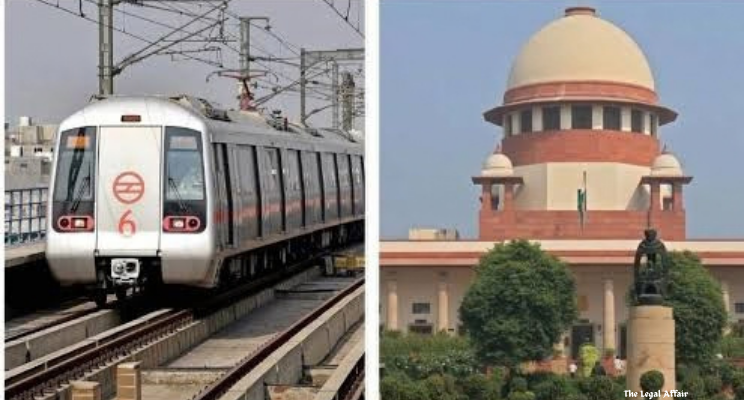
Introduction:
The Supreme Court of India has expressed serious concern over the reported shutdown of metro stations in Delhi ahead of the protests announced for October 10 by the CJP and opposition parties against the Chief Election Commissioner. The Court observed that a complete suspension of metro services could adversely affect the rights of ordinary citizens who are entitled to use public transport for their daily needs. The proceedings bring into focus an important constitutional question: to what extent can public authorities restrict essential public services as a preventive measure in anticipation of protests or demonstrations?
A three-judge Bench comprising Chief Justice of India Surya Kant, Justice Joymalya Bagchi and Justice V. Mohana was hearing petitions challenging the restrictions imposed in Delhi in connection with the proposed demonstrations. During the hearing, the Bench raised concerns about the consequences of shutting down metro stations, particularly where such a measure could inconvenience members of the public who have no connection with the proposed protests.
The issue assumes significance because the Delhi Metro is an important component of the capital’s public transport network. Thousands of commuters depend on it to travel to workplaces, educational institutions, hospitals, government offices and other essential destinations. A decision to close metro stations, especially in busy areas, may therefore affect not merely the participants in a demonstration but also residents, employees, students, patients and visitors who rely on the service for their everyday activities.
At the same time, the authorities responsible for maintaining law and order have a legitimate duty to anticipate potential disturbances, prevent violence and protect public property. Large demonstrations can create security challenges, particularly where they take place near sensitive government buildings, public offices or areas with heavy pedestrian movement. Preventive restrictions may consequently be necessary in certain circumstances, depending on the nature of the anticipated threat and the information available to the authorities.
The legal difficulty arises when a measure intended to manage a particular security risk becomes so extensive that it substantially interferes with the ordinary activities and legitimate interests of the wider public. The Supreme Court’s concern, as reflected in the available case summary, highlights the need to assess whether shutting down public transport is a proportionate response to the anticipated risks associated with a demonstration.
The petitions challenging the restrictions imposed in Delhi thus raise questions concerning the balance between public order and individual liberty, the permissible scope of preventive administrative action, and the responsibility of public authorities to ensure that security arrangements do not impose unnecessary hardship on citizens.
It is important, however, to distinguish the Court’s reported observations from a final judicial determination. The available case summary records the Bench’s concern regarding the shutdown of metro stations, but it does not provide the complete pleadings, the detailed submissions of counsel, any cited precedents, or the operative directions issued at the conclusion of the hearing. The legal issues must therefore be examined in their broader constitutional context without attributing findings or orders to the Court that have not been established by the available information.
Arguments of the Parties:
The proceedings before the Supreme Court involved competing concerns relating to the freedom to assemble, the ability of citizens to move freely, and the government’s responsibility to maintain public order. The petitioners questioned the extensive restrictions imposed in Delhi ahead of the October 10 demonstration, while the Union Government and the authorities responsible for law and order maintained that preventive measures were necessary to address potential security risks.
The challenge to the restrictions was brought before the Court by petitioners concerned about the closure of metro stations, cancellation of trains and other measures affecting movement into and within the national capital. Senior Advocate Kapil Sibal appeared for Communist Party of India (Marxist) general secretary Mariam Alexander Baby. Other senior advocates, including Abhishek Manu Singhvi, Gopal Sankaranarayanan and Vrinda Grover, along with advocate Prashant Bhushan, also raised concerns regarding the extent of the restrictions. Their submissions, as reported during the hearing, focused on the impact of these measures on public movement and the exercise of fundamental rights.
The petitioners’ principal concern was that the authorities appeared to have imposed restrictions on a scale that extended beyond the management of the proposed demonstration. According to their submissions, the closure of metro stations and the cancellation of trains could make it difficult for ordinary citizens to enter Delhi, travel within the city or reach their intended destinations. They argued that the anticipated possibility of a law-and-order problem should not automatically become a justification for restricting the movement of the entire population.
Senior Advocate Kapil Sibal questioned the rationale behind cancelling trains arriving in Delhi, including services originating in other parts of the country. His submission highlighted the practical consequences of a blanket approach to security. A passenger travelling to Delhi for work, medical treatment, education or a personal emergency could face the same restrictions as a person intending to participate in the demonstration, despite having no connection with the protest.
The petitioners also raised concerns about the reported restrictions affecting hotels and other facilities. They contended that the consequences of the measures were not confined to transport alone but could interfere with the ability of people to travel to Delhi and arrange accommodation. The broader submission was that preventive action should remain directed towards the specific risks identified by the authorities instead of placing extensive restrictions on citizens who were not involved in the anticipated gathering.
Another important aspect of the petitioners’ case concerned the constitutional protection of peaceful assembly. Article 19(1)(a) of the Constitution guarantees freedom of speech and expression, while Article 19(1)(b) protects the right to assemble peaceably and without arms. Article 19(1)(d) guarantees citizens the right to move freely throughout the territory of India. The petitioners’ objections drew upon the broader principle that these freedoms cannot be rendered ineffective through excessive administrative restrictions.
The petitioners maintained that the possibility of disorder should not, by itself, be treated as sufficient reason to bring public life to a standstill. They argued that the police and other authorities are entrusted with the responsibility of managing gatherings, controlling crowds and responding to unlawful conduct. Where the law permits a demonstration subject to specified conditions, the authorities should ordinarily consider whether those conditions can be enforced before adopting restrictions that affect a much larger section of society.
Their submissions also raised the question of timing. The proposed demonstration was scheduled for October 10, while the restrictions were due to begin on October 9. A hearing or decision after the date of the proposed protest could substantially reduce the practical value of the legal challenge. The petitioners therefore sought urgent consideration, arguing that effective judicial review required the Court to examine the restrictions before their consequences had become irreversible.
At the same time, the petitioners’ challenge did not eliminate the requirement that demonstrations be conducted within the framework of the law. The right to assemble peacefully is constitutionally protected, but it is not an unrestricted entitlement to occupy any public space, disregard lawful directions or obstruct public services without consequence. The legal question was whether the particular restrictions adopted in anticipation of the demonstration were justified, not whether the authorities were prohibited from taking any preventive action at all.
The Solicitor General, Tushar Mehta, appeared for the Union Government and the authorities defending the security arrangements. His position was that the restrictions had been introduced to prevent unlawful activities and maintain order. The government was concerned that a gathering announced as peaceful could develop into an unlawful assembly or lead to a situation requiring additional police intervention.
The authorities’ position must be understood against the background of their responsibility to prevent disturbances rather than merely respond after violence has occurred. Public demonstrations may involve substantial crowds, movement towards sensitive locations and pressure on transport infrastructure. If the police have credible information suggesting that a gathering could create a serious security risk, they may be required to take preventive steps before the situation deteriorates.
From this perspective, restrictions on access to particular locations or the regulation of transport could be defended as precautionary measures intended to protect demonstrators, commuters, public property and government establishments. The government was entitled to point out that public order cannot always be maintained through measures adopted only after an incident has occurred. Preventive administration necessarily involves an assessment of risks and the possibility that circumstances may change rapidly.
The Solicitor General also emphasised the need to provide the authorities with some flexibility in managing a developing situation. As reported during the hearing, the government expressed concern that the administration should not be deprived of the ability to respond to changing circumstances. The underlying argument was that security agencies must be allowed to assess the situation on the ground and adopt measures considered necessary to prevent unlawful conduct.
However, the government’s position encountered a central question from the Bench: whether the complete stoppage of metro and rail services was necessary when the same objectives might be achieved through regulation. The distinction was important because a measure that controls access to a particular sensitive area is different in scope and impact from one that prevents a large number of citizens from using public transport.
The Court was therefore required to consider the competing interests without treating either as absolute. The government’s duty to maintain public order had to be weighed against the public’s entitlement to access transport facilities and the constitutional freedoms implicated by restrictions on movement and assembly.
The proceedings also brought into focus the position of the protest organisers. The Court noted that the lawyers appearing before it did not represent the organisers themselves and that the organisers’ perspective was not directly before the Bench at that stage. Consequently, the Court sought information about the proposed gathering, including its expected size and arrangements, before deciding how the competing interests could appropriately be balanced.
This aspect of the hearing was significant because the legality and necessity of security measures may depend upon facts such as the number of participants, the location and duration of the demonstration, the likelihood of obstruction, and the availability of alternative arrangements. Without such information, a court may find it difficult to determine whether a particular restriction is necessary or whether a less restrictive measure would adequately address the anticipated risk.
The dispute was therefore not simply a contest between the right to protest and the government’s power to regulate demonstrations. It concerned the limits of preventive action in a constitutional democracy and the obligation to ensure that measures adopted for public safety do not unnecessarily interfere with the rights and daily lives of people who are not involved in the event.
Court’s Judgment:
The Supreme Court’s response centred on the distinction between completely stopping public transport and regulating its operation to address a specific security concern. The Bench expressed serious concern that a total shutdown of metro services would affect citizens who were entitled to use those facilities. It questioned whether the authorities could achieve their security objectives through more targeted arrangements rather than imposing a comprehensive prohibition on movement.
The Bench comprising Chief Justice Surya Kant, Justice Joymalya Bagchi and Justice V. Mohana examined the restrictions in the context of the anticipated October 10 protests. The orders placed before the Court reportedly included directions concerning metro stations and certain railway services, based on the likelihood of crowds moving towards sensitive areas. The restrictions were scheduled to operate from October 9, immediately before the planned demonstration.
The Court’s concern was that a complete suspension of public transport could affect a far wider group than those who might participate in the demonstration. Metro passengers include employees travelling to work, students attending classes, patients seeking medical care, people visiting government offices and individuals travelling for personal reasons. Such commuters cannot automatically be treated as potential participants in a protest merely because they intend to enter or travel through Delhi on the relevant date.
In this context, the Bench drew attention to the fact that citizens are entitled to avail themselves of public facilities. The importance of this observation lies in the relationship between administrative decision-making and the public interest. Transport services are provided to facilitate mobility across the city. When their operation is restricted for security reasons, the consequences for ordinary users must form part of the decision-making process.
The Court did not suggest that the authorities were powerless to impose restrictions. Instead, its concern was with the breadth of the measures adopted. The distinction between regulation and complete prohibition became central to the proceedings. Regulating train frequency, controlling entry and exit at selected stations, deploying security personnel or managing access to sensitive areas may allow the authorities to address a specific risk while preserving a substantial degree of public mobility.
A blanket shutdown, by contrast, may produce extensive disruption without necessarily being the only effective means of maintaining public order. The Court’s intervention therefore focused on whether the restrictions could be reconsidered and replaced with a more balanced arrangement.
The Bench’s approach reflects the constitutional principle of proportionality. In simple terms, proportionality requires that a restriction imposed to achieve a legitimate public objective should not go further than reasonably necessary to achieve that objective. A measure may pursue a valid purpose, such as preventing violence or protecting sensitive locations, yet still require reconsideration if its adverse consequences are excessive in relation to the risk being addressed.
This principle is particularly relevant where administrative measures affect fundamental rights. The government may have a legitimate reason to regulate public movement during a large demonstration, but the existence of a legitimate objective does not automatically validate every measure adopted in its name. The nature of the anticipated threat, the effectiveness of the restriction and the availability of less restrictive alternatives remain relevant considerations.
The Court’s concern also reflects the need for a rational connection between the security objective and the measure imposed. If the concern is the movement of demonstrators towards particular sensitive locations, it becomes necessary to consider why transport services across a much wider area must be stopped. Restrictions tailored to specific locations, times or anticipated crowd movements may offer a more proportionate response, depending on the facts and the level of risk.
The Court’s reported order made this distinction explicit. It recorded that the Solicitor General had agreed to impress upon the competent authorities the need to reconsider a complete prohibition and allow metro and rail movement in a regulated manner, keeping the principle of proportionality in mind. The Bench further made clear that there should be no complete prohibition on the movement of the metro.
This direction was significant because it addressed the immediate impact of the restrictions while leaving room for the authorities to formulate appropriate security arrangements. Rather than requiring the government to abandon its security responsibilities, the Court required reconsideration of the manner in which those responsibilities could be discharged without imposing unnecessary hardship on the public.
The Court also called for a considered decision on allowing metro and other railway services to operate in an appropriately regulated manner. It directed that the decision should receive wide publicity and that an advisory should be published in newspapers and on official websites. The purpose was to ensure that people travelling within Delhi would have access to clear and timely information and would not suffer avoidable inconvenience because of uncertainty regarding transport operations.
The requirement of public communication is an important aspect of effective administration. Restrictions on transport can affect travel plans, employment, medical appointments and other time-sensitive activities. Even where a restriction is justified, unclear or delayed information may increase the hardship experienced by commuters. Advance notice and accessible advisories enable citizens to make alternative arrangements and reduce confusion.
The Court’s approach must also be understood in light of Article 19 of the Constitution. Article 19(1)(a) protects freedom of speech and expression, while Article 19(1)(b) protects peaceful assembly without arms. These freedoms are subject to the reasonable restrictions permitted by Articles 19(2) and 19(3), respectively. Public authorities may regulate demonstrations to protect public order and other constitutionally recognised interests, but the restrictions must remain within the limits prescribed by the Constitution.
Similarly, Article 19(1)(d) protects citizens’ freedom to move throughout India, subject to reasonable restrictions under Article 19(5). The right to movement does not mean that every road, station or public facility must remain accessible in every circumstance. Security emergencies and genuine public-order concerns may justify limitations. However, a restriction that substantially interferes with ordinary movement must be assessed in light of its legal basis, purpose, scope and practical consequences.
The Supreme Court’s observations are consistent with the broader constitutional understanding that fundamental rights and public order must be balanced through lawful and proportionate measures. The government cannot ignore genuine security risks, but neither can public convenience and cnstitutional freedoms be treated as irrelevant whenever a demonstration