


Introduction:
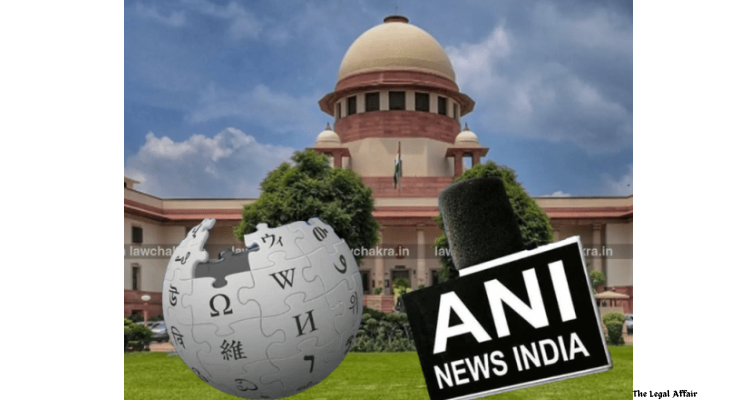
The Supreme Court, in Wikimedia Foundation Inc. v. ANI Media Private Limited (Diary No. 2483/2025), issued notice on a petition filed by Wikimedia Foundation challenging the Delhi High Court’s order directing the removal of a Wikipedia page and related discussions concerning an ongoing defamation case initiated by news agency Asian News International (ANI) against Wikipedia. A bench of Justice Abhay S. Oka and Justice Ujjal Bhuyan raised concerns about the legality of the High Court’s directive, particularly regarding the takedown of content critical of judicial proceedings. The case originated from ANI’s defamation suit against Wikipedia, alleging that its Wikipedia page contained defamatory remarks about ANI’s credibility and editorial policies. ANI had sought Rs. 2 crores in damages and demanded the removal of the content, leading the Delhi High Court to order Wikimedia to disclose the subscriber details of three individuals who edited ANI’s Wikipedia page. The Supreme Court’s intervention now puts the spotlight on the larger issue of media freedom and judicial sensitivity to public discourse.
Arguments of Both Sides:
Wikimedia, represented by Senior Advocate Kapil Sibal, argued that the Delhi High Court’s order was legally flawed as it mandated the removal of content without first establishing its defamatory nature. Sibal contended that Wikimedia had no control over Wikipedia’s editorial content and that the controversial statements were originally sourced from an article published in The Indian Express. He emphasized that the order amounted to preemptive censorship and violated principles of free speech and media autonomy. The petitioner further submitted that judicial proceedings are subject to public scrutiny, and critical commentary—unless proven contemptuous—should not be arbitrarily suppressed.
On the other hand, ANI, through its counsel, defended the High Court’s decision, arguing that the Wikipedia page in question contained misleading and defamatory content that interfered with ongoing legal proceedings. ANI’s counsel pointed out that certain statements suggested that a judge had threatened to shut down Wikipedia in India, which the High Court found to be prima facie contemptuous. ANI insisted that the individuals responsible for such edits were not before the court and that Wikimedia had failed to take accountability for the defamatory content. The news agency maintained that allowing such content to persist would not only damage its reputation but also undermine the integrity of judicial proceedings.
Judgement:
During the Supreme Court hearing, Justice Oka expressed scepticism over the High Court’s approach, observing that courts should not be overly sensitive to public criticism. He remarked that it is common for judicial remarks to be discussed and even criticized in the media. The bench noted that unless content is explicitly proven to be contemptuous, its removal solely on the grounds of criticism sets a problematic precedent. Justice Oka further stressed that courts should tolerate public discourse about their proceedings, stating, “If the court says something orally and, on social media, there is a comment about it, why should the court be touchy about such comments?” The bench emphasized the need for a clear distinction between genuine contempt and critical discussions in the public domain.
The Supreme Court acknowledged ANI’s argument that the correct version of the article was not on record and permitted ANI to submit a counter-affidavit by the end of the month. However, it expressed concern over the broader implications of restricting online discussions about court proceedings. While issuing notice to ANI, the Court made it clear that it would examine the legality of the High Court’s directive in its next hearing scheduled for April 4, 2025.