


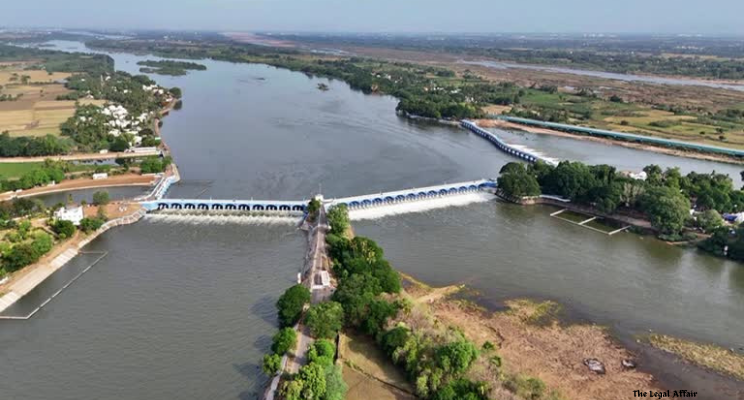
Introduction:
In a significant development in the decades-long Cauvery River water dispute, the Supreme Court of India, on Thursday, November 13, 2025, refused to entertain the State of Tamil Nadu’s plea challenging the approval granted by the Central Water Commission (CWC) for the preparation of a Detailed Project Report (DPR) for Karnataka’s proposed Mekedatu Dam project across the Cauvery River. The Bench, comprising Chief Justice of India B.R. Gavai, Justice K. Vinod Chandran, and Justice N.V. Anjaria, held that Tamil Nadu’s application was “premature” since the matter was still under consideration by the statutory expert bodies — the Cauvery Water Regulation Committee (CWRC) and the Cauvery Water Management Authority (CWMA). The Court emphasized that judicial intervention at this stage would be unwarranted as the Court lacked the technical expertise to assess the hydrological and environmental implications of the project. This latest order, rendered in State of Karnataka v. State of Tamil Nadu (MA 3127/2018 in Civil Appeal No. 2453/2007), underscores the Supreme Court’s consistent approach of deferring to specialized expert bodies in inter-State river water management and disputes under the Inter-State River Water Disputes Act, 1956. The Bench reaffirmed that the Court would step in only if the statutory process was completed and Tamil Nadu’s grievances persisted after the DPR approval. The judgment thus strikes a balance between judicial restraint and the obligation to ensure compliance with binding water-sharing obligations under the 2018 Cauvery Water Management Scheme notified by the Central Government.
Arguments of the State of Tamil Nadu:
Senior Advocate Mukul Rohatgi, appearing for the State of Tamil Nadu, strongly opposed the preparation of the Detailed Project Report (DPR) for the Mekedatu Balancing Reservoir cum Drinking Water Project, contending that it would have serious and irreversible consequences for Tamil Nadu’s farmers and the Cauvery delta region. He argued that the proposed dam, to be constructed by the State of Karnataka, was located at a higher altitude upstream of the inter-State border, near the Biligundlu measuring station — the designated point for assessing water release to Tamil Nadu. According to the learned counsel, such a project would enable Karnataka to regulate or withhold the flow of water to Tamil Nadu, thereby defeating the purpose of the final decision of the Cauvery Water Disputes Tribunal, as modified by the Supreme Court in its 2018 judgment.
Rohatgi stressed that Tamil Nadu’s agrarian economy, which is heavily dependent on Cauvery water for irrigation, would suffer irreparable loss if the Mekedatu project was permitted to proceed unchecked. He pointed out that the State of Karnataka had not obtained the mandatory approvals from the Cauvery Water Management Authority (CWMA) and the Cauvery Water Regulation Committee (CWRC), both of which were constituted under the 2018 Cauvery Water Management Scheme notified by the Union Government under Section 6A of the Inter-State River Water Disputes Act, 1956. He contended that the Central Water Commission’s directive to prepare the DPR without prior clearance from these expert bodies was contrary to the statutory framework and the apex court’s earlier directions.
Further, Mr. Rohatgi submitted that the project was politically motivated and intended to subvert the binding directions of the Supreme Court requiring Karnataka to release 177.25 TMC (thousand million cubic feet) of water annually to Tamil Nadu. He urged the Court to intervene preemptively, arguing that once the DPR was prepared and administrative approvals obtained, it would be nearly impossible to halt the project, resulting in grave injustice to Tamil Nadu. The senior counsel contended that judicial oversight was essential at this stage to prevent a fait accompli. He reiterated that the Mekedatu project would adversely affect not only the flow of water but also the ecological balance of the Cauvery basin, leading to environmental degradation and violation of the right to livelihood of thousands of farmers in the delta region.
Arguments of the State of Karnataka:
Opposing the plea, Senior Advocate Shyam Divan, representing the State of Karnataka, termed Tamil Nadu’s application as “misconceived” and “premature.” He argued that the order of the Central Water Commission merely permitted the preparation of a Detailed Project Report and did not amount to final approval or execution of the dam project. He emphasized that the DPR was still subject to scrutiny and mandatory clearances from the Cauvery Water Management Authority (CWMA) and the Cauvery Water Regulation Committee (CWRC), which would thoroughly examine the feasibility, hydrological balance, and inter-State implications of the project before any further steps could be taken.
Mr. Divan submitted that Karnataka, as an upper riparian State, has the sovereign right to utilize its share of water within the parameters of the Supreme Court’s 2018 judgment, which determined the annual water entitlement between the two States. He assured the Bench that Karnataka was fully committed to releasing the 177.25 TMC of water to Tamil Nadu as directed and that the proposed Mekedatu project would not affect this obligation. Instead, the project, he argued, was designed primarily as a balancing reservoir to store excess floodwater and supply drinking water to Bengaluru and surrounding areas, without altering the downstream flow regime during the water release periods.
The learned senior counsel also pointed out that the preparation of the DPR was a technical step that would involve expert evaluation of various factors, including environmental and hydrological impact, and therefore it was inappropriate for the Supreme Court to intervene at this stage. He contended that the Court’s earlier orders had recognized the role of expert bodies in overseeing water distribution and river management, and judicial interference before the completion of this process would set a wrong precedent. Mr. Divan further argued that Tamil Nadu’s apprehensions were speculative and politically motivated, aimed at obstructing developmental projects within Karnataka’s territory despite the project being within the legally allocated water quota. He urged the Court to dismiss the application and allow the statutory expert mechanisms to function independently and objectively.
Court’s Judgment and Analysis:
After hearing both sides, the Supreme Court Bench led by Chief Justice B.R. Gavai dismissed Tamil Nadu’s application, holding that it was premature and devoid of merit at this stage. The Court carefully examined the sequence of administrative and technical processes concerning the Mekedatu project and found that the Central Water Commission’s order merely permitted preparation of a Detailed Project Report, which in itself did not authorize construction or implementation. The Bench clarified that the CWC had specifically mandated that the DPR would be subject to prior approval of the Cauvery Water Management Authority (CWMA) and the Cauvery Water Regulation Committee (CWRC) after due consideration of Tamil Nadu’s objections. Therefore, the Bench held that there was no cause of action warranting judicial intervention at this stage.
The Court observed:
“At this stage, what is being done by the order passed by the CWC is only the preparation of the DPR, that too after taking into consideration the objections of the State of Tamil Nadu, the experts of the CWMA and CWRC. It is further to be noted that the CWC had further directed that the prior approval of the CWMA and CWRC would be a prerequisite for the consideration of the DPR. In that view of the matter, we find the present application to be premature.”
The Bench further reaffirmed its earlier order dated August 25, 2023, wherein it had declined to adjudicate upon technical issues concerning the monsoon water release and directed the CWMA to evaluate the matter. Emphasizing the same principle, the Bench reiterated that the Court does not possess the necessary technical expertise to assess complex hydrological issues, which are best addressed by specialized expert institutions. Chief Justice Gavai observed:
“We reiterate what was observed in our order dated 25.08.2023 that we don’t possess expertise. This Court time and again reiterated that this Court should refrain from areas which are best reserved for experts.”
The Court noted that the CWC’s direction to proceed with DPR preparation was based on the recommendations of expert bodies, thereby ensuring procedural transparency and adherence to the statutory mechanism under the Inter-State River Water Disputes Act, 1956. It stressed that judicial prudence demanded restraint in matters requiring technical evaluation, as premature interference could disrupt the structured process of decision-making.
However, while dismissing the application, the Supreme Court issued a cautionary note to Karnataka, reminding it of its binding obligation to release water to Tamil Nadu in accordance with the Court’s previous orders and the operational framework of the Cauvery Water Management Scheme, 2018. The Bench observed:
“If Karnataka fails to comply with the directions of this Court, it faces the risk of committing contempt of the Court.”
At the same time, the Court preserved Tamil Nadu’s right to challenge the project at a later stage, if the DPR, upon completion, is approved by the CWMA and the CWC. The Bench clarified that Tamil Nadu would be free to seek appropriate legal remedies in accordance with law once a final decision is taken on the project’s approval. Thus, while dismissing the application as premature, the Court ensured that Tamil Nadu’s legal and constitutional remedies remained protected for future stages.
In the broader context, the Supreme Court’s ruling highlights a recurring judicial theme — deference to expert bodies in technical and policy-driven disputes involving inter-State resources. The judgment underscores that the role of the judiciary is not to pre-empt expert evaluation but to ensure adherence to due process and compliance with statutory mandates. It reflects the Court’s consistent approach that matters involving complex environmental, hydrological, and scientific assessments must be addressed by competent authorities rather than through premature litigation.
The Court’s order also reaffirmed the binding nature of the Cauvery Water Management Scheme, 2018, notified under Section 6A of the Inter-State River Water Disputes Act, 1956, which was framed to implement the Supreme Court’s 2018 decision modifying the Cauvery Tribunal’s award. The scheme vests the CWMA and CWRC with powers to regulate and monitor water releases and projects affecting the flow of the river. The Court observed that allowing Tamil Nadu’s petition at this stage would undermine this statutory framework and blur the distinction between judicial and administrative functions. By restraining itself, the Supreme Court reinforced the institutional autonomy of expert bodies while safeguarding the constitutional balance between federal interests and environmental governance.
Accordingly, the Court dismissed the application filed by Tamil Nadu as premature, directing that the process before the expert authorities must proceed unhindered. The Bench concluded that judicial interference could be considered only after the statutory process culminates in a final decision and if any substantive rights of the parties are adversely affected.