


Introduction:
In the case Ashok Patil v. The Deputy Commissioner & Others (WP No. 203166 of 2025), the Karnataka High Court, on Thursday, delivered a significant order relating to the exercise of the right to peaceful assembly under Article 19(1)(b) of the Constitution. The matter was heard by Justice M.G.S. Kamal and concerned a petition filed by Ashok Patil, Convenor of the Rashtriya Swayamsevak Sangh (RSS), Kalaburagi, seeking permission to conduct a route march, or Pathasanchalana, in Chittapur Town. The petition came up in light of the state’s previous restrictions on public gatherings and the petitioner’s contention that such restrictions violated the fundamental freedoms of speech, expression, and peaceful assembly. The State Government, represented by Advocate General Shashi Kiran Shetty, and the petitioner, represented by Senior Advocate Aruna Shyam, presented opposing views on the number of participants and band members permitted for the event. Ultimately, the High Court disposed of the matter, upholding the permission granted by the Tahsildar while making a limited modification to accommodate the cultural and symbolic importance of the event, marking 100 years of the RSS organisation.
Arguments on behalf of the Petitioner:
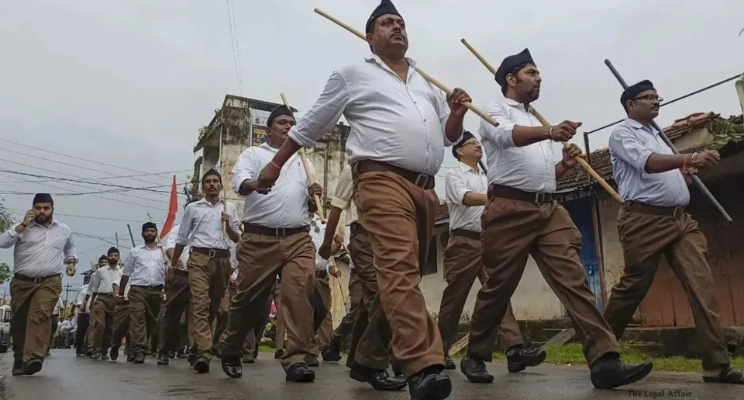
Senior Advocate Aruna Shyam, appearing for the petitioner and Convenor of RSS Kalaburagi, commenced arguments by submitting that the petitioner had duly applied to conduct a route march in Chittapur Town, intended to celebrate the centenary year of the RSS, a moment of immense historical and cultural significance for its members and the local community. He submitted that the route march, or Pathasanchalana, was a symbolic gathering reflecting discipline, patriotism, and unity, and that the organisers had undertaken to conduct it peacefully under the supervision of local authorities. Shyam expressed gratitude to the State Government and the Tahsildar for having granted permission for the event through an order dated November 12, 2025, but sought modification of two specific conditions imposed in that order—first, the restriction limiting the number of participants to 300, and second, the limitation of band members to 25. He requested that the participant limit be increased to 600, and the band strength to 50, stating that this was a special, one-time request in light of the 100-year celebrations of the organisation.
Shyam argued that such restrictions were overly stringent, especially given that the gathering was intended to be peaceful and had the necessary administrative oversight. He contended that the right to peaceful assembly is a fundamental right guaranteed under Article 19(1)(b) of the Constitution, and any restriction must meet the test of reasonableness under Article 19(3). The counsel pointed out that the occasion was extraordinary and emotionally significant, representing the centennial milestone of an organisation that has contributed to various national service activities. Therefore, limiting the number of participants to only 300 would dilute the essence of the celebration and prevent the community from fully partaking in an event of historical importance.
Further, Shyam emphasized that the petitioners had an impeccable record of compliance with law and order regulations during similar past events in other areas, and no instance of violence or disruption had been recorded. He also highlighted that the earlier ban order issued by the Government of Karnataka on October 18, 2025, prohibiting gatherings of more than ten persons in public places, had already been stayed by the High Court, which found that such a prohibition prima facie infringed the fundamental rights of citizens. Therefore, he submitted that the authorities should show a liberal approach, especially when the event aligns with the constitutional ethos of freedom of expression and peaceful assembly. The learned Senior Counsel concluded that while the petitioner accepted all other conditions in the Tahsildar’s order, the modifications sought—an increase to 600 participants and 50 band members—were modest and reasonable, keeping in mind the sentiments of the local populace and the symbolic significance of the centenary celebrations.
Arguments on behalf of the Respondent (State):
Advocate General Shashi Kiran Shetty appeared for the State of Karnataka and the local administration, submitting that the permission for the route march had already been granted after due consideration of law, order, and logistical concerns. He clarified that the State was not opposing the event but had to ensure public safety and administrative manageability, particularly given that such marches could potentially attract large gatherings and heightened public attention. The AG submitted that the number of 300 participants and 25 band members was not arbitrary but fixed after analyzing data from previous marches conducted by the petitioner and similar organisations in nearby towns, where attendance ranged between 100 and 150 persons. The authorities had thus decided to fix 300 as an upper limit, which was already twice the usual attendance observed in prior events.
Shetty stressed that while the Government respects the right to peaceful assembly, such rights are not absolute and must be balanced with considerations of public order, safety, and administrative preparedness. The AG cited the October 18, 2025, Government Order restricting mass gatherings, noting that it was issued to ensure peace and security amid sensitive law-and-order situations across the State. Though the order was stayed, the rationale behind it—to prevent large, unregulated gatherings—remained valid. He stated that the authorities must act with prudence and foresight to prevent any potential issues, particularly when large numbers of people assemble in public places.
The AG, however, maintained a conciliatory tone, noting that the State was not opposed to revising certain conditions if justified. When Senior Advocate Shyam requested an increase in band members from 25 to 50, Shetty expressed no objection to that specific modification, recognising that it would not materially impact public order. He reiterated that while the State respects the petitioner’s sentiments, it also bears the responsibility to maintain law and order and ensure that permissions granted are within administratively sustainable limits. Therefore, the restriction on the number of participants should remain at 300 to ensure smooth management and adherence to the conditions laid down in the permission order.
Court’s Judgment:
After hearing both sides and perusing the records, Justice M.G.S. Kamal noted that the permission granted by the Tahsildar, Chittapur, through the order dated November 12, 2025, was issued after due consideration of relevant factors and in line with the State’s responsibility to maintain order during public events. The Court observed that the petitioner had acknowledged the permission granted and had expressed appreciation toward the authorities for the same. However, the petitioner’s request to modify two specific conditions warranted judicial consideration.
The Court took note of the petitioner’s submission that the event was being organised to commemorate 100 years of the RSS, a milestone of special cultural and social significance for its members and supporters. Justice Kamal recorded that the petitioner’s plea for increasing the number of participants to 600 and band members to 50 was based on this unique occasion, described as a one-time measure intended to respect the sentiments of the people. The Court also took note of the Advocate General’s submission that while the number of participants had been fixed after careful assessment of prior events, he did not object to the petitioner’s request to increase the band strength to 50.
In view of this, the Court found merit in partially allowing the petitioner’s plea. It upheld the condition restricting the number of participants to 300, observing that the limit had been determined based on empirical data and practical considerations of public order and crowd management. The Court emphasised that the State has the right and duty to impose reasonable restrictions to ensure that public gatherings are conducted peacefully without disruption to law and order. However, the Court accepted the petitioner’s request to modify the number of band members from 25 to 50, noting that the same was reasonable, especially since the State had no objection.
Accordingly, the Court dictated its order in the following terms:
“Order dated 12.11.2025, passed by the office of Tahsildar, Chittapur, according permission to the petitioner to conduct a march is placed on record. Learned counsel for the petitioner, while appreciating and acknowledging the effort by the State for granting permission, requests that the maximum 300 participants in the route march granted be increased to 600 and the limit of 25 persons in the band be increased to 50. He submits that it is being requested as a one-time measure. In response, the learned Advocate General submits that the number of 300 is limited, taking into view the route march done by the petitioner in nearby areas, which was in the range of 100-150, and the number is fixed based on data collected from surrounding areas. Senior counsel submits that at least the authority may permit 50 members in the band instead of 25, which is accepted by the learned Advocate General. Except this, the rest of the order remains the same.”
The Court thus permitted the route march to be conducted on November 16, 2025, with 300 participants and a band strength of 50 members, subject to adherence to all other conditions imposed by the Tahsildar’s order.
Justice Kamal also took note of the larger constitutional backdrop concerning the right to peaceful assembly. Referring to the earlier stay order passed by a coordinate bench against the State Government’s October 18, 2025, ban on public gatherings, the Court observed that such restrictions cannot be absolute and must be subject to the principles of proportionality. The Court reiterated that while the State has the power to regulate assemblies in the interest of public order, it cannot impose unreasonable curbs that effectively extinguish the exercise of constitutional freedoms. The Court concluded by stating that democratic values flourish only when citizens are permitted to express their beliefs, organise peaceful gatherings, and commemorate historical or cultural events, provided they adhere to the rule of law.