


Introduction:
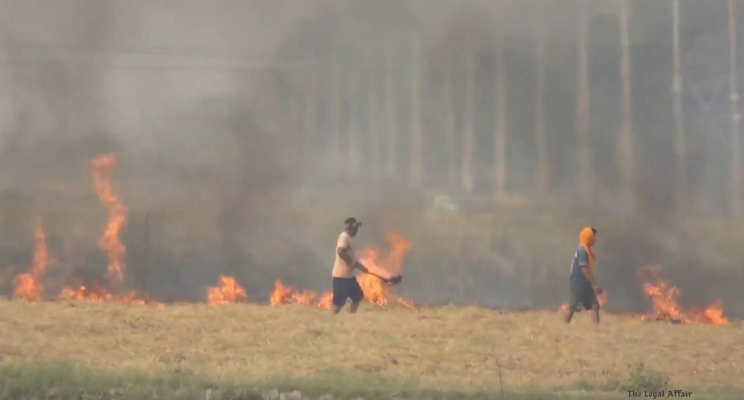
The Supreme Court of India, during a pivotal hearing on November 18, 2024, addressed the pressing issue of stubble burning, a major contributor to Delhi-NCR’s alarming air pollution levels. The case arose amidst mounting concerns about the discrepancies in data regarding farm fires collected by different satellite systems. The Court, emphasizing the fundamental right to clean air under Article 21 of the Indian Constitution, directed the Union Government and the Commission for Air Quality Management (CAQM) to ensure comprehensive satellite monitoring. This directive is aimed at providing real-time inputs to States for immediate action against farm fires.
The proceedings presided over by a bench comprising Justice Abhay S. Oka and Justice Augustine George Masih, saw detailed arguments by Senior Advocate Aparajita Singh, who serving as the amicus curiae in the MC Mehta case, and counter-submissions from the government. The Court’s orders mark a significant intervention in the ongoing battle against air pollution in the region.
Amicus Curiae’s Submissions:
Senior Advocate Aparajita Singh informed the Court of critical deficiencies in the current farm fire monitoring mechanisms. She highlighted:
- Polar-Orbiting Satellite Limitations:
Data collected by NASA’s polar-orbiting satellite, used by ISRO, is limited to specific timeframes—10:30 AM and 1:30 PM. These observations miss fire incidents occurring outside these windows.
- Advantages of Stationary Satellites:
The amicus curiae emphasized the potential of stationary satellites, such as a Korean satellite that captures data at 4:20 PM, to provide continuous monitoring throughout the day.
Discrepancies in Data: Significant differences were observed between data from NASA’s polar-orbiting satellite and the Korean stationary satellite, indicating the need for more reliable and comprehensive monitoring mechanisms.
- Real-Time Action:
She stressed that timely data dissemination to States and CAQM could lead to prompt interventions, reducing the impact of stubble burning.
- Union Government and CAQM’s Stance:
The Union Government and CAQM acknowledged the importance of improved data collection but argued that:
- Existing Efforts:
Data from the NASA satellite has been instrumental in identifying and addressing farm fire incidents.
- ISRO Involvement:
ISRO’s expertise in satellite technology could be leveraged to bridge the data gaps identified.
- Implementation Challenges:
Practical challenges in integrating data from different satellites and ensuring its real-time application were highlighted.
Despite these points, the government agreed to explore enhanced monitoring systems as directed by the Court.
Court’s Observations and Judgment:
- Need for Comprehensive Monitoring:
The Court underscored the importance of accurate and continuous monitoring of farm fires to combat air pollution effectively. It observed that:
- Stationary Satellites’ Role:
Stationary satellites, by providing uninterrupted data, can offer a clearer picture of fire incidents across the day.
- Accountability:
Prompt reporting of stubble-burning incidents will enable States and CAQM to take immediate corrective measures.
- Fundamental Rights at Stake:
The bench highlighted that unchecked stubble burning and resultant air pollution constitute a direct violation of citizens’ fundamental rights under Article 21, which guarantees the right to life. It emphasized the urgent need for stricter enforcement of laws and directives to address this issue.
- Directive to the Government:
The Court issued the following directives:
- Data Collection:
The Union Government and CAQM must arrange for data from stationary satellites, including the Korean satellite or others, to monitor farm fires throughout the day.
ISRO’s Involvement: ISRO was tasked with assisting in integrating this data for effective use.
- Compliance Report:
The government and CAQM were directed to submit a compliance report by Friday, detailing steps taken to implement the order.
Retrospective Data: Data from stationary satellites, starting October 1, 2024, must be procured to analyze trends and improve response strategies.
- Broader Context:
The Court reiterated its earlier criticism of Punjab and Haryana for failing to enforce CAQM directives on stubble burning. It called for stringent accountability mechanisms to ensure compliance with air quality norms.
- Impact and Implications:
The Supreme Court’s directions are expected to bring about a paradigm shift in the management of stubble burning. Real-time satellite data can enhance the effectiveness of interventions by enabling early detection and immediate action. This initiative could also pave the way for advanced technological solutions in tackling environmental challenges.