


Introduction:
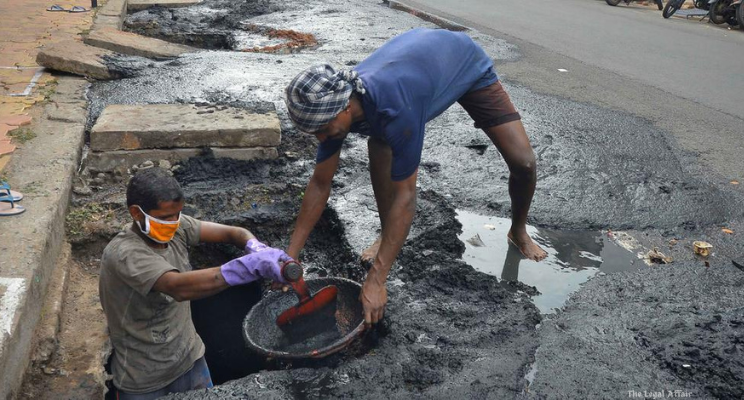
The Punjab and Haryana High Court recently addressed a significant issue concerning the practice of manual scavenging, which took place within the premises of Panjab University. The incident came to light when the court, led by Chief Justice Sheel Nagu and Justice Anil Kshetarpal, took suo moto cognizance of the matter. The practice of manual scavenging is explicitly prohibited in India under the Prohibition of Employment as Manual Scavengers and their Rehabilitation Act, 2013. The case, which highlighted the continued occurrence of this inhumane practice, saw Panjab University providing an undertaking that such an incident would not recur, and that the Supreme Court’s guidelines in Dr Balram Singh v. Union of India would be strictly followed.
Background of the Case:
The issue arose when the High Court learned of an incident of manual scavenging at Panjab University. In light of this, the court initiated suo moto proceedings to address the situation. The bench expressed grave concern over the violation of human dignity and legal norms, as manual scavenging remains a prohibited and punishable offence. During the hearing, the counsel for Panjab University assured the court that strict adherence to the guidelines issued by the Supreme Court in Dr. Balram Singh v. Union of India would be maintained.
In the Dr. Balram Singh case, the Supreme Court had, on October 20, 2023, issued a series of directions to the Union and State Governments to eradicate manual scavenging and rehabilitate those affected. The judgment, delivered by Justices S. Ravindra Bhat and Aravind Kumar, underscored the urgency of addressing this inhuman practice. Justice Bhat quoted Dr. B.R. Ambedkar, emphasizing the fight for human dignity and reclamation of personality. The directions included providing skill development programs, scholarships, and other support mechanisms for manual scavengers and their families while ensuring strict implementation of the 2013 Prohibition Act.
Arguments Presented:
The counsel for Panjab University acknowledged the occurrence of manual scavenging within the campus but assured the court that it was an isolated incident. They argued that steps had already been taken to ensure compliance with the law, and all relevant authorities and staff members were sensitized to the issue. The council emphasized that strict adherence to the Supreme Court’s judgment in Dr Balram Singh was being enforced to ensure such incidents would not recur.
Court’s Concerns:
Chief Justice Sheel Nagu, expressing indignation, questioned how an incident of manual scavenging could take place within a reputed institution despite its explicit prohibition. The bench highlighted that manual scavenging not only violates legal mandates but also demeans human dignity. The court referred to the broader implications of non-compliance with laws designed to protect vulnerable individuals and eradicate caste-based discrimination.
Supreme Court’s Guidelines in Dr. Balram Singh Case:
The Supreme Court’s judgment in Dr. Balram Singh v. Union of India provided a comprehensive roadmap for the complete eradication of manual scavenging in India. The directives included:
- Strict Enforcement of the Prohibition Act: AAll-Unionand State Governments were directed to implement the Prohibition of Employment as Manual Scavengers and their Rehabilitation Act, 2013, in letter and spirit.
- Identification of Manual Scavengers: Governments were instructed to identify all individuals engaged in manual scavenging and provide immediate support.
- Skill Development and Rehabilitation: Training programs and scholarships were to be provided to manual scavengers and their families, enabling them to secure dignified employment.
- Awareness Campaigns: Authorities were directed to conduct nationwide campaigns to raise awareness about the illegality of manual scavenging and promote labour dignity.
- Regular Monitoring: A periodic review mechanism was established to ensure the implementation of these measures.
- Punishment for Violators: Strict penalties were recommended for employers found engaging manual scavengers, ensuring accountability.
Justice Bhat’s poignant words, quoting Dr Ambedkar, underscored the moral imperative to eradicate this practice: “Ours is a battle not for wealth or power but for the reclamation of human personality.”
High Court’s Judgment:
After hearing the submissions, the Punjab and Haryana High Court disposed of the suo moto petition, taking note of Panjab University’s assurance that such incidents would not be repeated. The university undertook to strictly follow the Supreme Court’s directives and sensitize its staff and administration.
The bench acknowledged the proactive steps taken by the university post-incident but stressed the need for ongoing vigilance and adherence to legal provisions. The court reiterated that manual scavenging violates fundamental human rights and constitutional principles, calling for zero tolerance toward its recurrence.
In disposing of the case, the court reminded all concerned institutions of their obligation to uphold human dignity and ensure compliance with the Prohibition Act. The judgment serves as a wake-up call for public institutions to introspect and strengthen mechanisms for eliminating such practices.