


Introduction:
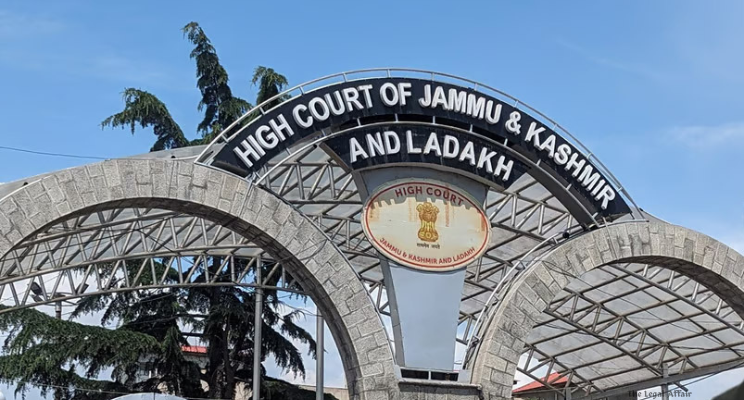
In the case titled Farooq Ahmad Lodhi Vs Union of India, 2025 LiveLaw (JKL), the High Court of Jammu & Kashmir and Ladakh reaffirmed the legal stance that individual landowners are not entitled to compensation for high-tension transmission lines passing through the aerial space over their land. This judgment was rendered by Justice Sindhu Sharma while adjudicating a writ petition filed by Farooq Ahmad Lodhi, a resident of Uri Tehsil, who alleged damage and loss due to a transmission tower and overhead line passing directly above his residential house. The petitioner contended that his property was rendered uninhabitable by the aerial infrastructure, and despite initial assurances from the authorities that compensation would be provided, he remained uncompensated. Lodhi approached the High Court under its writ jurisdiction seeking Rs. 20 lakhs as compensation for property damage, Rs. 5 lakhs for mental agony, and interest for delayed redress since 1996. The petitioner also relied on RTI documents to allege discriminatory compensation practices and claimed a violation of his constitutional rights under Articles 14 and 21 of the Constitution of India.
Arguments:
The petitioner’s primary argument revolved around the notion that the aerial intrusion over his private land constituted a compensable form of acquisition or at least a civil wrong justifying state liability. He claimed that the high-tension wires affected the habitability and market value of his property and that his right to peaceful enjoyment of property and human dignity had been impaired. Lodhi emphasised that other similarly situated individuals had been compensated under comparable circumstances, pointing to a precedent of selective compensation. He argued that such discriminatory actions violated Article 14 (equality before the law) and Article 21 (right to life and dignity), particularly when accompanied by false assurances from government officials that he would be paid for the overhead encroachment. Furthermore, the prolonged distress and legal uncertainty since 1996 were framed as an egregious delay that itself warranted interest and compensation. His plea also underscored the psychological trauma of living under high-tension lines, emphasising mental health and environmental well-being, seeking redress in monetary terms for these intangible harms.
In response, the Union of India and other respondents categorically denied any legal or factual liability. They argued that the transmission infrastructure had been laid strictly by statutory norms, technical feasibility reports, and duly approved schemes. The respondents stated that any verbal or informal assurance made to the petitioner did not equate to a legal promise or create an enforceable obligation. They further contended that the petitioner had previously approached a civil court seeking injunctive relief but had voluntarily withdrawn the suit based on conditional assurances, which did not crystallise into any legal liability. Importantly, the respondents emphasised that aerial transmission lines do not constitute acquisition of land under the law and that mere overhead passage through the sky does not result in any deprivation of legal ownership or rights. The State maintained that the aerial right of way, particularly in the context of electricity transmission, is vested with the sovereign by default and that no enforceable legal, fundamental, or constitutional right of a landowner is violated by such lawful acts. The Union also contested the factual basis of the claim that Lodhi’s house had become uninhabitable, asserting that no such damage was documented or admitted.
Judgement:
Justice Sindhu Sharma, in dismissing the petition, delivered a detailed judgment clarifying the legal status of aerial rights, sovereign infrastructure development, and the limits of writ jurisdiction in matters involving factual disputes. The Court heavily relied on the Division Bench ruling in Ranvijay Chand and another v. State of J&K and others, 2005 (1) JKJ 236, which laid down the principle that landowners cannot assert any legal, constitutional, or fundamental rights against transmission lines passing over their land. Justice Sharma quoted extensively from the precedent, affirming that the aerial right of way is a sovereign entitlement and does not give rise to a compensable interest under the existing legal framework. The Court noted that compensation is only warranted in cases of physical occupation, damage, or acquisition of land, not for mere traversal through aerial space.
The judgment also addressed the evidentiary limitations of writ proceedings under Article 226 of the Constitution. Justice Sharma observed that the petitioner’s claims—particularly the allegations regarding damage to the roof of his house, mental distress, and discriminatory treatment—necessitated a detailed factual inquiry, cross-examination, and evidentiary proof, none of which could be effectively conducted in writ jurisdiction. The Court invoked its earlier ruling in Sanjay Kumar Gupta v. State of J&K & others, reiterating that when the crux of a matter involves disputed facts or requires adjudication based on evidence, the proper forum is a civil court and not the High Court acting in its constitutional writ capacity.
On the issue of alleged discrimination and selective compensation raised by Lodhi through RTI records, the Court maintained that such claims could not be generalised or mechanically applied without a legal determination of entitlement. Merely because some individuals may have received compensation under different circumstances does not automatically confer a legal right on others unless it is shown that the factual matrix was identical and legally comparable. The Court noted that the petition failed to establish this parity and, in any case, relied upon documents that were insufficient to base a finding of discrimination under Article 14. It emphasised that policy decisions involving compensation for infrastructure projects must be grounded in objective legal norms, not on perceived parity or grievance.
The Court was also unpersuaded by the petitioner’s invocation of Article 21, stating that while the right to life includes the right to a healthy environment and dignified existence, it does not extend to an enforceable right against lawful infrastructure laid down in the public interest under statutory authority. Justice Sharma remarked that such arguments, though emotionally compelling, must pass the test of legal enforceability. The transmission line was constructed under a sanctioned scheme after technical evaluation and statutory approvals, and therefore, the petitioner’s grievance, though unfortunate, was not legally tenable.
Finally, the Court underscored the need for a rational balance between individual rights and public infrastructure needs. In a country like India, where rapid electrification and development necessitate expansion of grid connectivity even in remote and hilly areas like Uri, occasional overlap with private land and airspace is inevitable. Justice Sharma emphasised that while the rights of individuals must be respected, they cannot be allowed to obstruct or unduly burden larger public interest projects executed by law. The judgment clarified that compensation regimes are governed by statute, and courts cannot award compensation merely based on perception or individual distress unless backed by legal entitlement and evidentiary substantiation.
Given the above, the Court dismissed the writ petition filed by Farooq Ahmad Lodhi and held that he was not entitled to any compensation for the aerial passage of high-tension wires over his property. However, the Court left open the possibility for the petitioner to approach an appropriate civil forum if he believed actual physical damage was caused to his property and was willing to substantiate it through admissible evidence.