


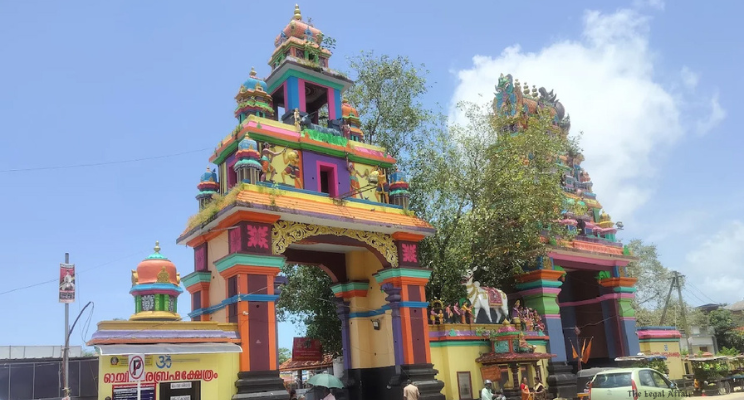
Introduction:
In the case Syamlal v. State of Kerala and Others, WP(C) No. 5853 of 2025, decided on 14 May 2025 by the Kerala High Court and reported as 2025 LiveLaw (Ker) 274, the petitioner, Syamlal, a devotee of the Oachira Parabrahma Temple, filed a writ petition under Article 226 of the Constitution seeking a direction for the Travancore Devaswom Board (TDB) to assume control and administration of the said temple. The temple, a significant spiritual centre in Kerala, is currently governed by the Oachira Parabrahma Trust. The petitioner contended that the continued management by the Trust was not in the best interests of the devotees and that the TDB, being a statutory authority overseeing temple management across the region, was better suited to administer the affairs of the temple. Citing public interest, he requested the Court to issue a writ of mandamus directing the Devaswom Board to intervene, inspect financial records, and take over temple operations. He also sought to quash a public notice issued by the Court-appointed Administrator concerning the initial steps for conducting elections to the Pothu Bharana Samithi—the temple’s executive administrative body.
The background of the case reveals a detailed legal journey. Earlier, a civil suit was filed before the Additional District Court – I, Kollam, for framing a comprehensive scheme for temple administration. In response, a preliminary decree was issued, directing the parties to submit a draft scheme within three months. The decree explicitly stated that until such a scheme is formulated, the administration would continue under the current by-laws. This preliminary decree was previously challenged before the High Court, which dismissed the appeal, thereby affirming the lower court’s directions. Further legal developments saw a petition reaching the Supreme Court via a special leave petition, seeking the appointment of an Administrator to oversee the election process for the Pothu Bharana Samithi. The Supreme Court concurred with the necessity of external oversight for a fair election and directed the High Court to appoint an Administrator. In compliance, the Kerala High Court appointed a retired judge to serve as the Administrative Head. This Administrator later issued a notice outlining the preliminary steps for conducting elections, which became the subject of the instant writ petition.
Arguments:
The petitioner argued that the existing Trust’s administration lacked transparency and that there was a legitimate need for statutory oversight by the TDB to restore public faith in the temple’s operations. Citing his fundamental right to worship and his role as a devotee, the petitioner maintained that the State has a constitutional obligation to ensure proper administration of public religious institutions. He further claimed that the notice issued by the Administrator regarding the election process was arbitrary and premature, particularly in the absence of a formal scheme sanctioned by a court.
Opposing the petition, the State, represented by Senior Government Pleader S. Rajmohan and TDB Standing Counsel G. Santhosh Kumar, contended that the petitioner’s claims were legally untenable. They argued that the current administrative framework had judicial backing and that the preliminary decree of the District Court—validating the continued management under existing by-laws—remained unchallenged and binding. The respondents emphasised that the High Court had previously declined to interfere with the District Court’s decree and that the petitioner was essentially seeking to re-agitate matters already decided. Additionally, it was contended that the notice by the Administrator was under the directions of the Supreme Court and the High Court, and therefore, not subject to judicial review under Article 226 of the Constitution.
Judgement:
Upon hearing both sides and perusing the material on record, the Division Bench comprising Chief Justice DK Upadhyaya and Justice Tushar Rao Gedela held that the writ petition lacked merit. The Court observed that the Civil Court had unequivocally held that the temple would continue to function under existing by-laws until a formal scheme was framed. The High Court had already affirmed this position in earlier proceedings. As such, the petitioner could not now seek a writ of mandamus under Article 226 to compel the Devaswom Board to intervene in the temple’s administration, particularly in disregard of prior judicial pronouncements. The Court remarked that to entertain such a writ would be contrary to the principles of judicial discipline and would allow litigants to bypass the rigour of civil litigation.
Regarding the notice issued by the Administrator, the Bench noted that the Administrator had been appointed under a specific direction from the Supreme Court, and was acting within the scope of the mandate given by both the apex court and the High Court. The petitioner’s plea to quash the notice was thus deemed impermissible. The Court emphasised that Article 226 jurisdiction could not be invoked to interfere with actions that were part of a lawful judicial mandate, particularly when such actions were part of an ongoing effort to reform and democratize temple administration through an election process.
In conclusion, the High Court dismissed the writ petition, reinforcing the established legal position that judicially sanctioned administrative arrangements cannot be circumvented by invoking writ jurisdiction. The Court’s decision upholds the principles of judicial consistency, legal finality, and due process.