


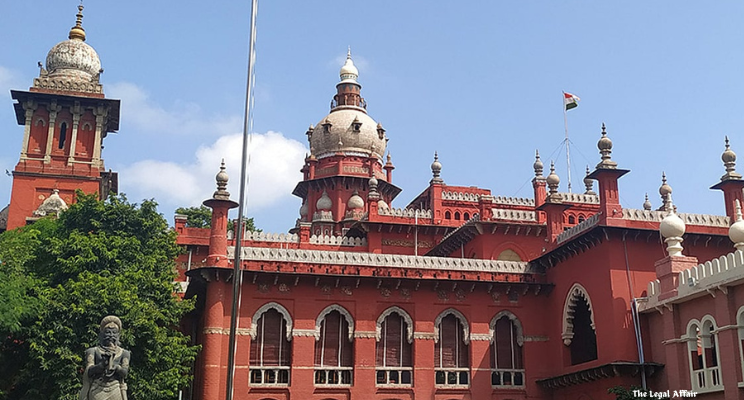
Introduction:
In the case of K V Venugopal v. Secretary to Government of Tamil Nadu, W.P.No.15257 of 2025, reported as 2025 LiveLaw (Mad) 169, the Madras High Court, presided over by Justice Bharatha Chakravarthy, delivered a landmark judgment that reaffirmed the principle that no caste can claim exclusive rights over the administration of temples. The Court emphatically rejected a writ petition that sought to restrict the appointment of trustees for the Karaneeswarar Koil in Saidapet, Chennai, to members of the Sengunthar community. This case marks a crucial reiteration of constitutional values of equality, non-discrimination, and secularism. The petitioner, the Secretary of Karani Gramam Sengundar Sangam, challenged a notification issued by the Joint Commissioner of the Hindu Religious and Charitable Endowments (HR & CE) Department, which invited applications from the general public for the post of trustees, rather than restricting it to a specific caste as allegedly done in an earlier 2022 notification. The court not only dismissed the writ petition but also took the opportunity to reinforce the idea that caste-based preferences in religious appointments are unconstitutional and violative of public policy. The judgment is a blend of constitutional reasoning, moral clarity, and philosophical reflections, quoting Swami Vivekananda and Dr. B.R. Ambedkar to drive home the idea that caste has no place in the realm of divinity.
Arguments of the Petitioner:
The petitioner, represented by Mr. L. Dhamodharan, contended that the Karaneeswarar Temple at Saidapet has traditionally been associated with the Sengunthar community and that its management, particularly the post of trustees, has been historically vested in members of this community. The petitioner claimed that the present notification issued by the HR & CE Department, which allows applications from the general public, deviates from the customary practice upheld in the previous 2022 notification where only members of the Sengunthar community were considered eligible. The petition sought the issuance of a fresh notification restricting the eligibility for the trustee position solely to members of the Sengunthar caste. Emphasizing on the purported customary rights and historical involvement of the community in temple affairs, the petitioner asserted that the deviation from community-based selection infringes on their traditional and religious rights. The petitioner further argued that the inclusion of persons from outside the Sengunthar community would dilute the temple’s cultural and communal identity and was against the very ethos of its foundation. According to them, this would also pave the way for administrative inefficiencies and deviations from long-standing religious practices associated with the temple, thereby disrupting its sanctity. The petitioner relied on customary law principles, which, according to him, recognized community-specific administration in religious institutions, particularly in Tamil Nadu where certain temples have been historically managed by specific castes or sects.
Arguments of the Respondents:
The respondents, represented by Mr. K. Karthikeyan, Government Advocate, opposed the plea on the grounds of constitutional validity and the statutory framework governing temple administration in Tamil Nadu. The HR & CE Department, through its counsel, argued that the present notification did not violate any legal or religious norm but instead conformed with constitutional mandates of equality, non-discrimination, and inclusive governance. The Government submitted that the earlier notification of 2022, which allegedly restricted applications to a specific caste, was not binding and did not confer any right to claim caste-based reservation or monopoly in temple administration. The respondents emphasized that the management of public religious institutions cannot be caste-exclusive and must be conducted in accordance with constitutional principles and the Tamil Nadu Hindu Religious and Charitable Endowments Act. The respondents also cited previous judgments of the Madras High Court and the Supreme Court, asserting that no caste or community can claim exclusive rights to manage a temple unless it qualifies as a religious denomination under Article 26 of the Constitution, which was not the case here. Furthermore, the Government stressed that temples are public institutions that belong to the entire Hindu community and cannot be privatized or monopolized by any single group. It was argued that allowing such claims would not only undermine the rule of law but also perpetuate caste-based divisions, which is antithetical to both the spirit of the Constitution and the teachings of Indian philosophers and reformers. The Government also pointed out that there were no credible documents or legal provisions granting the Sengunthar community an exclusive right to administer the Karaneeswarar Temple.
Court’s Judgment:
Justice Bharatha Chakravarthy, delivering the judgment, dismissed the writ petition with firm constitutional reasoning and a deep moral undertone. The court categorically rejected the petitioner’s plea to restrict the appointment of temple trustees to a particular caste, stating that such a request was not only unconstitutional but also against public policy. Quoting a previous judgment delivered by him earlier in the year, the judge reiterated that any prayer that seeks to perpetuate caste-based distinctions in religious or public life is inherently violative of the equality clauses enshrined in the Constitution. The Court declared that “before God, all persons are human beings and therefore, there cannot be any discrimination based on caste.” This assertion formed the ethical backbone of the judgment and set the tone for the broader jurisprudential stance taken by the Court.
Justice Chakravarthy further drew inspiration from the philosophical insights of Swami Vivekananda, who stated that the soul has neither caste nor sex nor imperfection, and from Dr. B.R. Ambedkar, who famously said that caste exists only in the mind and has no physical existence. These reflections were used not merely as rhetorical flourishes but as normative affirmations that religious practice and administration must transcend social stratification. The court emphasized that temples are public religious institutions meant for the benefit of all Hindus and must therefore be managed in an inclusive, secular, and constitutionally compliant manner. The judge noted that caste is not a religious denomination and no caste can claim the exclusive right to administer a temple, citing various precedents from the Madras High Court and the Supreme Court.
The court observed that public interest and constitutional morality must prevail over caste-based customary claims, particularly when such claims are devoid of legal sanctity. Justice Chakravarthy highlighted that even if there existed a historical precedent of a community managing a temple, such a practice could not be given legal backing if it infringes upon the rights of others or violates constitutional principles. The court also referred to the Tamil Nadu HR & CE Act, which provides the government the power to oversee temple management and make appointments to ensure transparency and accountability.
Justice Chakravarthy firmly stated that in a secular republic like India, the administration of religious institutions must be regulated by constitutional norms rather than by caste-based identities or historical monopolies. He lamented the fact that, despite decades of social reform and legal progress, certain individuals continued to approach courts with prayers rooted in casteism. The judgment was a strong affirmation that caste-based discrimination, even in the garb of tradition or community rights, cannot find place in a modern constitutional democracy. Accordingly, the writ petition was dismissed, and the impugned notification issued by the HR & CE Department, inviting applications from the general public for the post of temple trustees, was upheld as valid and legal.