


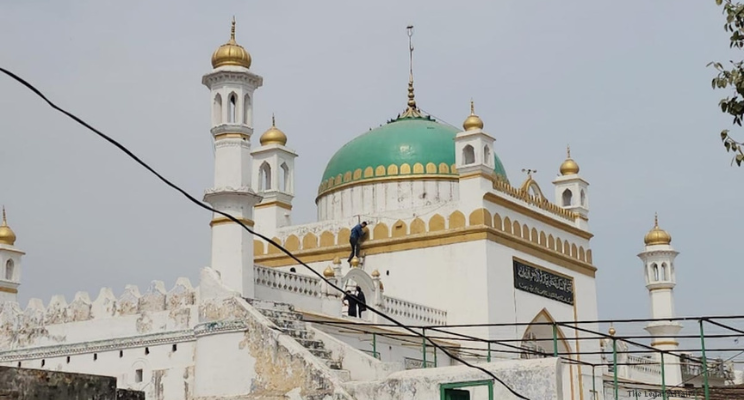
Introduction:
In the case concerning the Shahi Jama Masjid in Sambhal, Uttar Pradesh, the Allahabad High Court, presided over by Justice Rohit Ranjan Agarwal, delivered a significant judgment on May 19, 2025. The court rejected the Mosque Committee’s plea challenging the trial court’s November 19, 2024, order that directed an Advocate Commissioner to survey the mosque premises. This decision came in the backdrop of a suit filed by eight Hindu plaintiffs, including Mahant Rishiraj Giri, who claimed that the mosque was constructed in 1526 after demolishing an ancient Hindu temple dedicated to Kalki, the last avatar of Lord Vishnu. The plaintiffs, represented by Advocates Hari Shankar Jain and Vishnu Shankar Jain, asserted their right to access the mosque, arguing that it was originally the site of the Harihar Temple. The court’s ruling emphasised that the Hindu plaintiffs’ suit was prima facie maintainable and not barred by any law, thereby allowing the survey to proceed. The Archaeological Survey of India (ASI) also submitted that the ‘Juma Mosque’ is a Centrally Protected Monument under the Ancient Monuments and Archaeological Sites and Remains Act, 1958, and that official records do not describe the mosque as a religious place. The ASI further argued that there is no historical, archaeological, or revenue evidence supporting the term ‘Shahi Masjid.’ This judgment paves the way for the continuation of the legal process in the district court, amidst heightened sensitivities surrounding religious sites in India.
Arguments of the Petitioners:
The Mosque Committee, representing the Shahi Jama Masjid, contended that the trial court’s order to conduct a survey was passed hastily and without issuing prior notice to them. They argued that the suit was filed at noon on November 19, 2024, and within hours, the judge appointed an Advocate Commissioner to carry out an initial survey at the mosque, which was conducted on the same day and again on November 24, 2024. The committee alleged that this rapid progression violated principles of natural justice and due process. They also highlighted that the mosque is a Centrally Protected Monument under the AMASR Act, and any survey or intervention should be by the provisions of this Act. The committee emphasised that the mosque has been a place of worship for centuries and that the sudden initiation of a survey based on unverified claims could disrupt communal harmony. They further argued that the plaintiffs’ claims were based on historical conjecture without substantive evidence, and that the court should not entertain such suits that could potentially inflame religious sentiments.
Arguments of the Respondents:
The Hindu plaintiffs, represented by Advocates Hari Shankar Jain and Vishnu Shankar Jain, argued that the Shahi Jama Masjid was constructed in 1526 after demolishing the ancient Harihar Temple dedicated to Lord Kalki. They claimed that historical records, including accounts from the Mughal era, support the existence of the temple at the site before the construction of the mosque. The plaintiffs asserted their right to access the mosque, contending that it was originally a Hindu place of worship. They emphasised that the survey ordered by the trial court was essential to ascertain the historical and archaeological facts surrounding the site. The plaintiffs also pointed out that the ASI, in its submission, stated that the ‘Juma Mosque’ is a Centrally Protected Monument and that official records do not describe it as a religious place. They argued that the survey would provide clarity on the historical claims and help in the just adjudication of the matter. The plaintiffs maintained that their suit was maintainable and not barred by any law, and that the survey was a necessary step in the legal process.
Court’s Judgment:
Justice Rohit Ranjan Agarwal, delivering the judgment, upheld the trial court’s order directing a survey of the Shahi Jama Masjid premises. The High Court rejected the Mosque Committee’s plea, stating that the appointment of the Advocate Commissioner and the conduct of the survey were conducted by legal procedures. The court emphasised that the Hindu plaintiffs’ suit was prima facie maintainable and not barred by any law, thereby allowing the legal process to continue in the district court. The judgment noted that the survey was a preliminary step to ascertain the facts of the case and did not, in itself, determine the rights of the parties involved. The court also took into account the ASI’s submission that the ‘Juma Mosque’ is a Centrally Protected Monument and that official records do not describe it as a religious place. The ASI further stated that there is no historical, archaeological, or revenue evidence supporting the term ‘Shahi Masjid.’ The court’s decision paves the way for the continuation of the survey and the legal proceedings in the district court, amidst heightened sensitivities surrounding religious sites in India.