


Introduction:
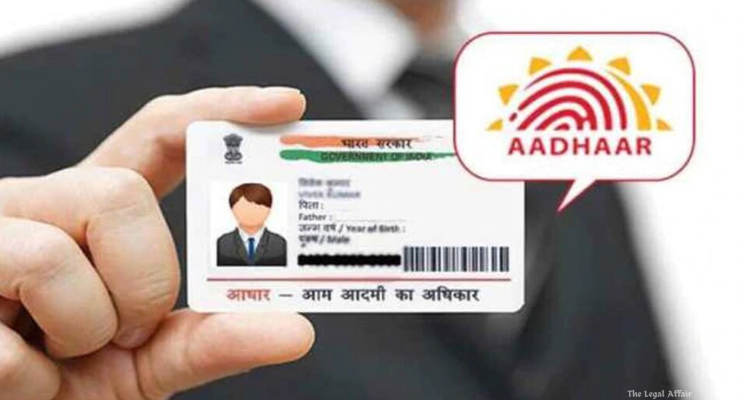
In a significant judgment, the Madhya Pradesh High Court has underscored that an Aadhaar card cannot be relied upon as conclusive proof of age, emphasizing that it serves only as an identity document. The court’s decision came in response to a plea filed by Sunita Bai Sahu, a widow seeking financial assistance under the Mukhyamantri Jan Kalyan (Sambal) Yojna, 2018, a state welfare scheme. Her claim for benefits was denied based on official records indicating her deceased husband’s age exceeded the eligibility limit. She argued that his Aadhaar card should be used to determine his age, which would make her eligible for the scheme. Citing a Supreme Court ruling and government circulars, the High Court reaffirmed that the Aadhaar card does not qualify as a valid document to prove age.
Justice G.S. Ahluwalia referred to the Supreme Court’s judgment in Saroj & Others vs. IFFCO TOKIO General Insurance Co. (2024), which ruled that Aadhaar cannot be used as age verification. The court emphasized that relying on Aadhaar for age determination would contradict its legal standing and purpose. This judgment has called for clarification across the state, mandating that Aadhaar be recognized solely as a tool for identity verification.
Arguments Presented:
Petitioner’s Arguments:
- Aadhaar Card as Proof of Age:
The petitioner, Sunita Bai Sahu, applied for the benefits under the Mukhyamantri Jan Kalyan (Sambal) Yojna, which offers financial aid to families of labourers who pass away due to unforeseen events like accidents. However, her claim was denied because her husband’s recorded age exceeded the scheme’s maximum eligibility of 64 years. Sunita argued that her husband’s Aadhaar card indicated a younger age, which should be accepted as proof, allowing her access to the scheme’s benefits.
- Inconsistency in Document Use:
Sunita pointed out the apparent inconsistency between official records and the Aadhaar card’s information, contending that reliance on Aadhaar as proof of identity in various schemes should extend to verifying age. She argued that denying this recognition created confusion, as government officials and authorities often accept Aadhaar for multiple identification purposes, which should logically include age verification for benefit eligibility.
- Right to Welfare Benefits:
The petitioner argued that rejecting the Aadhaar card as age proof directly impacted her access to state welfare, denying her basic support intended for families in need. Her plea emphasized that Aadhaar’s information should be used to simplify verification procedures, especially for the most vulnerable members of society seeking assistance from government schemes.
Respondent’s Arguments:
- Legal Limitations of Aadhaar as Age Proof:
The respondent, representing the State of Madhya Pradesh, contended that the Aadhaar card’s primary purpose is identity verification, not age determination. Referring to the Supreme Court’s ruling in Saroj & Others vs. IFFCO TOKIO General Insurance Co., the state argued that Aadhaar does not meet the standards for age documentation and that relying on it would conflict with the card’s intended use and legal status.
- Supreme Court and UIDAI Guidelines:
The respondent emphasized that Supreme Court judgments and UIDAI (Unique Identification Authority of India) guidelines have clarified that the Aadhaar card is an identification document, not a substitute for date-of-birth proof. They cited a UIDAI circular (No. 08/2023), which categorically stated that Aadhaar should not be used as proof of age or date of birth, but solely as identity verification. This distinction, they argued, prohibits the use of Aadhaar as definitive age proof in welfare scheme applications.
- Official Records and Consistency with Scheme Policy:
The state defended its decision by asserting that official records, not Aadhaar, should be the standard for verifying the age of individuals seeking state benefits. The Mukhyamantri Jan Kalyan (Sambal) Yojna’s age restriction is explicitly based on these official records, and adopting Aadhaar as age-proof would lead to policy inconsistencies and potential misuse. By adhering to standard documents for age verification, the government argued that it upholds transparency and accountability in welfare distribution.
Court’s Judgement:
After careful consideration, Justice G.S. Ahluwalia dismissed the petition, ruling that the Aadhaar card does not constitute valid proof of age and that state and central authorities should recognize it only as an identity document. The judgment further instructed the state government to issue notices to all relevant authorities to prevent Aadhaar from being used as age documentation. Here is a breakdown of the Court’s rationale:
- Supreme Court Precedent on Aadhaar Usage:
The Court cited the Supreme Court’s ruling in Saroj & Others vs. IFFCO TOKIO General Insurance Co. (2024), which explicitly stated that Aadhaar is not meant to establish age. This precedent made it clear that neither the petitioner nor the government could rely on Aadhaar for age verification, as the ruling from the Supreme Court is binding on all judicial and administrative authorities within the country.
- UIDAI Clarifications on Aadhaar’s Purpose:
The Court referred to the UIDAI circular No. 08/2023, which explicitly categorizes Aadhaar as a document for identity verification only, not as a substitute for age proof. This guidance further reinforced the decision to restrict Aadhaar’s application in verifying age, as using it beyond its intended scope would undermine the UIDAI’s regulatory framework.
- Rejection of Aadhaar in Scheme Eligibility Criteria:
Justice Ahluwalia’s ruling observed that allowing Aadhaar to serve as age-proof in welfare schemes would conflict with Sambal Yojna’s specified criteria. Since the scheme is designed with precise eligibility requirements based on official age records, permitting Aadhaar for age determination would potentially disrupt the program’s structure and undermine the reliability of its criteria.
- Instructions for Wider Circulation:
To ensure consistency and avoid ambiguity, the Court ordered that copies of the judgment be circulated across government offices within Madhya Pradesh, instructing that Aadhaar should not be used for age verification. The Chief Secretary of the state was directed to inform all departments and ensure compliance with the judgment to maintain uniformity across administrative practices.
- Petitioner’s Appeal Dismissed:
The Court dismissed the petitioner’s appeal, reaffirming that official records determine the age for welfare scheme eligibility. The ruling further stated that even if the petitioner sought an appeal before the Sub-Divisional Officer (SDO), any adjudicating authority in Madhya Pradesh would be bound by this decision, making further appeals unnecessary.
Conclusion:
This ruling by the Madhya Pradesh High Court reinforces the legal and administrative boundaries of Aadhaar’s functionality, reiterating its role as a document for identity verification only. By affirming the limits of Aadhaar’s applicability, particularly concerning age verification, the judgment aligns with Supreme Court precedent and UIDAI guidelines. The case also brings clarity to welfare scheme applicants, ensuring they rely on standard official records for age proof to avoid potential disputes.
For state authorities, the judgment highlights the importance of clarity and consistency in applying Aadhaar, setting a standard that may influence similar rulings in other states. The decision reflects a balance between simplifying identification processes through Aadhaar and upholding structured eligibility criteria within government welfare schemes.