


Introduction:
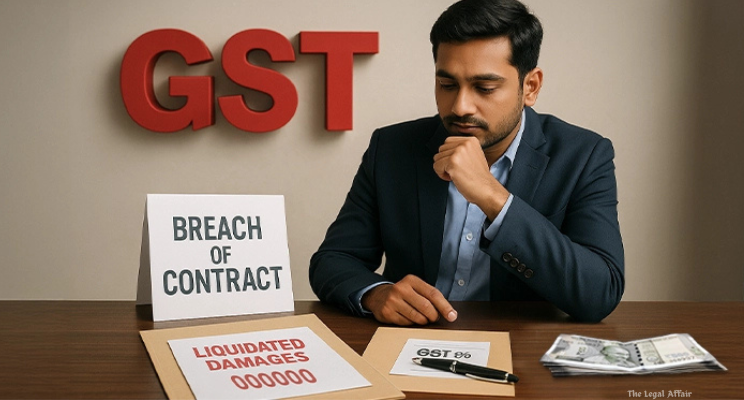
In M/s Krazybee Services Pvt. Ltd. v. Additional Director, DGGI, BZU [WRIT PETITION NO. 16471 OF 2024 (T-RES)], the Karnataka High Court examined an important and recurring issue under the Goods and Services Tax (GST) regime—whether liquidated damages recovered for breach or delay in contractual obligations can be treated as “consideration” for a supply and thereby subjected to GST. The case was decided by Justice S.R. Krishna Kumar, who carefully analysed the statutory framework of the CGST Act, the nature of liquidated damages under contract law, and the binding clarifications issued by the Central Board of Indirect Taxes and Customs (CBIC) through Circular No. 178/10/2022 dated 03.08.2022. The petitioner, M/s Krazybee Services Pvt. Ltd., a non-banking financial company (NBFC), had entered into a Master Service Agreement with Finnovation Tech Solutions Private Limited, a Lending Service Provider (LSP). Under the agreement, any breach or delay by the LSP entitled the petitioner to recover liquidated damages. Despite the clear contractual and legal position, the GST department issued a show cause notice proposing to levy GST on such liquidated damages, treating them as taxable consideration for supply. Challenging this action, the petitioner approached the High Court, contending that liquidated damages are compensatory in nature and fall outside the scope of GST. The judgment is significant as it reiterates the compensatory character of liquidated damages and reinforces the binding nature of CBIC circulars on the tax authorities.
Factual Background:
The petitioner, M/s Krazybee Services Pvt. Ltd., is engaged in the business of providing financial services and operates as a non-banking financial company. In the course of its business, it entered into a Master Service Agreement with Finnovation Tech Solutions Private Limited, which acted as a Lending Service Provider. Under the agreement, the LSP was obligated to perform certain contractual duties within stipulated timelines and in accordance with agreed standards. The agreement specifically provided that in the event of breach, delay, or non-performance by the LSP, the petitioner would be entitled to recover liquidated damages as compensation for the loss suffered. Such liquidated damages were pre-estimated amounts agreed upon by the parties to avoid future disputes regarding quantification of loss.
During the relevant period, the petitioner recovered certain amounts from the LSP by invoking the liquidated damages clause. Subsequently, the Directorate General of GST Intelligence (DGGI) issued a show cause notice to the petitioner, alleging that the amounts received as liquidated damages were liable to GST. The department asserted that these receipts constituted consideration for tolerating an act or situation, or for refraining from an act, which according to them amounted to a “supply” under the CGST Act. It was also alleged that the petitioner had entered into similar transactions with other entities such as M/s IIFL, M/s PayU Finance India Pvt. Ltd., and M/s MAS Financial Services Pvt. Ltd., where GST was charged under different nomenclatures, and therefore the petitioner could not adopt two different tax treatments for similar transactions. Aggrieved by this demand, the petitioner challenged the show cause notice before the Karnataka High Court.
Issues for Consideration:
The principal issues that arose for consideration before the High Court were whether liquidated damages recovered for breach or delay in contractual obligations can be treated as consideration for supply under the CGST Act, whether such liquidated damages are taxable under GST in view of Circular No. 178/10/2022 dated 03.08.2022, and whether the department was justified in issuing the impugned show cause notice demanding GST on such compensatory payments.
Arguments on Behalf of the Petitioner:
The petitioner contended that the amounts recovered from the LSP were purely in the nature of liquidated damages arising out of breach of contract and were compensatory in character. It was argued that liquidated damages are paid to compensate the aggrieved party for loss or damage suffered due to non-performance or delay and do not involve any element of quid pro quo. Therefore, such payments cannot be construed as consideration for any supply under Section 7 of the CGST Act.
Strong reliance was placed on Circular No. 178/10/2022 dated 03.08.2022, particularly Paragraphs 7.1 to 7.1.6, which categorically clarify that compensation received for breach of contract, including liquidated damages, is not taxable under GST. The circular explains that such payments are covered under Sections 73 and 74 of the Indian Contract Act, 1872, and are meant to make good the loss suffered by the aggrieved party rather than to provide any service to the defaulting party. The petitioner emphasized that the circular is binding on the tax authorities and that the department could not ignore its clear mandate.
The petitioner further submitted that merely because there were other transactions between the petitioner and other LSPs where GST was charged under different heads, the same could not be used as a basis to fasten tax liability on liquidated damages, especially when the circular specifically excludes such receipts from the ambit of GST. It was also argued that the show cause notice was issued mechanically without proper appreciation of the contractual terms and the binding clarifications issued by the CBIC, and therefore deserved to be quashed.
Arguments on Behalf of the Respondent Department:
The respondent department sought to justify the issuance of the show cause notice by contending that the petitioner had effectively tolerated the breach or delay committed by the LSP and had received monetary consideration for such tolerance. According to the department, such tolerance amounted to a supply of service under GST, making the liquidated damages taxable. The department further argued that in similar transactions with other entities, GST was charged by the petitioner, and therefore adopting a different tax treatment for the present transaction amounted to tax evasion.
The department relied on the general provisions of the CGST Act and certain portions of the CBIC circular, particularly the generic discussion on taxable supplies involving agreement to tolerate an act. It was contended that the nomenclature used in the contract should not determine taxability and that the substance of the transaction should be examined to ascertain whether there was a supply for consideration.
Court’s Analysis and Reasoning:
Justice S.R. Krishna Kumar undertook a detailed examination of the contractual framework, the statutory provisions under the CGST Act, and the CBIC circular dated 03.08.2022. The Court first analysed the nature of liquidated damages under contract law and observed that such damages are pre-estimated compensation agreed upon by the parties at the time of entering into the contract to address potential losses arising from breach or delay. The Court emphasized that liquidated damages are compensatory and restitutive in nature and are not intended to provide any benefit or service to the defaulting party.
The Court then turned to the CBIC Circular No. 178/10/2022 and noted that Paragraphs 7.1 to 7.1.6 specifically deal with compensation received for breach of contract and clearly state that such compensation is not taxable under GST. The Court observed that while Paragraphs 6 and 7 of the circular are generic, Paragraphs 7.1 to 7.1.6 are specific and directly applicable to the facts of the present case. The Court held that when a circular contains both general and specific provisions, the specific provisions must prevail in cases falling within their scope.
The Court rejected the department’s argument that the petitioner had tolerated the breach in return for consideration. It held that tolerance of breach is not a service but a legal consequence arising from the failure of one party to perform its contractual obligations. The Court clarified that there is a fundamental distinction between a contractual arrangement where one party agrees in advance to tolerate an act for consideration and a situation where compensation is paid as a consequence of breach. In the latter case, there is no voluntary or reciprocal arrangement to supply a service.
Addressing the department’s contention regarding similar transactions with other entities, the Court held that the existence of other taxable transactions cannot be a ground to tax non-taxable receipts, particularly when the law and the circular expressly exclude such receipts from the ambit of GST. The Court reiterated that tax liability must be determined strictly in accordance with statutory provisions and binding clarifications, and not on the basis of perceived inconsistencies in accounting or nomenclature.
Court’s Judgment:
After a comprehensive analysis, the Karnataka High Court held that the liquidated damages recovered by the petitioner from its Lending Service Providers were compensatory in nature and did not constitute consideration for any supply under the CGST Act. The Court held that such receipts are squarely covered by Paragraphs 7.1 to 7.1.6 of Circular No. 178/10/2022 dated 03.08.2022 and therefore fall outside the purview of GST. The Court further held that the show cause notice issued by the department was unsustainable in law and deserved to be quashed.
Accordingly, the writ petition was allowed, and the impugned show cause notice demanding GST on liquidated damages was set aside. The judgment reaffirmed the principle that compensatory payments arising from breach of contract cannot be artificially treated as taxable supplies and that binding circulars issued by the CBIC must be scrupulously followed by the tax authorities.