


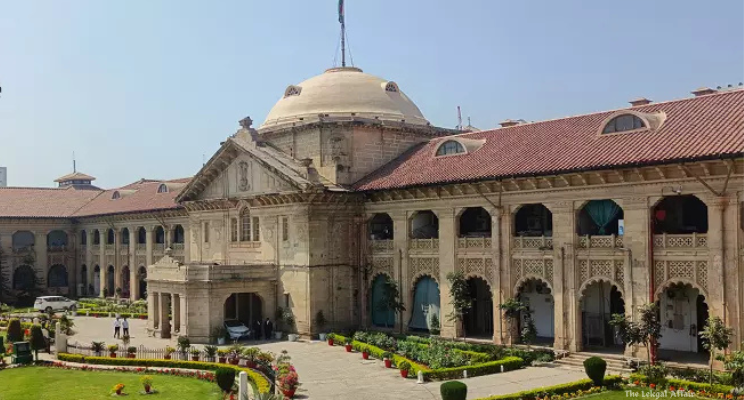
Introduction:
In a strong reaffirmation of the principle that the State does not enjoy any special privilege when it comes to procedural discipline, the Allahabad High Court dismissed a review petition filed after an extraordinary delay of 5,743 days, holding that government departments are bound by the same standards of diligence and accountability as private litigants. The judgment was delivered by a Division Bench comprising Justice Neeraj Tiwari and Justice Vivek Kumar Singh in Civil Misc. Review Application (Defective) No. 99 of 2025, titled State of Uttar Pradesh and Another v. Mohan Lal.
The review petition arose out of proceedings under the Urban Land (Ceiling and Regulation) Repeal Act, 1999, in which the original judgment had been passed on 13 November 2009. The State sought to explain the inordinate delay by contending that it had pursued a Special Leave Petition (SLP) before the Supreme Court, which itself was dismissed on 3 May 2024 on the ground of delay as well as on merits. Even after dismissal of the SLP, there was a further delay of approximately 489 days in approaching the High Court for review.
The Court categorically rejected the explanation offered by the State, observing that bureaucratic red tape, file movement, and internal correspondence cannot constitute “sufficient cause” for condonation of such gross delay. Emphasising that condonation of delay is an exception and not a vested right, the Court held that the law treats the government and private parties alike and that undue indulgence to the State would undermine the rule of law and procedural certainty.
Arguments on Behalf of the State:
The State of Uttar Pradesh, seeking condonation of a delay of 5,743 days, argued that the delay was neither deliberate nor intentional but was occasioned due to procedural and administrative reasons inherent in governmental functioning. It was submitted that after the judgment dated 13 November 2009 was passed under the Urban Land (Ceiling and Regulation) Repeal Act, the matter was examined at various administrative levels, following which a decision was taken to challenge the judgment before the Supreme Court by filing a Special Leave Petition.
The State pleaded that the SLP was eventually filed, though with a substantial delay, and came to be dismissed by the Supreme Court on 3 May 2024, both on the ground of delay of 1,633 days and on merits. It was contended that only after the dismissal of the SLP did the State take steps to initiate review proceedings before the High Court. The delay post-SLP dismissal, amounting to around 489 days, was sought to be explained on the basis of time consumed in obtaining certified copies, collecting records from the advocates who had appeared before the Supreme Court, internal communications between departments, preparation of proposals, and issuance of instructions to counsel.
The State urged the Court to adopt a liberal approach while considering applications for condonation of delay filed by government bodies, submitting that unlike private litigants, governmental decisions involve multiple layers of scrutiny, approvals, and procedural formalities. It was argued that the delay was attributable to systemic constraints rather than negligence or mala fides and that refusal to condone the delay would result in grave prejudice to public interest.
Relying on the general principle that matters should be decided on merits rather than being thrown out on technicalities, the State sought indulgence of the Court, contending that substantial justice should prevail over procedural rigour.
Arguments on Behalf of the Respondent:
Opposing the application, the respondent argued that the delay of 5,743 days, amounting to nearly 16 years, was ex facie unconscionable and demonstrated complete apathy and negligence on the part of the State. It was submitted that the explanation offered was vague, mechanical, and entirely unsatisfactory, failing to disclose any concrete or compelling reason that could be construed as “sufficient cause” under law.
The respondent contended that the State could not seek to justify such an enormous delay by relying on internal administrative processes, file movement, or bureaucratic procedures, which are routine aspects of governance. It was argued that if such explanations were accepted, the limitation law would become meaningless insofar as government litigation is concerned.
It was further submitted that even after the dismissal of the SLP by the Supreme Court on both delay and merits, the State remained inactive for another 489 days, which clearly reflected a casual and negligent approach. The respondent emphasised that the State had already exhausted its remedy before the Supreme Court and that the review petition was an abuse of process intended to prolong settled litigation.
Reliance was placed on multiple judgments of the Supreme Court which categorically hold that government departments cannot claim a different yardstick for condonation of delay and that negligence, inaction, or lack of bona fides cannot be masked under the guise of administrative inefficiency. The respondent thus prayed for dismissal of the review petition at the threshold.
Court’s Judgment and Reasoning:
After considering the rival submissions and examining the material on record, the Allahabad High Court dismissed the review petition, holding that the State had failed to demonstrate any sufficient cause for condonation of the extraordinary delay. The Court made it clear that condonation of delay is an exception and not an anticipated benefit, particularly for government departments.
The Bench observed that government agencies are under a special obligation to act with diligence and commitment, given that they function using public resources and are expected to uphold the rule of law. The Court emphatically rejected the notion that the State should be treated leniently merely because of its bureaucratic structure, holding that the law “shelters everyone under the same light” and cannot be twisted to favour the government.
The Court noted that the explanation offered by the State revolved around routine administrative steps such as sending proposals, issuing communications to lawyers, retrieving records from Supreme Court counsel, and navigating internal bureaucratic mechanisms. These reasons, the Court held, do not constitute sufficient cause, particularly when the delay runs into several years.
Relying on authoritative precedents of the Supreme Court, including Union of India v. Central Tibetan Schools Administration, State of Madhya Pradesh v. Bherulal, Union of India v. Jahangir Byramji Jeejeebhoy, and Majji Sannemma v. Reddy Sridevi, the Court reiterated that the expression “sufficient cause” cannot be liberally interpreted where negligence, inaction, or lack of bona fides is clearly attributable to the applicant.
The Bench further observed that it hardly matters whether the litigant is a private individual, the State, or the Union of India when it comes to condoning gross delays of several years. Accepting the State’s plea would effectively grant it a perpetual licence to ignore limitation periods by taking shelter behind slow-moving administrative machinery.
The Court was particularly critical of the State’s conduct even after dismissal of the SLP by the Supreme Court, noting that no satisfactory explanation was offered for the additional delay of 489 days. This, according to the Court, reflected a casual and negligent attitude, wholly incompatible with the standards expected from a responsible litigant.
Holding that the State had failed to cross the threshold requirement for condonation of delay, the Court dismissed the review petition, thereby bringing finality to the litigation.