


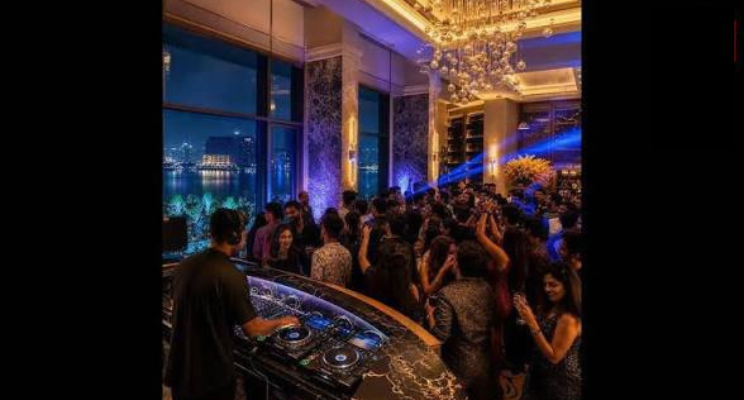
Introduction:
The Kerala High Court has observed that the police cannot treat DJ parties as events inherently associated with drug consumption and that law-enforcement action must not be founded on stereotypes, assumptions or generalisations. Emphasising the distinction between legitimate preventive policing and arbitrary restrictions on individual freedoms, the Court remarked that there is a fine line between policing and what it described as a “Police Raj”.
A Division Bench comprising Justice Devan Ramachandran and Justice Basant Balaji made these significant oral observations while considering an appeal preferred by the Kerala Government against a Single Judge’s decision setting aside police notices restricting the operation of the Kochi Radisson Blu hotel beyond midnight and curtailing the conduct of DJ parties after 11 PM.
The dispute raised important questions concerning the extent of police powers to regulate entertainment activities, the prevention of drug-related offences, and the limits imposed by constitutional freedoms. At the centre of the controversy was whether the police could impose restrictions on DJ parties and hotel operations based on apprehensions that such gatherings might become venues for the consumption or circulation of prohibited substances.
The Single Bench had earlier set aside the police notices that restricted the hotel’s operating hours and curtailed DJ parties. The State challenged that decision before the Division Bench, maintaining the issue of police intervention in the context of preventing drug-related activities.
During the hearing, the Division Bench expressed concern over what it perceived as an attempt to associate DJ parties generally with drug consumption. The judges questioned the legal and factual basis for treating a particular form of entertainment as inherently suspicious merely because it involved professional DJs, music and dancing.
The Court clarified that its observations should not be understood as opposition to strict action against narcotics or prohibited substances. On the contrary, it expressly stated that drugs cannot be tolerated under any circumstances and that there must be zero tolerance towards drug-related activities.
However, the Bench emphasised that the objective of preventing drug offences cannot justify restrictions founded on broad assumptions about particular forms of entertainment or the people who participate in them.
The Court also raised questions about the legal definition of a DJ party, whether any specific licence or police permission was required to organise such gatherings, and whether restrictions could be imposed on parties conducted in private spaces where liquor was not served.
It questioned whether the State was proposing a general restriction on nightlife or merely seeking to regulate particular activities that could be demonstrated to involve unlawful conduct.
The proceedings therefore brought into focus the relationship between preventive policing and constitutional liberty, particularly the freedoms protected under Articles 19(1)(a) and 19(1)(g) of the Constitution, concerning freedom of expression and the right to practise any profession or carry on any occupation, trade or business.
The matter also raised broader questions about the requirement of legal authority, objective standards and proportionality when the police seek to regulate entertainment establishments and private social gatherings.
While indicating that its earlier interim order should continue, the Bench directed the State to clarify the restrictions it proposed to impose on DJ parties and other gatherings. The matter was posted for further consideration on November 20, 2026.
Arguments of the Parties:
The appeal was preferred by the Kerala Government against the Single Bench order that had set aside the police notices restricting the operation of the Kochi Radisson Blu hotel beyond midnight and curtailing DJ parties after 11 PM.
The State was represented by Additional Advocate General P.A. Mohammed Shah and Government Pleader Renoy Vincent. The respondents were represented by Anand Kalyanakrishnan, S. Rajeev, C. Dheeraj Rajan, V. Vinay, M.S. Aneer and Libin Varghese.
The State’s challenge brought into consideration the responsibility of the police to prevent criminal activities, particularly offences involving narcotic drugs and prohibited substances. The underlying concern was the possibility that certain entertainment gatherings could provide an environment in which drug-related activities might occur.
From the State’s perspective, policing is not confined to responding to offences after they have been committed. It also involves taking preventive measures, subject to statutory authority, to avert anticipated criminal activities and maintain public order.
The police authorities are entrusted with the responsibility of identifying potential threats, preventing unlawful activities and ensuring that establishments operating within their jurisdiction comply with applicable laws and regulatory requirements.
The State’s position was therefore considered in the context of the need for preventive policing and the possibility of regulating activities that might create opportunities for drug-related offences.
However, the Bench sought greater clarity regarding the precise nature of the State’s objection to DJ parties. It questioned whether the concern was directed towards the consumption of alcohol, the playing of music, dancing or the possibility of drug consumption.
The Court specifically asked the State to explain what it understood by the expression ‘DJ party’ and whether such gatherings were independently regulated under any statutory provision.
The Bench also questioned whether a DJ party conducted at a venue without a bar licence or without serving liquor could nevertheless be prohibited by the police. It sought to understand whether the State considered the mere organisation of a DJ party sufficient to justify police intervention.
These questions were significant because the existence of a potential risk of criminal activity does not automatically establish that every gathering falling within a particular category can be restricted.
The Court also sought the State’s position on whether parties conducted in private spaces required any specific permission or licence and, if so, under which legal provision such permission was required.
On the respondents’ side, the challenge was directed against the police notices that restricted the hotel’s operations beyond midnight and curtailed DJ parties after 11 PM.
The Single Bench had already set aside these notices, and the respondents were defending the relief granted in their favour against the State’s appeal.
The issues raised before the Division Bench concerned the legal basis for the restrictions and whether police authorities could impose such limitations without identifying a specific statutory requirement or demonstrating a legally sustainable basis for treating DJ parties as inherently connected with drug-related offences.
The respondents’ position, as reflected in the controversy, also brought into focus the distinction between regulating unlawful conduct and restricting otherwise lawful entertainment activities merely because of generalised apprehensions.
The available case summary does not reproduce the complete written submissions or the detailed oral arguments of either side. Accordingly, the parties’ respective positions must be understood through the issues raised during the hearing and the questions put to the State by the Bench.
Court’s Judgment:
The Kerala High Court expressed strong reservations about the State’s approach towards DJ parties and the possibility of imposing restrictions based on assumptions that such gatherings were inherently associated with drug consumption.
The Division Bench made it clear that the police cannot adopt stereotypes as the foundation of law-enforcement action. While preventive policing is an essential responsibility of the police, it must operate within the boundaries of law and cannot become an instrument for imposing arbitrary restrictions upon legitimate activities.
Policing cannot be based on stereotypes and generalisations
One of the most significant observations of the Bench concerned the tendency to associate DJ parties with drug-related activities.
The Court orally remarked:
“You are stereotyping DJ parties to mean parties where drugs will find its place. Policing cannot be allowed on stereotypes. Policing cannot be on assumptions and generalisations.”
The Bench questioned the justification for treating DJ parties as inherently suspicious and observed that the police cannot proceed on the assumption that the presence of professional DJs, music and dancing necessarily indicates the possibility of drug consumption.
It pointed out that professional disc jockeys are recognised participants in the entertainment industry and that their profession cannot be viewed negatively merely because their performances take place at social gatherings.
The Court observed that treating all DJ parties as potential venues for drug consumption could result in targeting a particular demographic and restricting lawful entertainment activities without sufficient justification.
In this regard, the Bench remarked:
“There are now people who are professional disc jockeys in the world. How can you say DJs are bad? If you do that, we’ll cross over to police Raj. You would be targeting certain demographic. You can’t do that. It is the 21st century.”
The observation highlights an important principle of constitutional governance: law-enforcement agencies must distinguish between individual unlawful conduct and activities that are otherwise lawful.
A particular form of entertainment cannot be treated as criminal merely because some individuals may misuse such gatherings to commit offences.
The police must identify legally relevant circumstances and act on objective information rather than rely on assumptions about the character of an event or the people attending it.
Fine distinction between policing and Police Raj
The Bench also made a significant observation regarding the limits of police authority.
It remarked that there is a fine line between legitimate policing and what it described as ‘Police Raj’.
The expression was used to caution against a situation in which preventive powers become so broad that they permit law-enforcement authorities to control lawful social activities without sufficient statutory justification.
The Court did not question the importance of policing or the authority of the police to prevent criminal offences. Rather, it emphasised that police powers must be exercised in accordance with the law and must not become arbitrary or disproportionate.
The distinction is particularly important where restrictions affect entertainment establishments, businesses and private gatherings.
Police authorities may take appropriate preventive measures when there is credible information about unlawful activities. However, the existence of a general possibility that an offence could occur at a particular type of gathering cannot, by itself, justify a blanket restriction on every such event.
The Court’s observations therefore underline the need for a legally sustainable basis before imposing restrictions that interfere with ordinary social and commercial activities.
Preventive policing is permissible, but must remain within statutory limits
Importantly, the Bench clarified that it was not opposed to police action against drug-related offences.
It expressly stated:
“Drugs cannot be tolerated under any circumstances. There must be zero tolerance towards drugs.”
The Court acknowledged that the responsibility of the police extends beyond taking action after a crime has occurred. Preventing offences before they take place is also an important part of law enforcement.
The Bench observed that preventive, predictive and pre-emptive policing have become relevant in contemporary times. However, such measures must be supported by law and exercised within the limits prescribed by the applicable statutory framework.
The distinction drawn by the Court is therefore between lawful prevention and arbitrary prohibition.
The police can take action against drug possession, consumption, trafficking and other prohibited activities in accordance with the applicable law. They can also undertake preventive measures when circumstances justify such intervention.
However, the power to prevent crime cannot be interpreted as an unrestricted authority to prohibit an entire category of social gatherings based on the assumption that unlawful activities might occur there.
This aspect of the oral observations is particularly important because it demonstrates that the Court was not seeking to dilute the State’s responsibility to tackle the drug menace. Instead, it was emphasising that the fight against narcotics must be conducted through lawful, objective and non-discriminatory methods.
Court questions the legal meaning of a DJ party
The Bench also sought clarification from the State regarding the meaning of the expression ‘DJ party’.
It questioned why the police were specifically concerned about DJ parties and whether the term had any recognised legal definition under the applicable regulatory framework.
The Court observed that the police could not simply use the expression without explaining the activities it covered or identifying the legal provisions governing such gatherings.
The Bench further asked whether the State’s objection was directed against alcohol, music or dancing, or whether it was based exclusively on the possibility of drug consumption.
In this context, it questioned whether people could be prevented from dancing or listening to music merely because such activities might allegedly create opportunities for drug-related offences.
The Court also drew attention to the fact that music and dancing are not confined to DJ parties. Such activities take place in different social and religious settings.
The Bench’s questions were intended to examine the logical and legal foundation of the proposed restrictions. If music and dancing are not unlawful in themselves, the police must explain why a gathering involving a DJ should be treated differently from other social events.
The Court’s approach suggests that regulatory restrictions must be based on the actual nature of the activity and the applicable law rather than on broad labels.
Whether DJ parties require a licence or police permission
Another important issue raised during the hearing concerned the legal requirement, if any, for obtaining a licence or police permission to conduct DJ parties.
The Bench specifically asked the State to identify the statutory provisions governing parties and whether a separate licence was required for organising such gatherings.
It questioned:
“Does a DJ party require a licence? Show us the law on this, give us the law on a party. Do you require a permission, particularly the police, to conduct a DJ party or any party?”
The Court also examined the position of gatherings conducted at establishments where liquor was not served and which did not possess an FL-3 licence.
It asked the State how the police proposed to prevent a DJ party from being conducted at a venue where no liquor was served and no bar licence was required for the activity in question.
These questions are legally significant because restrictions imposed by public authorities must have a valid legal foundation.
The police cannot assume that every activity requires their permission merely because it takes place in a commercial establishment or private venue.
If a particular licence is required under an applicable statute, the authorities may enforce the relevant licensing conditions. Similarly, where an establishment violates lawful operating restrictions, the police and regulatory authorities may take appropriate action.
However, the requirement of permission cannot be created merely through administrative assumptions. The authority imposing a restriction must identify the legal provision under which it exercises that power.
The Court therefore sought a clear explanation of the regulatory framework applicable to DJ parties and other private gatherings.
Questioning restrictions on nightlife and private gatherings
The Bench further asked the State to clarify whether its proposed restrictions were intended to prohibit DJ parties alone or whether they extended to other forms of social gatherings.
It questioned whether the police were effectively suggesting that there should be no nightlife and observed that such a broad restriction was not necessarily the case advanced by the State.
The Court asked the State to identify the specific restrictions it wanted to impose and explain the regulations governing parties conducted in private spaces.
It also sought clarification regarding whether a licence was required for organising such gatherings.
The questions were important because restrictions on private social events may affect not only entertainment businesses but also the ordinary freedom of individuals to organise lawful gatherings.
The Court was therefore concerned with ensuring that any proposed regulatory framework clearly distinguished between activities that require statutory permission and those that do not.
The Bench indicated that the State could return with its position on the regulation of parties in private spaces, suggesting that the legal framework required further examination before the issue could be conclusively decided.
Constitutional principles governing restrictions on lawful activities
Although the observations were made orally during the hearing, the questions raised by the Bench engage important constitutional principles.
Article 19(1)(a) of the Constitution guarantees freedom of speech and expression. Music, artistic performances and cultural activities may fall within the broader protection of expressive freedom, subject to the restrictions permitted by Article 19(2).
Article 19(1)(g) guarantees citizens the right to practise any profession or carry on any occupation, trade or business, subject to reasonable restrictions under Article 19(6).
These provisions do not create an unrestricted right to organise any event at any place or time. Entertainment establishments remain subject to applicable licensing laws, public-safety requirements, noise regulations and other valid statutory restrictions.
Nevertheless, any restriction affecting constitutionally protected freedoms must have legal authority and satisfy the applicable standards of reasonableness.
The principles of proportionality and non-arbitrariness are also relevant. A restriction should have a legitimate objective, bear a rational connection with that objective and avoid unnecessarily interfering with protected freedoms.
The Court’s concern regarding stereotyping is also consistent with the constitutional requirement of equality under Article 14. State action must not be arbitrary or based on irrational classifications.
A particular category of entertainment cannot automatically be treated as unlawful merely because certain offences may occasionally occur in connection with it.
The authorities must establish an objective basis for intervention and ensure that preventive action is proportionate to the actual risk.
Earlier interim order to continue; crackdown against drugs must remain vigorous
Towards the conclusion of the hearing, the Division Bench indicated that its previous interim order should continue.
At the same time, it reiterated that policing involves both responding to criminal activity and taking preventive steps to avert offences, provided such measures are statutorilyauthorised.
The Bench observed that:
“Policing is not merely acting after a crime, but is also prevention