


Introduction:
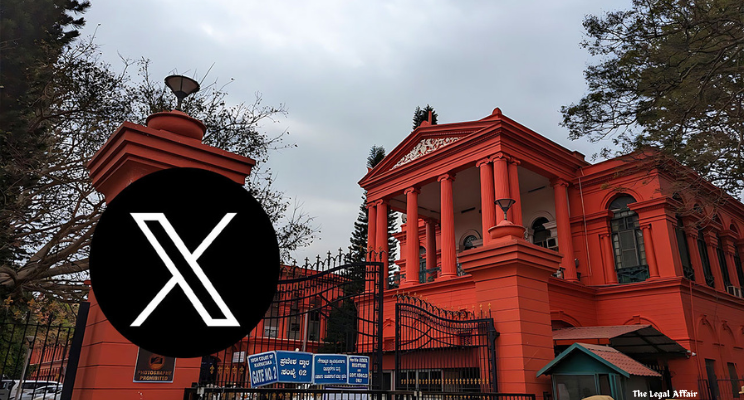
The Karnataka High Court, in a landmark ruling delivered on September 24, 2025, dismissed a plea filed by X Corp (formerly Twitter) against the Union of India, where the social media giant had sought a declaration that Section 79(3)(b) of the Information Technology Act, 2000, does not empower government authorities to issue information blocking orders and that such powers lie exclusively under Section 69A of the Act read with the Information Technology (Procedure and Safeguards for Blocking of Access of Information by Public) Rules, 2009. The case, titled X Corp v. Union of India & Others, WP 7405/2025, was presided over by Justice M. Nagaprassana, who emphatically upheld the government’s regulatory authority over digital platforms operating within Indian jurisdiction. While rejecting the challenge, the Court not only upheld the validity of Section 79(3)(b) and the Sahyog Portal but also made strong observations on the importance of regulating social media content in a democratic society, especially in the context of offences against women and threats to dignity guaranteed under the Constitution. The Court ruled that freedom of speech under Article 19(1)(a) of the Constitution is subject to reasonable restrictions under Article 19(2), and further held that intermediaries such as X Corp cannot invoke the protective canopy of Article 19 since it is a fundamental right reserved exclusively for Indian citizens. This judgment marks a significant development in the ongoing tussle between global technology companies and sovereign regulatory regimes.
Arguments of the Petitioner:
X Corp advanced a multi-pronged challenge to the government’s reliance on Section 79(3)(b) for issuing information blocking orders. The central contention of the company was that Section 79, by design, is a “safe harbour” provision which merely exempts intermediaries from liability for third-party content, subject to conditions of due diligence. It was never intended as a source of substantive power for the government to direct intermediaries to block or remove content. According to the petitioner, the only legitimate authority for issuing information blocking orders is Section 69A of the IT Act read with the Blocking Rules of 2009, as interpreted by the Supreme Court in the celebrated case of Shreya Singhal v. Union of India. By seeking to expand Section 79(3)(b) into a source of authority, the government was effectively creating a parallel regime for censorship, outside the strict safeguards mandated by Section 69A.
X Corp further argued that compelling intermediaries to proactively scrutinize user content or comply with blocking orders under Section 79(3)(b) amounts to deputizing them as censors of online speech, which runs contrary to constitutional principles of free expression. The petitioner submitted that the government’s reliance on Section 79 is misplaced since even in the Shreya Singhal judgment, the government itself never projected Section 79 as an empowering provision. Thus, an exemption clause could not be stretched into a power-conferring provision.
Another key argument advanced by X Corp was that the Sahyog Portal, designed to automate takedown requests under Section 79(3)(b), was unconstitutional as it circumvented the checks and balances laid down in Section 69A. The platform alleged that the Sahyog mechanism, by mandating compliance with takedown orders issued without judicial or independent oversight, created a chilling effect on free speech. X Corp also sought protection from any coercive action against its employees or representatives for non-compliance with the Sahyog Portal until the final adjudication of the case.
On the constitutional plane, the petitioner argued that the government’s orders under Section 79(3)(b) amounted to unreasonable restrictions on free speech, contrary to the spirit of Article 19(1)(a). It claimed that the government’s expansive interpretation of Section 79 would transform a safe harbour provision into an instrument of censorship, chilling legitimate expression. The company contended that unlawful content must be dealt with under the specific mechanism provided in Section 69A, which requires transparency, reasoned orders, and procedural safeguards.
Arguments of the Respondent (Union Government):
The Union of India, in response, mounted a strong defence of its regulatory regime under Section 79(3)(b) and the Sahyog Portal. The government argued that unlawful or illegal content cannot enjoy the same level of constitutional protection as legitimate free speech. Article 19(1)(a), though a noble guarantee, is always subject to reasonable restrictions under Article 19(2), including those necessary to protect public order, decency, and morality. The Centre submitted that intermediaries cannot claim absolute immunity under the guise of free expression, particularly when the content in question involves offences against women or threatens the dignity of citizens.
On the question of safe harbour, the government emphasized that it is a conditional protection and not an absolute right. Intermediaries enjoy exemption from liability only if they demonstrate due diligence and act expeditiously upon receiving actual knowledge of unlawful content. Section 79(3)(b), in particular, provides that intermediaries lose safe harbour protection if they fail to disable or remove access to unlawful information upon receiving notice from the government or its agencies. Thus, far from being an exemption-only clause, Section 79(3)(b) creates a statutory obligation on intermediaries to cooperate in removing unlawful content.
Defending the Sahyog Portal, the government described it as a tool of public good, designed to streamline cooperation between citizens, intermediaries, and the state in combating cybercrime. It rejected the allegation that Sahyog was unconstitutional, stating that it merely automated the process of sending takedown notices envisaged under Section 79(3)(b) and Rule 3(b) of the 2021 IT Rules. Far from creating a censorship regime, the portal facilitated compliance and accountability in a digital ecosystem increasingly vulnerable to misuse. The government also countered the petitioner’s reliance on Shreya Singhal, pointing out that the judgment dealt with the 2011 Rules, which are now obsolete, and that the 2021 Rules have introduced a fresh regulatory framework requiring independent interpretation.
Finally, the government challenged X Corp’s locus standi to invoke fundamental rights under Article 19, highlighting that such rights are reserved exclusively for Indian citizens and cannot be claimed by foreign corporations. It also questioned the company’s selective compliance, noting that while X abides by takedown orders in the United States and other jurisdictions, it refuses to extend the same respect to Indian law.
Court’s Judgment and Reasoning:
Justice M. Nagaprassana, delivering a detailed and strongly worded judgment, dismissed the petition filed by X Corp and upheld the government’s interpretation of Section 79(3)(b) and the Sahyog Portal. The Court observed that social media, as the modern amphitheater of ideas, cannot be left in a state of anarchic freedom. Regulation of speech in this domain, the Court held, is neither novel nor unique, as every sovereign nation regulates digital platforms. The Court drew parallels with the United States and other jurisdictions, noting that India’s resolve to regulate online content cannot be branded as unconstitutional.
The Court eloquently underscored that unregulated speech under the guise of liberty becomes a license to lawlessness, while regulated speech preserves both liberty and order—the twin pillars of democracy. It categorically rejected the petitioner’s argument that social media platforms should be exempt from the rigour of Indian law, stating that no platform can presume to treat the Indian marketplace as a playground for disseminating information in defiance of statute.
On the constitutional issue, the Court held that Article 19(1)(a) rights are subject to the reasonable restrictions under Article 19(2). Moreover, it noted that the protective canopy of Article 19 cannot be invoked by X Corp, as the provision is a charter of rights conferred only upon Indian citizens. Thus, the petitioner’s reliance on constitutional free speech guarantees was misplaced.
The Court also rejected the argument that Section 79(3)(b) was merely an exemption clause, holding instead that it creates a statutory obligation on intermediaries to disable unlawful content once notified. The Sahyog Portal, far from being unconstitutional, was described as a beacon of cooperation between citizens and intermediaries, conceived under statutory authority to combat the menace of cybercrime. To challenge its validity, the Court observed, was to misunderstand its purpose.
Justice Nagaprassana also clarified that reliance on the Shreya Singhal judgment was misplaced since it dealt with the 2011 Rules, which are now “confined to history.” The 2021 Rules, distinct in conception and fresh in design, demand their own interpretative approach unsided by precedents concerning the bygone regulatory framework. The Court reiterated that regulation of communication has existed across technological ages—from postal services to instant messaging—and social media platforms cannot claim exemption from regulatory discipline.
In conclusion, the Court upheld the government’s authority under Section 79(3)(b) and validated the Sahyog Portal, dismissing the petition in its entirety. It also made broader remarks about the need for accountability and responsibility in the digital age, observing that liberty comes with responsibility and the privilege of access to Indian citizens carries with it a solemn duty of accountability.