


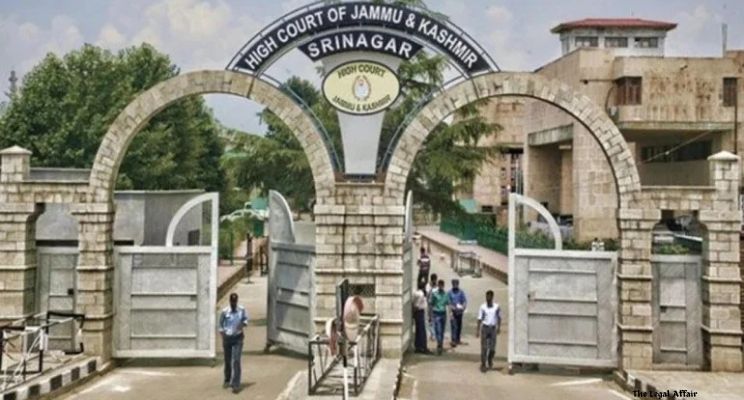
Introduction:
The case titled J&K Horticulture Produce Marketing and Processing Corporation vs. Abdul Razak Malla & Others, 2025 LiveLaw (JKL) 167, came before the High Court of Jammu and Kashmir and Ladakh, where a crucial question of employment law concerning the doctrine of “no work, no pay” was examined. The Division Bench comprising Justice Rajnesh Oswal and Justice Mohammad Yousuf Wani delivered a significant ruling reinforcing employee rights. The appellant Corporation challenged the Writ Court’s decision, which directed it to release pending salaries and consequential benefits to the employees who had opted for the Voluntary Retirement Scheme (VRS) but had remained unpaid and out of service due to the employer’s failure. The High Court reaffirmed that when employees are deprived of work due to the employer’s act or omission, they cannot be denied wages by relying upon the “no work no pay” principle.
Arguments of the Appellant and Respondents:
In the present matter, the J&K Horticulture Produce Marketing and Processing Corporation (the appellant) challenged the Writ Court’s order on several grounds. The appellant submitted that once the employees had opted for VRS and the same was accepted, their association with the Corporation ceased. It was further contended that for the period post-acceptance of VRS and before any reinstatement, no salary could be paid as the employees were not rendering any service. They strongly argued that the principle of “no work, no pay” would apply, stating that salary is a quid pro quo for the services rendered and that payment without work would be an unjust enrichment of the employees at the cost of the Corporation. On the other hand, the respondents (employees) countered by highlighting that after their voluntary retirement was accepted, the Corporation failed to clear their dues within the stipulated time of 60 days as mandated under Clause 5(iv) of the VRS Scheme. Consequently, they were compelled to approach the High Court, leading to a situation where they were taken back into service upon the Writ Court’s interim orders. The respondents further contended that they were willing and ready to serve but were prevented by the Corporation’s omissions. They emphasised that it was the Corporation’s inaction that forced them into a state of enforced idleness, and hence, denying their salaries would be wholly unjustified. Relying on broader principles of fairness and justice, they urged that the Corporation’s default cannot prejudice the employees’ entitlements.
Court’s Judgement:
After a careful analysis of the facts, submissions, and applicable legal principles, the High Court of Jammu and Kashmir and Ladakh sided firmly with the employees. The Division Bench began by noting that the respondents’ exit from service was not complete merely by offering VRS; the actual retirement and its benefits were contingent on the Corporation’s compliance with clearing dues within the prescribed period. It was observed that the Corporation’s failure to release the benefits and dues in time forced the respondents into limbo — a situation squarely attributable to the employer and not the employees. Importantly, the Court reiterated that the doctrine of “no work, no pay” is fundamentally grounded in fault theory. It applies only when the employee, by his own volition or misconduct, refrains from work. Where an employee is forcibly kept away from work by the employer’s act, as in the instant case, the salary cannot be denied under the guise of “no work, no pay.” Citing the authoritative ruling in Commissioner, Karnataka Housing Board v. C. Muddaiah, (2007) 7 SCC 689, the Court observed that when an employee is prevented from working without any fault on his part, the doctrine does not apply. In the Muddaiah case, the Supreme Court had categorically held that unjustified non-employment resulting from the employer’s actions does not disqualify an employee from claiming salary. The Division Bench found that the factual matrix before it was analogous to that case, further strengthening the employees’ claim. The Court further criticised the Corporation for seeking refuge under technicalities while being the very cause of hardship to the respondents. The Court remarked that the Corporation’s omissions breached the binding terms of the VRS scheme, and it cannot now rely on the employees’ non-service to deny them their rightful dues. It firmly upheld the Writ Court’s findings and held that the respondents were entitled not only to the pending salaries but also to all consequential benefits for the period they were kept out of employment due to the Corporation’s failure. The Division Bench concluded that there was no infirmity, illegality, or perversity in the judgment of the Writ Court, which had correctly applied the law and principles of justice. Consequently, the appeal was dismissed, and the Corporation was directed to comply with the order for release of salaries and benefits within the stipulated time frame. The judgment stands out as a strong reaffirmation that public sector undertakings and employers, in general, must act fairly, promptly, and responsibly in honouring their obligations towards employees, especially when schemes like VRS are floated with promises of expeditious settlement. The Court’s interpretation seeks to prevent employer misconduct from unfairly prejudicing employees and underlines the broader constitutional mandate of securing just and humane conditions of work under Article 43 of the Constitution of India.