


Introduction:
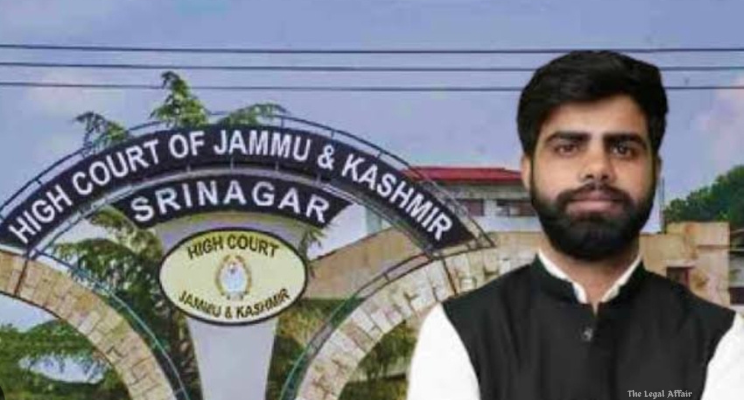
In a notable judgment, the Jammu & Kashmir and Ladakh High Court quashed the preventive detention order against Aqib Ahmad Renzu, a former Srinagar Municipal Corporation (SMC) Corporator, under the Jammu & Kashmir Public Safety Act (PSA). The court ruled that the detention lacked sufficient legal justification and emphasized that preventive detention laws must not serve as substitutes for standard criminal procedures. The order was originally issued by the District Magistrate of Srinagar in October 2023, shortly after Renzu had been granted bail in multiple criminal cases. The appeal, heard by a division bench comprising Acting Chief Justice Tashi Rabstan and Justice M.A. Chowdhary, resulted in a precedent-setting ruling that reinforces the protection of individual liberty from arbitrary state actions.
Background:
The preventive detention of Aqib Ahmad Renzu, ordered on October 4, 2023, stemmed from a series of FIRs filed against him between 2013 and 2023, including accusations of sexual harassment and involvement in unlawful activities. Despite being granted bail in these cases, the authorities sought his preventive detention under the PSA, claiming that it was necessary to prevent him from disturbing public order. Following the dismissal of a Habeas Corpus Petition by a Single Judge Bench in June 2024, Renzu appealed, leading to the current proceedings.
Arguments by the Appellant:
Advocate Shuja ul Haq, representing Renzu, argued that the detention was arbitrary and disproportionate, especially given Renzu’s bail status in the registered criminal cases. Haq further contended that the detention violated Renzu’s constitutional rights under Article 22(5) of the Indian Constitution, as the authorities failed to provide him with the materials that justified his detention, thereby preventing him from challenging the order effectively.
Haq stressed that Renzu was a nationalist figure who had worked against anti-national elements in the region, and the detention was politically motivated, arising from local rivalries. Furthermore, Haq criticized the vague nature of the detention order, arguing that preventive detention laws are designed for exceptional circumstances and should not be misused to sidestep regular judicial processes.
Arguments by the Respondents:
The Government Advocate, Faheem Nisar Shah, defended the detention, asserting that Renzu posed a serious threat to public order and that preventive detention was necessary to prevent further unlawful activities. Shah emphasized the significance of preventive detention laws in regions like Jammu & Kashmir, where potential threats to public peace and security can be magnified.
Shah argued that the preventive detention order was legally sound and justified, despite Renzu’s bail in criminal cases. He maintained that preventive detention serves a different purpose—preventing future offenses rather than addressing past conduct—and that there was no political motivation behind the detention.
Court’s Observations and Judgment:
The High Court quashed the detention, finding the grounds of the order vague and lacking the specificity needed to justify preventive detention under the PSA. The bench noted that while the FIRs involved criminal allegations, none posed an imminent threat to public order justifying Renzu’s detention under preventive laws. The judges also emphasized that preventive detention should only be used when regular criminal law is inadequate, which was not the case here, as Renzu had already been granted bail in the pending cases.
The court further criticized the procedural flaws in the detention, notably the authorities’ failure to provide Renzu with the materials they relied upon, a violation of Article 22(5) of the Constitution. Referring to Supreme Court rulings such as Ram Krishan Bhardwaj v. State of Delhi and Thahira Haris v. Government of Karnataka, the bench reiterated that detainees must be given sufficient information to make an effective representation against their detention.
Additionally, the court ruled that preventive detention cannot replace the regular criminal process, especially in cases where the individual has already been granted bail. Citing Vijay Narain Singh v. State of Bihar, the court underscored that preventive detention is an extraordinary measure that should only be employed in urgent situations where public safety is at risk. In this case, no such imminent threat was proven.
Conclusion:
The High Court ordered the immediate release of Aqib Ahmad Renzu, provided he was not required in any other case, quashing the detention order on legal grounds. The ruling reaffirmed the principle that preventive detention must not be used to circumvent the ordinary judicial process and emphasized the protection of individual liberty against unjust state actions.