


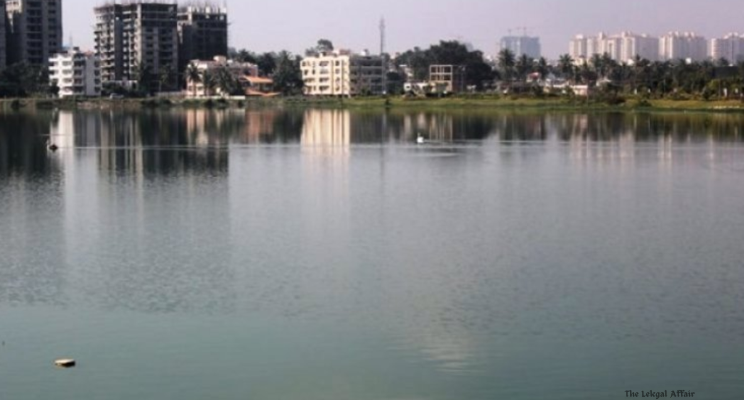
Introduction:
The case titled Navneetlal Vanmalidas Khakhkhar (Thakkar) v. Ahmedabad Municipal Corporation, R/LPA/1280/2025 in R/SCA/14892/2025, before the Gujarat High Court brought into focus a longstanding dispute concerning alleged encroachment upon a water body known as Isanpur Lake in Ahmedabad, involving petitioners who challenged eviction notices issued by the Ahmedabad Municipal Corporation (AMC) ordering them to vacate the land recorded as survey no. 630. The appellants, who were petitioners before the single judge, approached the division bench comprising Chief Justice Sunita Agarwal and Justice D.N. Ray after the single judge dismissed their writ petition against eviction notices issued under the allegation that their houses and a temple located on the disputed survey land amounted to unauthorized construction over land categorized as a lake or water body, thereby constituting illegal encroachment on public property. The appellants contended that they had been residing on the land for decades and that the presence of a temple and residential structures had been acknowledged historically by the erstwhile Isanpur Gram Panchayat, which purportedly permitted the constructions, and that AMC continued collecting taxes for several years despite having knowledge of their occupation, strengthening their plea that their possession was legally protected and not unauthorized.
Arguments of the Appellants:
Before both the single judge and the division bench, the appellants relied heavily on the doctrine of long-standing possession, claiming that they and their predecessors have occupied the property for more than fifty years, during which period they constructed residential units and a temple dedicated to Lord Hanuman. They argued that the emergence of a divine idol in 1966 prompted construction of the temple, with alleged permissions received from the erstwhile gram panchayat. They asserted that AMC’s conduct of levying and collecting taxes from them over decades created a legitimate expectation that their occupation had implicit recognition and that the authorities could not suddenly treat them as trespassers. It was further argued that the land reportedly belonged to a trust earlier, and after the enactment of the Gujarat Devasthan Abolition Act, 1969, the land vested in the state government, triggering a legal dispute that had persisted for years. The appellants claimed that they had replied to earlier notices issued by the Collector in 1978 questioning the construction activities, and that their reply was sufficient to show that their presence was known to public authorities long before AMC took over administrative control after the merger of the gram panchayat. They insisted that the land, though recorded as a lake, had not been developed or used as such for decades, and that possession for over half a century gave rise to equitable rights which should protect them from eviction. They further contended that the constructions were not unauthorized since the previous local body granted permission, even though they admitted that no formal documentary proof of permission existed because records allegedly were not preserved during the transition phase. They also argued that since the Collector had handed over the land to AMC only in 2009, it was inequitable for AMC to invoke waterbody protection decades later without considering the rights created by long-term possession. The appellants urged that AMC’s inaction and tax collection amounted to tacit acknowledgment of their rights. Lastly, they sought an injunction against the eviction, arguing that dispossession from their homes and temple would cause irreparable harm and violate their right to life under Article 21 of the Constitution.
Arguments of the Respondent Corporation:
The Ahmedabad Municipal Corporation countered that the petitioners were encroachers with no legal rights, title, or interest in the land, which is unequivocally classified as a water body in official revenue records. The AMC asserted that survey no. 630 admeasuring 95608 sq. mts. is recorded as government-owned land used as “talav” (lake), forming part of Town Planning Scheme No. 53, Isanpur, under which original survey numbers 629, 630, and 631 were converted into final plots 160, 161, and 162 after notification and approval. The AMC contended that since the land stands vested in the government and later in AMC for development and beautification purposes, no private construction—whether residential or religious—could legally exist on a designated water body, as such structures obstruct public purpose and cause ecological harm. It further argued that illegal construction was polluting Isanpur Lake, with drainage water entering the lake due to these structures. The AMC firmly stated that tax collection does not create ownership or confer title, as taxes are collected on the basis of occupation and cannot legitimize encroachment or convert a public water body into private property. The corporation emphasized that water bodies are ecologically sensitive public assets protected under constitutional environmental jurisprudence, and no equitable rights can be claimed against environmental protection. It further asserted that the petitioners had failed to produce any documentary evidence of allotment, permission, or title, and were therefore mere encroachers engaging in unauthorized usage of public land. The AMC relied on settled law that long possession does not confer ownership rights upon government land unless supported by lawful title, and further submitted that factual controversies cannot be adjudicated under Article 226 of the Constitution.
Court’s Judgment:
After considering the parties’ arguments, the division bench upheld the single judge’s findings, ruling that the appellants were unauthorized occupants of government land classified as a water body and had failed to produce a single document proving lawful permission for construction. The bench held that the revenue records clearly established the land as “talav” belonging to AMC, and the petitioners’ structures were illegal encroachments impermissible under environmental and municipal laws. The Court reiterated that mere long possession cannot crystallize into ownership over government property, particularly when the land is a public lake and part of an approved planning scheme. The bench noted that issues raised by the petitioners required factual inquiries unsuitable for adjudication in a writ jurisdiction, and thus Article 226 relief was unavailable. The Court concluded that the appellants’ claim that AMC acquiesced by collecting taxes was legally untenable, since tax payments neither validate encroachment nor create title. The Court dismissed the appeal in its entirety and refused to stay the eviction, holding that no interference was warranted in the single judge’s order. The ruling reinforces judicial policy barring regularization of encroachments on water bodies and underscores that environmental protection supersedes individual claims of unauthorized occupancy.