


Introduction:
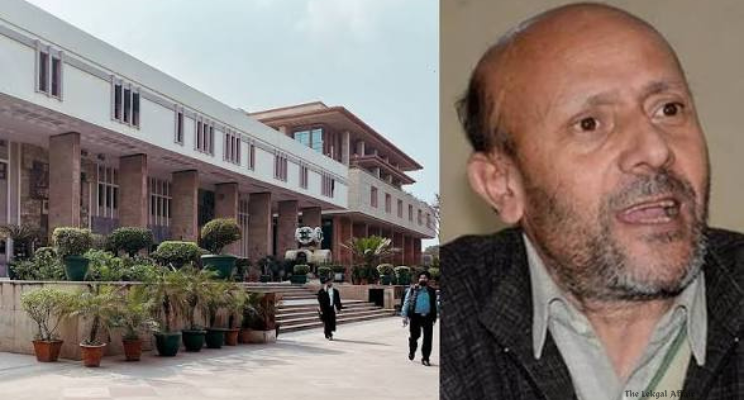
In a significant interim relief order balancing humanitarian considerations with national security concerns, the Delhi High Court on May 18 granted interim bail to jailed Baramulla Member of Parliament Abdul Rashid Sheikh, popularly known as Engineer Rashid, in a terror funding case being investigated by the National Investigation Agency.
The interim bail was granted by a Division Bench comprising Justice Prathiba M. Singh and Justice Madhu Jain after taking note of the death of Rashid’s father at AIIMS, New Delhi, during the intervening night of May 17 and 18. The Court permitted the incarcerated parliamentarian to attend funeral rites, burial ceremonies, and related religious observances associated with the demise of his father.
The case arises from proceedings initiated by the National Investigation Agency under the provisions of the Unlawful Activities (Prevention) Act (UAPA), in which Rashid stands accused in connection with an alleged terror funding network operating in Jammu and Kashmir. Rashid, however, has consistently denied the allegations against him.
Despite being in judicial custody, Rashid achieved a major political victory in the 2024 parliamentary elections by winning the Baramulla Lok Sabha constituency in Jammu and Kashmir. His electoral success while incarcerated attracted national attention and further intensified political and legal discussions surrounding the case.
The interim bail plea before the High Court was moved on humanitarian grounds following the demise of Rashid’s father. The application informed the Court that under Islamic customs and family traditions, several rituals and ceremonies were required to be performed over an extended mourning period. These included funeral prayers, burial rites, recitation of the Quran, mourning gatherings, and observance of Eid-ul-Adha rituals connected with the bereavement period.
The plea specifically requested temporary release to enable Rashid to fulfil his religious, cultural, and familial obligations during the mourning period. The National Investigation Agency, while opposing unrestricted relief, confirmed before the Court that the death of Rashid’s father had been officially verified.
The order reflects the delicate judicial exercise of balancing personal liberty and humanitarian concerns against the seriousness of allegations involving terrorism and unlawful activities. While granting interim bail, the Court imposed multiple restrictions intended to ensure that the temporary release was used strictly for humanitarian purposes and did not interfere with the ongoing investigation or judicial proceedings.
The decision once again highlights how constitutional courts in India continue to examine requests for temporary liberty even in stringent UAPA cases through the lens of humanitarian necessity, constitutional fairness, and procedural safeguards.
Arguments of the Parties:
The appellant, Abdul Rashid Sheikh, approached the Delhi High Court seeking interim bail on compassionate grounds following the death of his father. Through his counsel, Rashid submitted that the demise of an immediate family member necessitated his temporary release from custody in order to perform essential religious and customary obligations associated with the funeral and mourning process.
It was argued that under Islamic traditions and family customs prevailing in Kashmir, several ceremonies and rites are observed over multiple days following the death of a parent. The plea highlighted that these rituals included funeral prayers, burial ceremonies, recitation of the Quran, condolence gatherings, and observance of religious practices extending up to Eid-ul-Adha.
The appellant contended that participation in these rituals was not merely symbolic but constituted an important religious and emotional obligation toward the deceased parent and the family.
The counsel appearing for Rashid emphasised that the request was limited in scope and purely humanitarian in nature. It was submitted that the appellant was not seeking adjudication on the merits of the criminal case or regular bail but only temporary release to fulfil family responsibilities arising from the bereavement.
The appellant further argued that constitutional courts have consistently recognised humanitarian circumstances such as death, medical emergencies, marriages, and funerals as valid grounds for grant of interim bail or temporary parole, even in serious criminal cases.
It was also submitted that Rashid was a sitting Member of Parliament elected from Baramulla constituency and there existed no apprehension that he would abscond or misuse the concession if reasonable conditions were imposed.
The plea stressed that denial of temporary liberty during the funeral and mourning period would cause irreparable emotional and familial hardship not only to the appellant but also to his grieving family members.
On the other hand, the National Investigation Agency opposed the grant of unrestricted liberty but acknowledged before the Court that the factum of death had been verified.
The NIA submitted that the appellant was facing serious allegations under the Unlawful Activities (Prevention) Act involving terror funding activities and therefore any temporary release must be accompanied by strict safeguards.
The agency expressed concerns regarding security implications, possible public gatherings, and the appellant’s interactions with persons outside his immediate family circle during the period of interim bail.
The prosecution therefore requested the Court to impose stringent conditions if interim bail was to be granted.
The NIA argued that considering the nature of allegations and the sensitive security environment in Jammu and Kashmir, unrestricted movement or public engagement by the appellant could potentially create law and order concerns or interfere with the investigation process.
The agency sought directions ensuring continuous police supervision during the period of release and restrictions on travel, communication, and public interaction.
It was also requested that the appellant be prohibited from contacting witnesses or engaging in any activity that could prejudice the pending criminal proceedings.
The prosecution ultimately left the matter to the discretion of the Court subject to the imposition of adequate safeguards protecting the interests of justice and national security.
Court’s Judgment:
After hearing both parties and perusing the records, the Delhi High Court granted interim bail to Abdul Rashid Sheikh until June 2, 2026, taking note of the death of his father and the humanitarian considerations arising from the bereavement.
The Division Bench comprising Justice Prathiba M. Singh and Justice Madhu Jain observed that the death of the appellant’s father had occurred during the intervening night of May 17 and 18 at AIIMS, New Delhi, and that the same had been verified by the investigating agency.
The Court recorded:
“The Court has heard the parties and perused the records. Accordingly, due to the demise of the Appellant’s father, interim bail is granted to the Appellant until 2nd June, 2026.”
While the order granting interim bail was brief, the conditions imposed by the Court reflected a carefully balanced approach intended to reconcile humanitarian relief with concerns relating to security and ongoing criminal proceedings.
The Court directed that Rashid would remain under continuous supervision during the entire period of interim bail. It ordered that at least two plain-clothed police personnel must accompany him throughout the duration of his temporary release.
This condition appears to have been imposed to ensure constant monitoring of the appellant’s movements and interactions while simultaneously allowing him to participate in funeral and mourning ceremonies with a degree of privacy and dignity.
The Court further restricted the locations where Rashid could stay during the interim bail period. He was permitted to remain only at his residences situated in Srinagar and Kupwara.
In addition, the Bench permitted him to visit burial grounds and places of worship solely for the purpose of carrying out customary rites and religious ceremonies connected with his father’s demise.
Recognising the sensitivity of the case and the possibility of public interaction due to Rashid’s political stature, the Court imposed another important restriction concerning meetings with persons other than immediate family members.
The Bench directed that any such meetings could occur only in the presence of police officials. This condition was clearly intended to prevent unauthorised political activity, interaction with potential witnesses, or any conduct capable of affecting the pending proceedings.
The Court also expressly restrained Rashid from contacting witnesses connected with the case or engaging in any unlawful activity during the period of interim bail.
Further, the appellant was prohibited from leaving the country without prior permission of the Court.
The order demonstrates how constitutional courts often adopt a calibrated approach while dealing with temporary bail requests in serious criminal cases, particularly those arising under special statutes like the UAPA.
Ordinarily, the stringent bail conditions under Section 43D(5) of the UAPA create a high threshold for grant of regular bail. However, courts have consistently recognised that humanitarian considerations such as death in the family, serious illness, or marriage ceremonies may justify temporary release even where allegations involve grave offences.
The present case illustrates the principle that temporary humanitarian relief does not necessarily amount to dilution of the prosecution case or adjudication on the merits of allegations.
Instead, interim bail in such situations is granted on narrowly tailored grounds and is accompanied by carefully structured safeguards intended to prevent misuse.
The order also reflects the judiciary’s continuing attempt to balance individual dignity and constitutional compassion with the imperatives of national security and criminal investigation.
Another notable aspect of the case is Rashid’s status as an elected Member of Parliament. While the Court did not specifically rely upon his parliamentary position while granting relief, the case once again highlights the complex intersection between criminal prosecution, electoral democracy, and constitutional rights.
The decision further demonstrates that even in politically sensitive and high-profile criminal matters, courts remain willing to consider humanitarian requests on their individual merits.
Importantly, the Court’s order was confined strictly to interim bail arising out of exceptional personal circumstances and does not affect the merits of the pending terror funding prosecution before the competent court.
The judgment therefore stands as another example of the judiciary’s effort to preserve human dignity and familial obligations while simultaneously ensuring that the administration of criminal justice and national security concerns remain fully protected.