


Introduction:
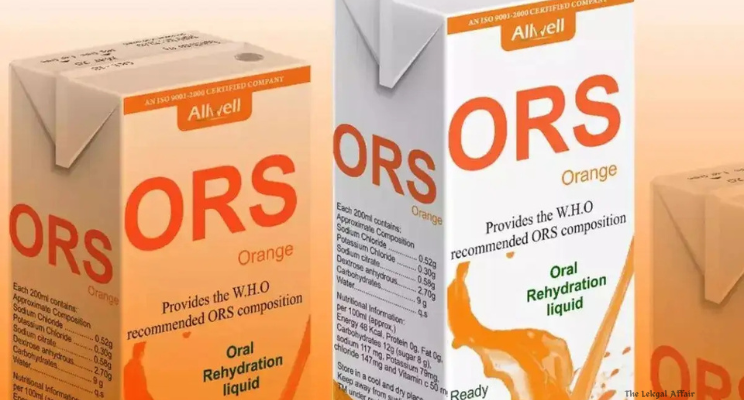
In a significant ruling concerning public health and consumer safety, the Delhi High Court, comprising Chief Justice D.K. Upadhyaya and Justice Tushar Rao Gedela, refused to grant interim relief to JNTL Consumer Health India Pvt. Ltd., a company engaged in the manufacture and sale of electrolyte beverages under the brand name “ORSL.” The company had approached the Court seeking permission to dispose of its existing stock after the Food Safety and Standards Authority of India (FSSAI) banned the use of the term “ORS” in the branding and labeling of such drinks. The bench, however, held that the issue went beyond commercial inconvenience and directly touched upon a matter of public health and potential consumer deception, particularly in rural areas where “ORS” is associated with life-saving oral rehydration solutions for diarrhoea and dehydration. The Court emphasized that such misbranding could mislead vulnerable sections of society and hence, could not be permitted even temporarily.
Arguments of the Petitioner:
Represented by Senior Advocate Mukul Rohatgi, the petitioner-company argued that it had been manufacturing and marketing beverages under the brand name “ORSL” for nearly two decades. The company asserted that the name was duly registered with the Controller General of Patents, Designs, and Trademarks (CGPDTM), and had thus acquired both statutory and market recognition. It was further contended that the FSSAI’s recent orders dated October 14 and 15, withdrawing permission to use “ORS” in the label, were arbitrary and passed without due consideration of the long-standing market presence and investment of the company.
The counsel maintained that the petitioner’s beverages were not being marketed as medical formulations nor were they being claimed to be substitutes for the WHO-approved Oral Rehydration Solution (ORS). Instead, they were described as electrolyte-energy drinks intended for general consumption, prominently labeled to indicate that they were not medical-grade ORS formulations. It was also submitted that consumers were adequately informed through packaging and advertisements that the beverages were for general rehydration, not for medical treatment of diarrhoea or dehydration-related illnesses.
Further, the petitioner emphasized that while manufacturing had been voluntarily halted following the FSSAI order, a large portion of stock—nearly ₹100 crore worth—remained in warehouses and retail channels. The company urged the Court to allow the disposal of existing stock through rebranding measures, submitting that the product was not adulterated, unsafe, or injurious to health. The concern, it said, was not over the composition but merely the nomenclature. The counsel added that destruction of the unsold stock would lead to enormous financial losses, job cuts, and wastage of resources, especially when consumers were familiar with the drink as a general energy beverage rather than a medicinal ORS.
The petitioner’s counsel also pointed out that the company was willing to comply with any rebranding or relabeling directions issued by the FSSAI to avoid future confusion. The plea was thus limited to an interim arrangement to clear existing stock already in distribution networks, without further manufacturing under the banned label. The counsel argued that the FSSAI’s approach was overly rigid and failed to distinguish between misleading labeling and established trademark use with disclaimers.
Arguments of the Respondent (FSSAI):
The FSSAI opposed the plea, reiterating that the term “ORS” holds a critical medical significance, particularly in developing countries where it is synonymous with oral rehydration therapy for diarrhoea and dehydration, conditions that primarily affect children and vulnerable populations. It was submitted that using the term “ORS” or a variant such as “ORSL” in a commercial beverage label could mislead consumers, especially in rural and semi-urban areas, into believing that they were purchasing a therapeutic product capable of restoring electrolyte balance in cases of illness.
The Authority emphasized that the petitioner’s beverage did not conform to the prescribed formulation standards for medical-grade ORS under the Food Safety and Standards (Food Products Standards and Food Additives) Regulations. The product did not contain the specific combination and concentration of glucose and electrolytes required for medical use, and allowing such products to be marketed under similar names would amount to misbranding within the meaning of Section 3(1)(zf) of the Food Safety and Standards Act, 2006.
The FSSAI further contended that the single bench of the Delhi High Court had already upheld the regulatory ban in a similar case involving Dr. Reddy’s Laboratories, where it was observed that the continued sale of such misleading products could cause adverse health consequences. The Authority stressed that this was not a case of harmless mislabeling but one that carried a potential risk to public health, as ordinary consumers might rely on these products for rehydration during medical emergencies, such as diarrhoeal dehydration, where incorrect electrolyte balance could lead to severe health complications or even fatalities.
The FSSAI also argued that the right to trade or carry on business is not absolute under Article 19(1)(g) of the Constitution, and reasonable restrictions in the interest of public health are constitutionally permissible. It was contended that once a product is found to be misbranded, no equitable relief can be granted to continue its sale in the market, even for a limited period.
Court’s Observations and Judgment:
After hearing both sides, the Division Bench observed that the central issue in the case was not of commercial hardship or intellectual property rights but one of potential public harm due to misbranding. The Court categorically stated that when a product bears nomenclature similar to a life-saving therapeutic substance such as “ORS,” the risk of misleading consumers—particularly those in rural or low-literacy populations—cannot be ignored.
Chief Justice D.K. Upadhyaya, speaking for the bench, remarked, “The difficulty is that in rural areas, if some child is suffering from diarrhoea, what ordinarily happens is that they buy ORS to balance electrolytes. In your product, you are also writing electrolyte; there is a possibility of misleading. It is not harmful to someone who is fit to take it but to those who are unfit to take it.” The Court emphasized that the matter was not about whether the drink was toxic or harmful to healthy individuals, but about preventing confusion that could endanger lives in vulnerable groups.
The bench further noted that the single bench had already refused interim relief in similar matters, finding that such misbranding was detrimental to public health. The Division Bench observed that the public’s trust in the “ORS” label had been built over decades through health campaigns and humanitarian interventions by bodies like UNICEF, which had distributed authentic ORS sachets free of cost in diarrhoea-prone regions. Therefore, any commercial misuse of the term undermined that trust and could have grave consequences.
The Court rejected the argument that the company’s long-standing use of the name or registration under trademark law could override the regulatory framework of the FSSAI. It clarified that trademark protection cannot legitimize misbranding or excuse a violation of statutory health standards. The bench also dismissed the plea to dispose of existing stock, holding that such permission would effectively perpetuate the misbranding that the FSSAI sought to prevent.
The judges underscored that even though the company had stopped manufacturing, permitting it to sell remaining stock under the same misleading label would continue to pose a public risk. The Court reasoned that health and safety considerations must outweigh commercial loss or inconvenience. The bench therefore declined to pass any interim order allowing the disposal or sale of the impugned products.
It was further observed, “Had it been sold on prescription, it would be different. It is not a scheduled drug, therefore if it is sold in the market it can cause more harm.” This remark highlighted the Court’s concern that the product’s easy availability could mislead laypersons into substituting it for medical-grade ORS in critical situations.
The bench concluded that the petitioner could pursue rebranding or reformulation in accordance with FSSAI standards but would not be entitled to any relaxation for existing misbranded products. Consequently, the petition was dismissed, reinforcing the principle that commercial rights must yield to public health imperatives when there is a risk of consumer deception.