


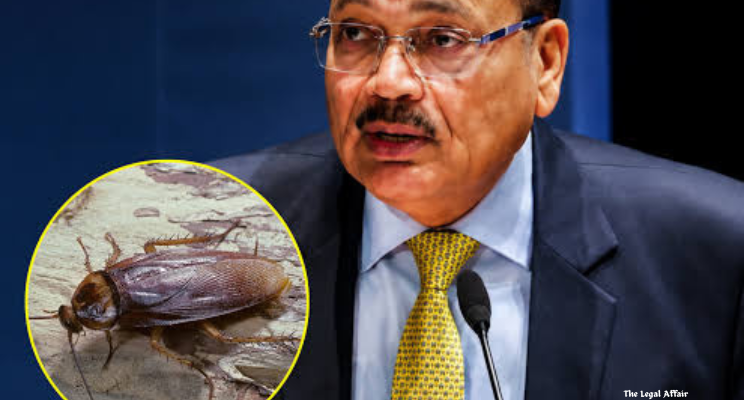
The recent remarks made by the Chief Justice of India, Surya Kant, during a court hearing have sparked widespread debate across legal and public circles after he referred to certain “youngsters” as “cockroaches” while expressing concern over the increasing misuse of professional spaces by individuals possessing fake degrees and questionable credentials.
The controversy arose during the hearing of a petition filed by an advocate seeking senior designation before the Supreme Court of India. While addressing the issue, the Chief Justice voiced serious apprehension regarding the authenticity of law degrees held by several advocates, particularly in Delhi, and even indicated that an investigation by the Central Bureau of Investigation could be considered to verify such qualifications.
During the proceedings, the CJI remarked that certain individuals had entered respected professions without merit and had begun “attacking the system” through various platforms. In that context, he stated:.
“There are youngsters like cockroaches, who don’t get any employment and don’t have any place in the profession. Some of them become media, some of them become social media, some of them become RTI activists, some of them become other activists, and they start attacking everyone,” the Chief Justice remarked in open court.
The comments quickly triggered criticism on social media, with many interpreting the statement as an attack on unemployed youth, activists, and members of the media. Legal commentators and public figures questioned whether such sweeping oral observations from the highest judicial office could undermine public confidence and unfairly stigmatise young professionals struggling with unemployment and systemic challenges.
During the hearing, the Chief Justice also reportedly stated that he doubted the genuineness of law degrees held by several advocates, particularly in Delhi, and even suggested that an investigation by the Central Bureau of Investigation may be required to verify academic credentials.
The observations come at a time when concerns regarding fake educational qualifications and declining professional standards are increasingly being discussed in legal and academic circles. However, the use of expressions such as “cockroaches” and “parasites” has overshadowed the larger issue and generated criticism from several quarters.
However, within hours of the controversy gaining momentum, Chief Justice Surya Kant issued a clarification, asserting that his remarks had been “misquoted” and “misunderstood” by a section of the media.
In his official statement, the CJI clarified that his criticism was never directed at the youth of India in general, but specifically at those who had fraudulently entered noble professions through fake and bogus degrees. He said such individuals existed not only in the legal profession but also across media, social media, and other public spheres, where they functioned as “parasites” weakening institutional credibility.
“I am pained to read how a section of the media has misquoted my oral observations made during the hearing of a frivolous case yesterday,” the CJI stated.
He further emphasised that he holds immense respect for Indian youth and considers them the “pillars of a developed India.” According to the Chief Justice, the controversy arose from selective reporting of oral remarks without the proper context in which they were made.
The clarification appears to be an attempt to rectify the perception that the judiciary was insensitive toward the struggles of young Indians. Instead, the CJI sought to underline that his concern was aimed at protecting the integrity of professions such as law and media from individuals who allegedly gain entry through fraudulent means and later misuse public platforms to attack institutions indiscriminately.
Public institutions, especially constitutional courts, command immense respect because of the restraint and dignity traditionally associated with judicial language. While courts often make stern oral observations during hearings, remarks that appear to generalise or demean sections of society inevitably invite public scrutiny.
India’s youth today occupy every major sphere — from litigation and journalism to entrepreneurship, activism, and public service. Many young professionals also use digital platforms and RTI mechanisms to raise issues of transparency and accountability. In that backdrop, remarks targeting youngsters involved in media or activism are likely to resonate far beyond the courtroom.
The controversy once again highlights the growing public attention on oral observations made by constitutional courts and the larger conversation surrounding judicial accountability, courtroom language, and institutional sensitivity in a democratic society.