


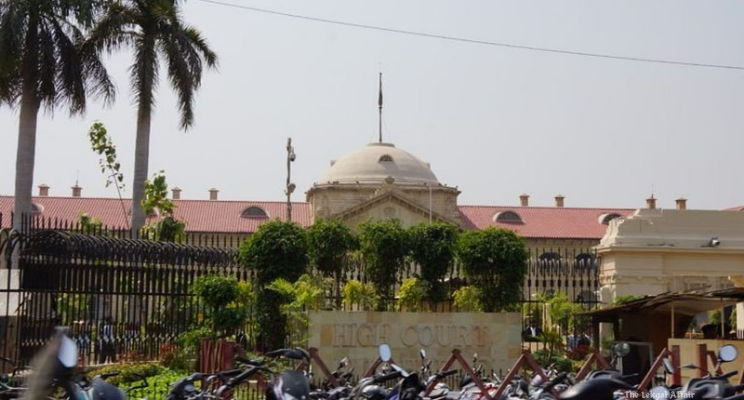
Introduction:
In Badal Chatterjee v. State of U.P. and Others, the Allahabad High Court, through a Division Bench comprising Justice Saral Srivastava and Justice Sudhanshu Chauhan, dealt with a disturbing instance of illegal and unsanctioned construction in the New Katra area of Prayagraj and the equally troubling apathy and complicity of the development authorities tasked with regulating urban planning. The case arose from a writ petition filed by a permanent resident of the locality who complained that respondents No. 6 and 7 were raising construction over their adjacent plot in gross violation of the sanctioned building plan, without leaving the mandatory setback. According to the petitioner, the illegal basement construction posed a serious threat to the foundation of his old residential house and directly infringed upon his easementary rights to air, light, and safety. What transformed this dispute from a routine case of unauthorized construction into a serious judicial intervention was the conduct of the private respondents and the Prayagraj Development Authority (PDA), including the acceptance of undertakings, illegal de-sealing of premises, continued construction beyond compoundable limits, and repeated attempts to frustrate enforcement through procedural tactics. The Court was thus called upon not only to adjudicate the legality of the construction but also to scrutinize the role of statutory authorities and reaffirm the principle that law exists to protect law-abiding citizens, not those who violate it with impunity.
Arguments:
The petitioner, a resident of New Katra, argued that the construction raised by respondents No. 6 and 7 was wholly illegal, unsanctioned, and in blatant deviation from the approved building plan. He contended that the respondents had failed to leave the mandatory setback as required under building regulations, thereby directly affecting his right to light and air, which are essential facets of a dignified and healthy life. It was further submitted that the excavation and construction of a basement beyond permissible limits had endangered the structural safety of his old house, with a real risk of damage or even collapse, potentially leading to loss of property and human life. The petitioner emphasised that despite repeated complaints, the PDA initially failed to take effective action, allowing the illegal construction to continue under its watch. He also relied upon the fact that the PDA itself had earlier sealed the premises by an order dated 03.05.2025, thereby acknowledging the illegality of the construction. According to the petitioner, the subsequent de-sealing of the premises on the basis of a vague plea of possible waterlogging, coupled with an undertaking by respondent No. 6 to demolish the illegal portion, was illegal, arbitrary, and beyond the authority of the concerned officer, particularly when the construction was admittedly beyond compoundable limits.
On the other hand, respondents No. 6 and 7, supported by submissions on behalf of the Prayagraj Development Authority, attempted to justify their conduct by contending that they had approached the authorities for compounding of deviations and that demolition was a harsh measure. It was argued that the de-sealing was sought to prevent damage due to waterlogging in the basement and that an affidavit had been filed undertaking to remove any illegal construction. The respondents sought indulgence of the Court by giving assurances that the deviations would either be compounded or removed. The PDA, through its counsel, attempted to defend its actions by suggesting that opportunities had been granted to the private respondents in accordance with procedure. However, when confronted by the Court, it was conceded that the construction in question was beyond the compoundable limit and that the Secretary had no power to permit de-sealing or regularisation in such circumstances. The private respondents also indicated their intention to challenge the demolition order in separate proceedings, a stance that further demonstrated, in the Court’s view, their adamant and defiant approach towards compliance with the law.
Judgment:
After a detailed examination of the facts, records, and conduct of the parties, the Allahabad High Court delivered a scathing and principled judgment, strongly condemning both the illegal construction and the manner in which the authorities handled the matter. The Court categorically held that once respondent No. 6 had knowingly given an undertaking on affidavit to demolish the construction raised in deviation from the approved plan, she could not thereafter expect the Development Authority to approach her for compounding of the map. The Bench observed that the respondents were fully aware that their construction was not in accordance with the sanctioned plan and that the deviations were substantial and non-compoundable. In such circumstances, the expectation of compounding was not only legally untenable but also indicative of an attempt to misuse the process of law.
The Court expressed serious shock and dismay at the conduct of the PDA, observing that the authorities appeared to lack empathy for residents whose safety and fundamental rights were jeopardised by illegal construction. It was noted that construction of a basement beyond permissible limits could severely damage the foundation of neighbouring houses, potentially leading to catastrophic consequences, including loss of life. The Court emphasised that illegal construction affecting setback requirements directly infringes easementary rights and obstructs access to fresh air and sunlight, which are indispensable for a healthy life. The Bench also took note of the fact that effective action by the PDA, including re-sealing of the premises, was taken only after the Court had taken cognizance of the matter, reflecting a disturbing pattern of inaction until judicial scrutiny intervened.
Summoning the Vice-Chairman of the Prayagraj Development Authority, the Court recorded his admission that the construction was indeed beyond the compoundable limit. This admission further exposed the illegality of the earlier de-sealing order and reinforced the Court’s view that the Secretary had no authority to permit such de-sealing. The Court did not appreciate the stand of the private respondents in indicating their intention to challenge the demolition order separately, observing in strong terms that courts exist for fair and law-abiding citizens, not for unscrupulous persons who violate the law with impunity. The Bench remarked that the repeated attempts of the respondents to delay compliance and seek indulgence reflected a complete lack of respect for the rule of law.
While noting the adamant conduct of the respondents and the apparent collusion of officials, the Court nevertheless granted one final opportunity, based on an undertaking given by counsel, to get the map compounded to the extent permissible and to demolish the construction beyond the compoundable limit. At the same time, the Court issued a stern warning that if compounding and demolition were not carried out by the next day, explanations would be sought from both the present and past Vice-Chairmen of the PDA who were responsible for allowing the illegal de-sealing. The present Vice-Chairman was directed to remain personally present before the Court on the next date. Through these directions, the Court sent a clear message that urban planning laws are not optional and that statutory authorities will be held personally accountable for facilitating or ignoring blatant violations.