


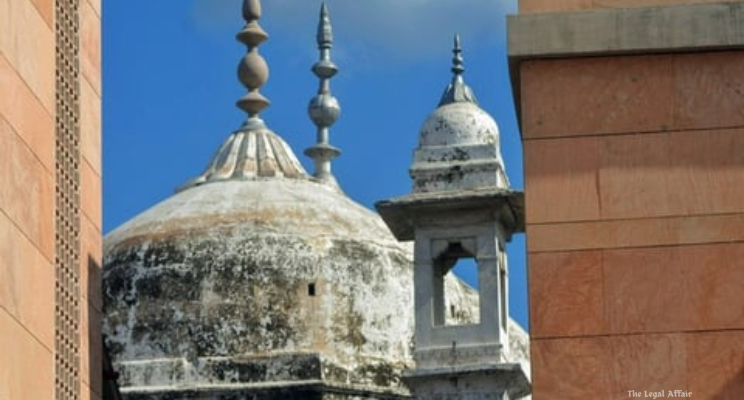
Introduction:
The Allahabad High Court, in a significant development concerning the Gyanvapi Mosque, today adjourned two petitions seeking an Archaeological Survey of India (ASI) survey of the mosque premises. The petitions, which request further examination of the premises to determine the presence of religious symbols and structures, were heard by a bench comprising Justice Rohit Ranjan Agarwal. The bench directed that the matters be posted for further hearing on February 24, 2025, in light of the Supreme Court’s interim order passed on December 12, 2024. The Supreme Court had placed a restraint on courts from passing any effective interim or final orders, including those related to conducting surveys, until further directions. The matters under consideration involve separate petitions—one filed by Rakhi Singh and the other by Lord Vishweshar, represented by his next friend, Advocate Vijay Shankar Rastogi. Both petitions seek an ASI survey of areas within the Gyanvapi Mosque complex that have not yet been surveyed, particularly focusing on the Wazukhana area and beneath the mosque’s central dome.
The first petition, filed by Rakhi Singh, challenges a Varanasi District Judge’s order from October 21, 2023, which had refused to direct the ASI to survey the Wazukhana area inside the Gyanvapi Mosque, except for a section known as the ‘Shiva Linga’. Singh’s petition calls for a more extensive survey of the premises to determine the extent of religious structures and symbols within the mosque. The second petition, filed by Lord Vishweshar, seeks a survey of the entire Gyanvapi Mosque complex, focusing on areas not previously covered by the ASI, particularly beneath the mosque’s central dome, which the petition claims may house the ‘Swayambhu Jyotirling’ – a significant Hindu religious symbol.
The Supreme Court’s December 12 order added a new layer of complexity to the matter, as it restrained lower courts from passing interim orders in cases concerning places of worship, including mosques and dargahs. This ruling came as part of the larger context of legal challenges to the Places of Worship Act, of 1991, which prohibits altering the religious character of places of worship as they stood on August 15, 1947. The Supreme Court’s intervention raised significant concerns over the growing number of lawsuits filed in various parts of the country, seeking ownership or changes to the status of medieval mosques and dargahs. The Court’s order is viewed as an important step in controlling the litigation around such sensitive religious matters, particularly when they involve historical and religious sites with long-standing significance to different communities.
Arguments of Both Sides:
In the first petition, filed by Rakhi Singh, the main argument was that the ASI should be allowed to survey the Wazukhana area inside the Gyanvapi Mosque to investigate whether some religious symbols or artefacts may be associated with Hindu worship. Singh’s legal team, led by Advocates Saurabh Tiwari and Vikash Kumar, argued that the refusal by the Varanasi District Court to allow an ASI survey of this area was unjustified, as it hindered the discovery of evidence that could be crucial to understanding the historical significance of the Gyanvapi Mosque complex. The petitioners argue that such a survey would help ascertain whether the mosque was originally a Hindu religious site, and they contend that a fair examination should not exclude key areas of the mosque from scrutiny.
On the other hand, the second petition filed by Lord Vishweshar, represented by Advocate Vijay Shankar Rastogi, challenges an October 2024 order by a Varanasi court that rejected a plea for a further ASI survey of the entire mosque complex, particularly focusing on the areas beneath the central dome. This petition claims that the central dome of the mosque may house the ‘Swayambhu Jyotirling’, a revered Hindu religious symbol. Advocates Ajay Kumar Singh, representing Lord Vishweshar, argued that this part of the complex had not been adequately surveyed, and the ASI needed to investigate to confirm the presence of religious symbols beneath the dome, as they are believed to be significant in Hindu mythology.
The petitioners in both cases argue that conducting further surveys by the ASI is essential for determining the religious and historical nature of the Gyanvapi Mosque. They contend that these surveys are necessary to ascertain whether the mosque was originally a Hindu temple and whether it contains any significant religious artefacts that may have been hidden or concealed over time. The petitioners claim that the information derived from these surveys would help settle longstanding disputes regarding the religious status of the mosque and its significance in the broader context of Hindu-Muslim relations.
The respondents, however, argue that further surveys should not be permitted, especially considering the Supreme Court’s order restraining lower courts from passing interim or final orders in cases related to places of worship. The respondents, including the mosque authorities, maintain that such surveys could be seen as attempts to alter the religious character of the site, which is prohibited under the Places of Worship Act, of 1991. They argue that any attempt to conduct a survey or excavate the premises could fuel communal tensions and exacerbate the ongoing disputes. Additionally, the respondents argue that the religious character of the Gyanvapi Mosque should be preserved and protected, and any actions that could potentially alter that character would be detrimental to the peaceful coexistence of religious communities in the country.
Court’s Judgment:
The Allahabad High Court, after hearing the arguments, decided to adjourn the two petitions seeking further ASI surveys of the Gyanvapi Mosque premises. The court scheduled the next hearing for February 24, 2025, after taking into account the Supreme Court’s interim order passed on December 12, 2024. The Supreme Court had specifically restrained courts from issuing any effective interim orders or final orders, including those related to conducting surveys, in cases involving places of worship. The Allahabad High Court also noted that the Supreme Court would be hearing a batch of petitions questioning the constitutional validity of the Places of Worship Act, 1991, a law that prohibits the conversion of the religious character of places of worship as they stood on August 15, 1947. The outcome of these petitions could significantly impact the ongoing legal proceedings related to the Gyanvapi Mosque.
The Allahabad High Court’s decision to adjourn the matter until February 2025 reflects the Court’s adherence to the Supreme Court’s order, which sought to address broader constitutional concerns related to the ownership and religious character of places of worship. The Court’s decision also indicates the sensitivity of the issues at hand, as any survey or investigation into the Gyanvapi Mosque’s premises could have far-reaching implications for religious and legal disputes in India. The court acknowledged that the matter involves complex issues of law, history, and religion, and thus, it requires careful consideration before any further orders are passed.
The Supreme Court’s intervention in December 2024 was seen as a significant step in curbing the rising number of suits claiming ownership or seeking to alter the religious status of medieval mosques and dargahs. By restraining lower courts from passing any interim or final orders, the Supreme Court has aimed to prevent further escalation of religious tensions and to allow for a more comprehensive examination of the constitutional issues surrounding the Places of Worship Act. The Allahabad High Court’s decision to adjourn the matter aligns with this broader legal and constitutional framework, ensuring that no further steps are taken that could impact the ongoing legal challenges to the Places of worship Act.