


Introduction:
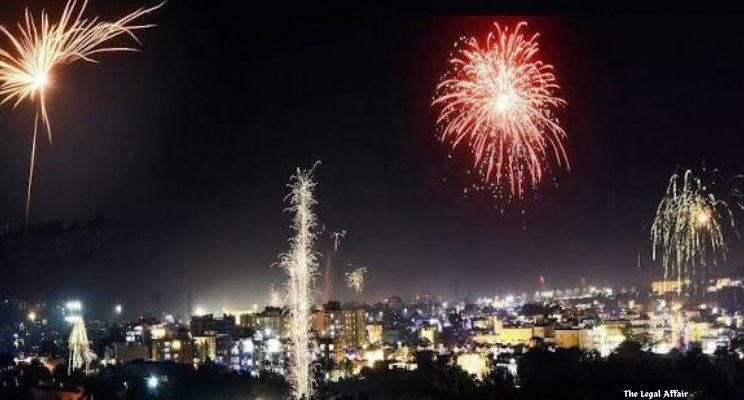
The Bombay High Court has issued a series of stringent directions to regulate noise and air pollution during religious processions and festivities across Maharashtra, emphasising that celebrations cannot be conducted at the cost of the fundamental rights of other citizens. The Court has directed the authorities to impose a total ban on bursting firecrackers on public streets and roads during festivities and prohibited the use of laser lights, high-intensity lumen lights and beams in religious processions and celebrations.
The directions were issued by a Division Bench comprising Justice Girish Kulkarni and Justice Dr Neela Gokhale in In Re: Noise and Environmental Pollution v. State of Maharashtra, Suo Motu PIL No. 1 of 2026. The proceedings were initiated suo motu by the High Court after taking note of recurring instances of noise and environmental pollution associated with religious processions and festivities.
The Court’s order comes against the backdrop of increasing concerns regarding excessive noise generated by high-powered speakers, sound systems, loudspeakers, dhol-tashas and other musical instruments during public celebrations. The Bench expressed particular concern over the impact of such noise in densely populated metropolitan areas such as Mumbai, Thane, Pune and Nashik, where a large number of residents may be exposed to prolonged and excessive sound levels even when they are not participating in the festivities.
The Court emphasised that the statutory framework regulating noise pollution does not disappear merely because a festival or religious procession is taking place. The Noise Pollution (Regulation and Control) Rules, 2000 continue to apply during festivities, and the authorities responsible for enforcement are required to ensure compliance with the prescribed standards.
The Bench observed that the time had come for festivals and processions to be conducted in a more dignified and regulated manner, particularly in densely populated cities. It expressed concern that violations of noise norms had continued despite the existence of statutory provisions and several judicial decisions dealing with noise pollution.
The Court’s directions extend beyond the volume of sound systems. It ordered that organisers of processions and festivities must install Decibel Measurement Meters at conspicuous locations so that noise levels can be monitored. Organisers must also furnish an undertaking that the sound systems used during the event will contain internal sound limiters capable of restricting the volume within permissible levels.
The Bench further directed authorities to consider requiring a security deposit of at least Rs 1 lakh from an association or group of persons and Rs 50,000 from an individual as a condition for granting permission under the Noise Pollution Rules. The deposit would be liable to forfeiture in the event of a breach of prescribed decibel limits, in addition to any other legal consequences.
The Court also directed that permissions granted to organisers should be displayed prominently during processions and festivities. The names, addresses and mobile numbers of persons responsible for organising the events are also to be displayed so that responsibility for violations can be identified and fixed.
Another important aspect of the order concerns the cumulative impact of multiple processions and events in the same locality. The Court directed designated authorities to consider the combined effect of several permissions being granted within a single ward. According to the Bench, merely examining each event separately would not provide an accurate picture of the overall noise burden imposed upon residents.
The Court also expressed serious concern regarding air pollution caused by the bursting of firecrackers. It noted that firecrackers are often burst on public roads and streets where pedestrians and vehicles are present, creating risks of accidents in addition to contributing to air and noise pollution.
The Bench further noted concerns regarding the toxicity of smoke produced by firecrackers. It observed that the extent of toxicity of emissions generated by firecrackers appeared to be an area insufficiently regulated and that the cumulative impact of such emissions on air quality could constitute a serious environmental and public health concern.
Against this background, the Court directed strict enforcement of the applicable legal provisions, including the Noise Pollution (Regulation and Control) Rules, 2000, the Environment (Protection) Act, 1986, the Bharatiya Nyaya Sanhita, 2023 and the Explosives Act, 1884, wherever applicable.
The Court clarified that the restrictions were not directed at any particular religion or festival. The directions concerning religious processions and festivities were framed generally and were intended to apply irrespective of the religious identity of the organisers or the festival being celebrated.
The proceedings have therefore brought into focus the legal balance between the freedom to celebrate religious and cultural occasions and the rights of citizens to live in an environment free from excessive noise and pollution. The Court has made clear that permission to conduct a procession or festival does not amount to permission to violate environmental and noise-control laws.
The matter has been adjourned for compliance until October 15, when the authorities are expected to report on the implementation of the directions.
Arguments of the Parties:
The proceedings before the Bombay High Court were initiated suo motu rather than through an ordinary adversarial petition filed by a private individual. The Court itself took cognisance of the recurring problem of noise and environmental pollution generated during religious processions and festivities.
The concerns before the Bench related primarily to the implementation of the Noise Pollution (Regulation and Control) Rules, 2000 and the failure, as perceived by the Court, of the enforcement machinery to consistently ensure compliance with those rules.
Senior Advocate Aspi Chinoy appeared as Amicus Curiae and assisted the Court in examining the legal and regulatory framework governing noise pollution. His submissions supported the proposition that the statutory restrictions on noise do not cease to operate merely because a festival or religious celebration is being conducted.
The Amicus Curiae’s position, as recorded by the Court, was that there cannot be an assumption that the Noise Pollution Rules become non-existent or are substantially relaxed during periods of festivities. The existence of a religious or cultural celebration cannot, by itself, create an exemption from statutory noise limits.
The Court agreed with this basic proposition and considered it necessary to clarify that the legal regime continues to operate even during religious festivals and public processions.
The State authorities, on the other hand, were required to explain the existing enforcement arrangements and the steps being taken to implement the statutory restrictions. The Advocate General appearing for the State sought to place before the Court an assurance that the Noise Pollution Rules were being appropriately implemented.
The Bench, however, expressed reservations about whether the situation on the ground supported the optimistic picture placed before it. The judges observed that despite repeated judicial pronouncements and the existence of a detailed regulatory framework, violations continued to occur.
The Court particularly referred to the enforcement responsibilities of authorities such as the Police Commissioner, Municipal Commissioner, Maharashtra Pollution Control Board and other designated agencies. The Bench observed that although these authorities possessed statutory powers, effective implementation had remained inadequate in practice.
The Court’s concern was not limited to one particular procession or one particular festival. Instead, the Bench considered the recurring nature of violations across metropolitan areas and other densely populated parts of the State.
The Court was particularly concerned about the impact of excessive noise on persons who may have no connection with the celebration. Senior citizens, persons who are ill or otherwise vulnerable, students preparing for examinations and young children were identified as sections of society that may be particularly affected by high levels of noise.
The Bench also considered the consequences of firecracker use. Apart from the noise generated by fireworks, the Court was concerned about smoke, air pollution and the risk of accidents when firecrackers are burst on public streets and roads.
The Court noted that pedestrians and vehicles continue to use public roads during festivals and processions. Sudden or uncontrolled bursting of firecrackers can therefore create an additional risk of injury or accidents.
Another concern related to the availability of firecrackers without clear and reliable information regarding the level of noise they would generate. The Bench noted that many firecrackers openly available for use did not appear to provide sufficiently clear information concerning their permissible decibel levels or the actual noise that could be produced when they were burst.
The Court also considered the question of toxicity. It observed that while the legal framework contains provisions dealing with environmental and noise pollution, the extent of toxicity of smoke generated by firecrackers appeared to remain inadequately regulated. The Court described this as a prima facie unregulated area requiring serious consideration.
The State authorities were consequently required to address not only the enforcement of sound limits but also the broader environmental implications of public celebrations.
The Court also focused on the manner in which permissions are granted for multiple events. The Bench observed that a locality may sometimes have several processions, festivals or public events taking place around the same period. If each permission is assessed independently, the authorities may fail to account for the cumulative effect of all the noise generated within the same geographical area.
The Court therefore called for a more scientific approach to granting permissions. The designated authorities were directed to consider the cumulative impact of multiple permissions granted within the same ward before allowing events to proceed.
The Bench’s observations also reflected the broader constitutional dimension of the proceedings. Excessive noise, according to the Court, is not merely a regulatory violation. A breach of the Noise Pollution Rules may affect the fundamental rights of other citizens.
The Court consequently emphasised that enforcement authorities could not treat violations as minor or routine breaches. Where violations occur, the statutory consequences must follow, including appropriate action under the relevant environmental, criminal and explosives laws.
The Court’s directions were therefore aimed at creating a system of accountability in which organisers could be identified and held responsible for violations rather than leaving enforcement dependent upon general assurances of compliance.
The requirement that organisers display their permissions and the names, addresses and mobile numbers of responsible persons was intended to facilitate precisely such accountability. It would enable enforcement authorities to identify who was responsible for a particular procession or event if the prescribed limits were breached.
The Court also contemplated financial accountability through the proposed security deposits. The minimum deposit of Rs 1 lakh for associations or groups and Rs 50,000 for individuals would operate as an additional condition attached to permission to conduct festivities under the Noise Pollution Rules.
The underlying idea was that a breach should have immediate and tangible consequences. If the prescribed decibel limits were exceeded, the deposit could be forfeited in addition to other action authorised by law.
Thus, while the proceedings were initiated suo motu, the hearing involved consideration of the responsibilities of government authorities, pollution-control agencies, police authorities and festival organisers. The Court’s ultimate directions were designed to create a regulatory framework in which permission to conduct a public event would be accompanied by clearly defined responsibilities and consequences for non-compliance.
Court’s Judgment:
The Bombay High Court’s judgment proceeds from the principle that the right to celebrate religious and cultural festivals does not exist in isolation from the rights of other members of society. The Bench recognised that religious processions and festivities form an important part of public life, but emphasised that their conduct remains subject to statutory restrictions, particularly those designed to protect citizens from excessive noise and environmental pollution.
The Court made it clear that there can be no assumption that the Noise Pollution (Regulation and Control) Rules, 2000 become inapplicable during festivals. The regulatory framework continues to operate even when a public event has a religious character.
The Bench agreed with the submission of Amicus Curiae Senior Advocate Aspi Chinoy that festivities cannot be treated as a legal exception to noise-control requirements. The Court observed that any impression that the statutory requirements disappear during festivals was inconsistent with the law.
The Court was particularly critical of the gap between the legal framework and actual enforcement. It noted that successive decisions of the Supreme Court and High Courts have already dealt with noise pollution, yet violations continue to occur.
According to the Bench, the problem is therefore not necessarily the absence of legal provisions. Rather, the difficulty lies in their effective implementation by the authorities responsible for enforcement.
The Court observed that the authorities could not escape responsibility by relying upon the existence of permissions or by asserting that adequate systems were already in place. The actual ground situation, according to the Court, demonstrated continuing instances of excessive noise and pollution.
The Bench consequently directed a regime of strict restraint concerning public festivities and religious processions. It specifically ordered a total ban on bursting firecrackers on public streets, roads and similar public spaces during festivities. Authorities were directed to take all necessary steps to prevent air and noise pollution resulting from such use.
The Court also prohibited the use of laser lights, high-intensity lumen lights and beams in festivities and processions. This direction formed part of the broader effort to regulate the environmental and public-safety consequences associated with large public celebrations.
With respect to sound systems, the Court directed the authorities to measure decibel levels generated by persons and organisations granted permission to conduct festivities or processions. Where violations were detected, stringent action was to be taken in accordance with law.
The Court also directed authorities to seize and confiscate devices, instruments or materials used in offending or unauthorised activities where legally permissible. The direction was intended to ensure that enforcement did not stop merely at recording a violation.
A particularly important feature of the judgment is the requirement that organisers install Decibel Measurement Meters and display the measurements at a conspicuous location. This creates a mechanism through which the noise level generated during a public event can be monitored rather than assessed solely through complaints received after the event.
The Court further directed organisers to furnish an undertaking that the sound systems used during the festivities or processions would be equipped with internal sound limiters. Such limiters are intended to prevent sound systems from being operated beyond the prescribed limits.
The Bench also introduced a financial safeguard by directing authorities to consider accepting security deposits as a condition for granting permission. The amount is to be at least Rs 1 lakh in the case of an association or group of persons and at least Rs 50,000 where an individual is responsible for the event.
The deposit is not described as a substitute for prosecution or other legal consequences. Rather, it would stand forfeited upon breach of the applicable decibel limit, in addition to whatever action the law requires against the offending persons.
The Court also directed that permissions granted for festivities and processions should be prominently displayed. The names, addresses and mobile numbers of persons responsible for organising the events are also required to be displayed.
This direction creates a direct chain of accountability. If excessive noise or another violation occurs, the enforcement authorities should be able to identify the persons responsible for the event without difficulty.
The Court further directed the authorities to sensitise organisers and Mandals regarding their obligations towards society. The Bench considered public awareness and responsibility to be important components of effective enforcement.
The Court’s approach also extends to the process by which permissions are granted. It directed the designated authorities to examine the cumulative impact of multiple permissions within a particular ward.
This means that an authority should not examine a proposed procession or celebration entirely in isolation. Where several events are likely to take place in the same area, the combined noise impact must also be considered.
The Court described such an assessment as requiring a methodical and scientific approach. Without consideration of the cumulative effect, permissions may result in a level of noise pollution inconsistent with the Noise Pollution Rules.
The environmental dimension of the order is equally significant. The Bench expressed serious concern about the air pollution produced by firecrackers, particularly during the months following the monsoon when maintaining ambient air quality in cities can already present a substantial challenge.
The Court referred to the smoke and other emissions generated by fireworks and observed that the cumulative impact of such pollution on air quality can create serious environmental and health concerns.
The Bench also highlighted the dangers of bursting firecrackers on public streets. Roads remain occupied by pedestrians, two-wheelers and cars, and the unexpected bursting of fireworks can create risks of accidents and injuries.
The Court was additionally concerned that firecrackers available for public use may not provide sufficiently clear information regarding the noise they will generate. The absence of adequate information concerning decibel levels makes effective regulation more difficult and can contribute to violations of prescribed noise limits.
The Court’s observations regarding toxicity were also significant. It noted that the regulation of the toxicity of smoke generated by firecrackers appeared to be an area requiring greater attention. The Court described this as a prima facie unregulated area and connected it with the broader question of air quality.
The Bench identified several groups that may be especially vulnerable to excessive noise. Senior citizens, persons suffering from illness, students preparing for examinations and children were specifically mentioned. The Court noted that such individuals may be particularly unable to withstand sustained exposure to high levels of noise.
The constitutonal dimension of the judgment emerges from the Court’s observation t