


Introduction:
The Sikkim High Court has taken suo motu cognisance of concerns regarding the allegedly dilapidated infrastructure of the Sikkim Government Law College at Burtuk and has constituted a five-member Fact-Finding Committee comprising members of the Bar to examine the condition of the institution and place a report before the Court.
The proceedings arise in In Re Dilapidated Condition of Infrastructure of Sikkim Government Law College, WP(PIL) No. 13 of 2026. The Division Bench comprising Chief Justice A. Muhamed Mustaque and Justice Bhaskar Raj Pradhan initiated the public interest litigation after students and members of the Representative Council approached the Chief Justice on September 11, 2026, raising concerns about the condition of the college building and other facilities available to law students.
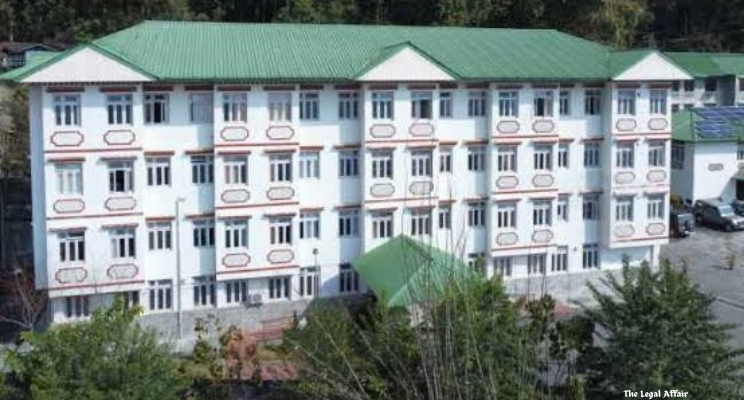
According to the concerns brought before the Court, the college building was allegedly in a “severely dilapidated state”, creating a potential threat to the safety and lives of students who attend classes there. The grievance, however, was not confined merely to the physical condition of the building. The students also brought to the Court’s attention the alleged absence or inadequacy of several facilities that are ordinarily necessary for a law college, including library infrastructure, moot court facilities, seminar and conference spaces, hostel accommodation, sanitation facilities and sports infrastructure.
The matter assumes particular significance because legal education is not limited to classroom teaching. A law college is expected to provide students with an academic environment in which they can access legal literature, participate in moot courts, attend seminars and conferences, engage in practical legal training and develop professional skills. The concerns raised before the High Court therefore extended beyond a question of maintenance of a government building and touched upon the broader question of whether students were receiving an adequate and safe environment for legal education.
During the hearing, the Division Bench interacted with three students who had brought the alleged deficiencies to the Court’s attention. The students placed photographs of the college building before the Court to demonstrate its condition. After considering the submissions and material placed before it, the Bench found that several issues warranted independent examination, particularly the structural integrity of the building.
Rather than reaching a final conclusion on the basis of the allegations alone, the High Court considered it appropriate to obtain an independent fact-finding report. The Court accordingly observed that there was a need to appoint a Fact-Finding Committee consisting of members of the Bar Associations of Sikkim.
The Bench appointed Senior Advocate Karna Thinlay Namgyal as the Convenor of the Committee. Senior Advocate Tashi Rapten Barfungpa, Deputy Solicitor General Sangita Pradhan, Advocate Zola Megi and Advocate Kazi Sangay Thupden were appointed as its other members.
The Court also directed the Structural Engineer of the Buildings and Housing Department to immediately inspect the college building and submit a report concerning its structural stability before the next date of hearing. This direction assumes importance because the allegation concerning the building was not merely about inconvenience or inadequate maintenance; it involved an alleged risk to the safety of students and other persons using the premises.
At the same time, the Court took note of the State’s position. The Additional Advocate General submitted that arrangements had been made to conduct classes through both offline and online modes at the college. The Bench nevertheless sought a more concrete response from the State Government regarding the measures proposed to address the deficiencies and the time within which those measures would actually be implemented.
The High Court consequently directed the State Government to file a statement setting out the measures it proposed to undertake and the corresponding timeline for their implementation. The matter has been listed for further consideration on September 29, 2026.
The proceedings thus represent an effort by the High Court to ascertain the factual position before determining what further directions, if any, may be necessary to ensure the safety of students and the adequacy of infrastructure at the Government Law College.
Arguments of the Parties:
The concerns before the High Court were brought to its attention principally through the representation made by students and members of the Representative Council. The students who appeared before the Bench sought to highlight what they claimed were serious deficiencies in the infrastructure of the Government Law College.
The principal concern was the condition of the college building itself. The students alleged that the structure was in a severely dilapidated condition and could potentially endanger the lives and safety of students. During the hearing, three students made submissions before the Court and produced photographs to substantiate their concerns. The photographs were relied upon to demonstrate the physical condition of the premises and to persuade the Court that the issue required immediate attention rather than being treated as an ordinary administrative grievance.
The students’ concerns also extended to the broader educational infrastructure. It was pointed out that the college allegedly did not have a proper library facility of the nature required under the applicable Bar Council of India norms. For a law college, the library occupies a central position because legal education necessarily involves extensive access to statutes, case law, commentaries, journals and other legal materials. The alleged inadequacy of the library was therefore presented as a deficiency affecting the academic environment available to students.
The students also raised concerns regarding the absence of adequate moot court halls. Moot court exercises are an important component of practical legal education because they provide students with an opportunity to develop advocacy, legal research, drafting and oral argument skills. The alleged lack of appropriate space for such activities was consequently identified as another infrastructure-related concern.
Similarly, the absence of a proper conference hall or auditorium was brought to the Court’s attention. Such facilities are relevant for conducting seminars, conferences, guest lectures, academic programmes and other activities forming part of a law institution’s academic environment. The grievance was that the absence of appropriate facilities restricted the college’s ability to conduct such programmes effectively.
Another concern related to the absence of hostel facilities for students. Although hostel accommodation may involve considerations different from those governing the structural safety of an academic building, the students placed it before the Court as part of the larger question concerning the adequacy of institutional infrastructure.
The availability of sanitation facilities was also questioned. The students pointed to an alleged insufficiency of washrooms and toilets. The concern assumes importance because adequate sanitation is a basic requirement in any educational institution and directly affects the health, dignity and day-to-day well-being of students.
The students further highlighted the lack of sports facilities. While sports infrastructure may not directly concern the structural safety of the college building, it was identified as one of the areas requiring examination in assessing the overall infrastructure available at the institution.
Thus, the case before the High Court involved two interconnected aspects. The first was an immediate safety concern relating to the structural condition of the college building. The second involved the broader adequacy of facilities necessary for students pursuing legal education.
On behalf of the State, the Additional Advocate General, Zangpo Sherpa, appeared along with Government Advocates Thinlay Dorjee Bhutia and S. K. Chettri and Assistant Government Advocate Sujan Sunwar. The State’s submissions indicated that steps had already been taken to ensure continuity of teaching. In particular, the Additional Advocate General informed the Court that arrangements had been made for both offline and online classes at the college.
The State’s position therefore indicated that the administration was not leaving students without access to academic instruction and had made alternative arrangements for conducting classes. The availability of online classes was particularly relevant in the context of concerns regarding the condition of the college premises, as it provided an immediate mechanism for continuing teaching while the infrastructure issues were being examined.
However, the Bench sought information going beyond the immediate continuation of classes. The Court specifically required the State Government to disclose what measures it proposed to undertake to address the infrastructure concerns and the timeline within which those measures would be carried out.
This distinction is significant. The continuation of classes, whether offline or online, addresses the question of academic continuity, but it does not by itself resolve allegations concerning structural safety, library facilities, moot court infrastructure, sanitation, accommodation or other institutional requirements. The Court therefore sought a comprehensive response from the government regarding the proposed remedial measures.
Rather than treating either side’s assertions as conclusively established, the High Court adopted a fact-finding approach. The appointment of a committee comprising members of the Bar, together with the separate inspection by a Structural Engineer, was intended to enable the Court to assess the factual situation objectively before determining the appropriate course of action.
Court’s Judgment:
The Sikkim High Court’s order reflects a cautious judicial approach to a public interest grievance involving the safety of students and the adequacy of infrastructure at a government educational institution. The Division Bench did not immediately pronounce upon the truth of every allegation placed before it. Instead, it considered that the allegations raised issues sufficiently serious to warrant an independent examination.
The Bench specifically observed that there was a need to appoint a Fact-Finding Committee for an inquiry by members of the Bar Associations of Sikkim and for submission of a report before the Court. The decision to constitute such a committee was therefore directed towards gathering reliable information concerning the actual condition of the institution.
Senior Advocate Karna Thinlay Namgyal was appointed as the Convenor. The Committee also comprises Senior Advocate Tashi Rapten Barfungpa, Deputy Solicitor General Sangita Pradhan, Advocate Zola Megi and Advocate Kazi Sangay Thupden.
The composition of the committee is significant because the Court chose experienced members of the legal profession to undertake an independent examination of the concerns. The committee’s role, as indicated by the order, is essentially fact-finding. It is not the final adjudicatory authority on the rights and liabilities of the parties. Its report is intended to assist the High Court in understanding the actual position on the ground.
The structural condition of the college building was treated as a matter requiring particularly urgent examination. Since the allegations suggested a possible threat to the safety and lives of students, the Court separately directed the Structural Engineer of the Buildings and Housing Department to inspect the building immediately.
The Engineer has been directed to submit a report concerning the structural stability of the college building before the next hearing. This direction creates a specialised technical mechanism for assessing an issue that cannot appropriately be determined merely on the basis of photographs or oral submissions.
The Court’s approach also recognises the difference between visual evidence of deterioration and a formal technical assessment of structural safety. Photographs may demonstrate cracks, damaged portions, deterioration or other visible defects, but the question of whether a building is structurally stable requires technical evaluation. By calling for the report of a Structural Engineer, the Bench has sought to ensure that the question of safety is examined through an appropriate technical process.
At the same time, the Court did not restrict the inquiry to the physical building. The Bench identified several other areas requiring examination. These included the availability of a proper library facility in accordance with the applicable Bar Council of India requirements, adequate moot court halls, conference halls or auditoriums for seminars, hostel facilities, sufficient washrooms and toilets, and sports facilities.
The reference to Bar Council of India requirements is particularly relevant in the context of legal education. Law colleges are not merely ordinary classroom institutions. Their academic infrastructure must support both theoretical and practical legal education. A library, for example, enables students to conduct legal research, while moot court facilities allow them to practise advocacy and develop courtroom skills. Similarly, seminar and conference infrastructure facilitates interaction with academics, practitioners and judges.
The Court’s identification of these issues indicates that its inquiry is concerned not only with whether students can physically attend classes but also with whether the institution possesses the basic infrastructure expected of a law college.
The High Court also took note of the submission made by the Additional Advocate General that arrangements had been made for conducting both offline and online classes. The Court did not disregard this assurance. However, the direction requiring the State to provide a detailed statement of proposed measures demonstrates that the Bench considered a broader and more structured response necessary.
The Court specifically directed the State Government to file a statement setting out the measures it proposed to take and the timeline within which those measures would be undertaken. The direction effectively requires the administration to move from a general assurance of arrangements towards a concrete action plan.
This aspect of the order is important in public interest proceedings concerning infrastructure. Merely acknowledging that deficiencies exist does not necessarily resolve them. Remedial measures generally require identification of the work to be undertaken, the authority responsible for implementing it, the resources required and a reasonable timeline. By seeking a statement from the State Government, the High Court has placed these matters on record and created a basis upon which compliance can subsequently be examined.
The order also demonstrates the role of the High Court’s public interest jurisdiction in circumstances where institutional conditions may affect the safety and educational interests of students. Educational infrastructure ordinarily falls within the domain of the executive administration. However, where allegations concern potentially unsafe premises and deficiencies affecting students’ basic educational environment, constitutional courts may call upon the State to explain the steps being taken and, where warranted, issue directions within the scope of their jurisdiction.
The Court’s intervention at this stage is therefore primarily supervisory and fact-finding. It has not, on the basis of the material presently before it, finally determined that the college building is structurally unsafe or that every alleged deficiency amounts to a violation of a statutory requirement. Instead, it has directed competent persons and authorities to ascertain the factual position.
This approach is also consistent with basic principles of judicial decision-making. Serious allegations affecting public institutions require reliable factual determination before final directions are issued. The constitution of the Fact-Finding Committee and the direction for a structural inspection enable the Court to obtain material that can assist it in reaching a reasoned conclusion at a subsequent stage.
The Court’s order also keeps open the possibility of further directions after receiving the reports. Once the Fact-Finding Committee submits its findings and the Structural Engineer provides the structural stability report, the Bench will be in a better position to assess whether immediate safety measures are necessary, whether repairs or reconstruction are required, and what steps may be appropriate concerning the other institutional deficiencies identified during the hearing.
The matter has accordingly been listed for further consideration on September 29, 2026.
At the next stage, the High Court is expected to consider the material placed before it, including the structural assessment and the State Government’s proposed action plan. The Court may then determine whether the measures proposed are sufficient to address the concerns raised or whether additional directions are required.
The proceedings in In Re Dilapidated Condition of Infrastructure of Sikkim Government Law College therefore remain pending. The present order does not finally decide the factual or legal issues surrounding the college’s infrastructure. Instead, it marks the Court’s first substantive intervention after taking suo motu cognisance of the concerns raised by students.
The larger significance of the proceedings lies in the fact that the safety and quality of an institution imparting legal education cannot be viewed separately from the conditions in which students are required to study. A law college is expected to provide not only classrooms but also an environment that supports research, advocacy training, academic interaction and the overall professional development of future members of the legal profession.
By directing an independent fact-finding inquiry, ordering an immediate structural inspection and requiring the State Government to disclose a time-bound plan for remedial measures, the Sikkim High Court has sought to place the factual and administrative response to the alleged deficiencies under judicial scrutiny. The next hearing on September 29 will therefore be significant in determining the course of the proceedings and the further directions, if any, that may follow from the reports and the State’s response.