


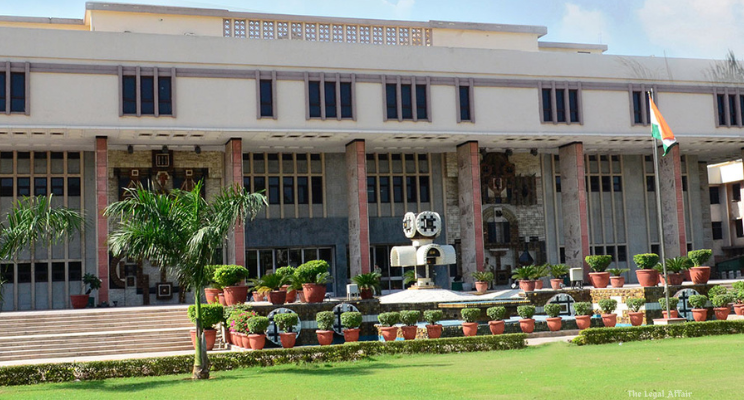
Introduction:
In M/s Sunlight Project Pvt. Ltd. v. Delhi Development Authority, the Delhi High Court examined a challenge filed under Section 34 of the Arbitration and Conciliation Act, 1996 against an arbitral award that rejected all claims raised by M/s Sunlight Project Pvt. Ltd., a commercial plot purchaser who had won a DDA auction but withheld payment of the balance consideration on the ground that the Delhi Development Authority failed to provide basic civic amenities at the subject site. The petitioner, Sunlight Project Pvt. Ltd., had emerged as the highest bidder in an open auction conducted by DDA for a commercial plot situated at Sector 20, Dwarka, New Delhi, at a bid value of ₹17.51 crores. After depositing earnest money, Sunlight sought several extensions to deposit the balance payment and simultaneously demanded that DDA provide infrastructural facilities such as water connection before payment could be completed. When DDA refused, Sunlight moved a writ petition which was dismissed on the ground that disputed facts could not be adjudicated under writ jurisdiction, whereafter Sunlight invoked arbitration. The Sole Arbitrator rejected all claims through an award dated 14.09.2020, giving rise to the present petition where the High Court was called upon to decide whether the award suffered from patent illegality, violated public policy, or warranted intervention under Section 34. Justice Jasmeet Singh, after an extensive evaluation of facts, contractual terms, and arbitral reasoning, ultimately upheld the award and dismissed the petition, reaffirming a crucial commercial and contractual principle: when a purchaser bids for land on an “as is where is basis,” the seller is not obligated to provide amenities beforehand, and the buyer cannot use the absence of such facilities as a reason to delay or avoid payment of the balance consideration.
Arguments of Both Sides:
The petitioner, M/s Sunlight Project Pvt. Ltd., advanced a detailed set of arguments asserting that the arbitral award suffered from patent illegality and violated the public policy of India under Section 34 of the Arbitration and Conciliation Act. Sunlight contended that the arbitrator’s finding—that Sunlight had not communicated to DDA any objection regarding forfeiture of earnest money—was erroneous in law and contrary to the statutory framework of Sections 73 and 74 of the Indian Contract Act, which mandate an independent inquiry into whether the party forfeiting earnest money has suffered actual loss. According to the petitioner, the arbitrator failed to conduct such an inquiry, and instead treated the forfeiture as justified without any evidence of loss being recorded by DDA. Sunlight also argued that it had repeatedly requested DDA to provide infrastructural amenities and basic facilities such as water and that the absence of such essential services rendered the plot commercially unusable, thereby giving Sunlight sufficient grounds to suspend payment of the remaining amount until DDA fulfilled its obligations. It further argued that the arbitrator incorrectly held that the issue had already been decided during earlier writ proceedings, when in fact the writ was dismissed merely on maintainability grounds and not on merits. In addition, Sunlight claimed that the finding that the balance consideration was unpaid due to lack of funds was perverse, unsupported, and contradicted by correspondence showing that Sunlight’s inability to use the plot due to lack of amenities was the real cause for delay. On the other hand, DDA argued that the petition was frivolous and aimed at reopening factual findings conclusively settled by the arbitrator. DDA submitted that the auction terms clearly stated that the plot was sold on an “as is where is basis,” which imposed no obligation on DDA to furnish amenities prior to payment. The authority pointed out that Sunlight knowingly accepted these terms, participated in the auction, and fully understood that the plot might lack amenities at the time of sale. DDA further argued that Sunlight admitted before the arbitrator that it had defaulted in making the balance payment and had also admitted the cancellation of allotment and forfeiture of earnest money. DDA maintained that loss caused to the public by delay in commercial development cannot always be quantified, and therefore earnest money clauses serve as genuine pre-estimates of loss, shifting the burden to buyers to prove that forfeiture amounts to penalty—a burden Sunlight failed to discharge. It was contended that the arbitrator’s findings were based on sound legal reasoning, precedents including Aggarwal Associates v. DDA (2010), and the factual matrix, thereby making the award immune from interference. DDA insisted that Section 34 does not permit reassessment of facts or substitution of judicial opinion for that of the arbitrator, and since no patent illegality had been demonstrated, the petition deserved dismissal.
Court’s Judgment:
The Delhi High Court, in a meticulously reasoned judgment delivered by Justice Jasmeet Singh, upheld the arbitral award and dismissed Sunlight’s petition by reaffirming well-settled principles governing auctions conducted on “as is where is basis,” the boundaries of judicial intervention under Section 34, and the nature of earnest money forfeiture in commercial transactions. The Court began by analysing the arbitral award and observing that the Sole Arbitrator had thoroughly evaluated all factual assertions, contractual clauses, and legal arguments before rejecting Sunlight’s claims. The High Court emphasised that Section 34 does not confer appellate jurisdiction on the Court; thus, it cannot reappreciate evidence or substitute its own view merely because another view may be possible. The Court noted that the arbitrator’s core findings included that Sunlight had failed to establish that DDA was contractually required to provide civic amenities before collecting the balance bid amount, and more importantly, that Sunlight had failed to pay the balance amount due to insufficient financial capacity rather than infrastructural deficiencies. The Court held that this factual finding, derived from correspondence exchanged between the parties, was logical and grounded in evidence, with no perversity or irrationality demonstrated. The Court emphasised that these very facts had been confronted in earlier writ proceedings where the Court found that disputed questions of fact existed and dismissed the writ petition, and Sunlight could not now re-agitate the same issues under Section 34. Justice Jasmeet Singh reiterated that the terms of the auction explicitly provided that the plots were sold on an “as is where is basis,” meaning the purchaser accepted the land in its existing condition, taking full responsibility for any deficiencies or developmental requirements. The Court invoked the Supreme Court’s judgment in Aggarwal Associates (Promoters) Ltd. v. DDA (2010) which held that when land is sold on an “as is where is basis,” buyers cannot demand amenities before making payment; the seller’s obligation does not extend to ensuring fully developed infrastructure unless expressly mentioned in the auction terms. Applying this principle, the Court observed that Sunlight, being a commercial developer, was fully aware that undeveloped plots are often auctioned without amenities and that the responsibility to verify the condition of the land rests solely upon the bidder. The Court criticised the petitioner for attempting to use the absence of amenities as an afterthought to justify non-payment. Further, the Court examined the arbitrator’s interpretation of the forfeiture clause relating to earnest money. The Court noted that the arbitrator correctly applied Sections 73 and 74 of the Indian Contract Act and held that when a contract describes an amount as earnest money or a genuine pre-estimate of loss, the burden lies upon the party seeking refund to prove that such forfeiture constitutes a penalty. Since Sunlight failed to prove this, and DDA had shown that re-auction processes incur administrative expenses, delay costs, and negative financial consequences, the forfeiture could not be said to be punitive. The Court agreed with the arbitrator that losses caused to public bodies in cases of delayed construction or stalled development cannot always be easily measured monetarily, and therefore forfeiture clauses exist to protect the public exchequer from speculative bidding. Additionally, the Court upheld the arbitrator’s finding that Sunlight never challenged the forfeiture contemporaneously, demonstrating that its challenge was belated, afterthought-driven, and lacking credibility. The High Court further held that the arbitrator’s view that the petitioner had failed to furnish any reliable material showing that DDA would earn profits in a resale process was correct, noting that the petitioner had not discharged the burden of proof at all. The Court affirmed that the arbitrator’s conclusions were supported by evidence, logical, and well within the four corners of contractual interpretation. Justice Jasmeet Singh was categorical in ruling that none of the statutory grounds for setting aside an arbitral award—such as patent illegality, conflict with public policy, breach of natural justice, or lack of jurisdiction—were established by the petitioner. The award neither violated the fundamental policy of Indian law nor suffered from unreasonableness or perversity. Sunlight, the Court noted, participated in the auction voluntarily, accepted the terms knowingly, defaulted in payment, and attempted to reshape its default into a legal grievance after losing commercially. Courts, the judgment emphasised, do not rescue parties from bad bargains or relieve them from contractual obligations freely undertaken. Upholding these contractual and legal principles, the High Court dismissed the petition, thereby endorsing the arbitrator’s award in full and reinforcing the sanctity of contracts, the limited nature of judicial scrutiny under Section 34, and the essential understanding that “as is where is basis” auctions impose no infrastructural obligations on the seller before payment is completed.