


Introduction:
In a significant legal development, the Telangana High Court has quashed proceedings against a private teacher accused of illegal gambling under the Telangana Gaming Act, 2017. The case centered around the interpretation of Section 9(1) of the Act, which penalises gaming activities conducted in public spaces. The court’s decision underscores the importance of precise legal definitions and the necessity for law enforcement to adhere strictly to statutory provisions.
Background:
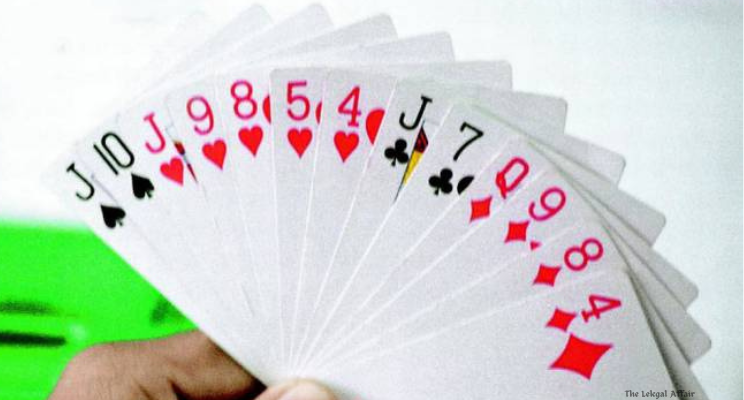
The petitioner, a private teacher, was implicated in a case where the police alleged that he, along with others, was involved in playing a card game involving betting. The incident occurred near the Indian Gas Agency, specifically within agricultural fields behind the Indian Gas Godown. Acting on information about illegal gambling activities, the police apprehended two individuals at the scene, seizing Rs. 3,900, two cell phones, and two bikes. Further investigation led to the seizure of Rs. 7,800 and 104 plastic playing cards. Subsequently, a case was registered under Section 9(1) of the Telangana Gaming Act, 2017.
Legal Provisions:
Section 9(1) of the Telangana Gaming Act, 2017, stipulates that any person found gaming or reasonably suspected to be gaming in any public street, thoroughfare, or place accessible to the public shall be punishable with imprisonment up to six months, a fine up to Rs. 5,000, or both. The crux of the case hinged on whether the location of the alleged gaming activity qualified as a “public place” under this provision.
Arguments Presented:
The petitioner’s counsel argued that the location in question was neither a public street nor a place accessible to the public. It was situated behind a gas agency, within agricultural fields, and not an area of ingress or egress accessible to the public. The defence emphasised that the prosecution failed to establish that the alleged gaming occurred in a public place as defined by the Act.
On the other hand, the prosecution maintained that the police acted on credible information and that the presence of gaming paraphernalia and money substantiated the charges. They contended that the location, being in proximity to a public area, fell within the ambit of Section 9(1).
Court’s Observations and Judgment:
Justice K. Sujana, presiding over the case, meticulously examined the provisions of the Telangana Gaming Act, 2017. The court observed that for a charge under Section 9(1) to hold, it must be unequivocally established that the gaming activity occurred in a public street, thoroughfare, or a place accessible to the public. The court noted that the prosecution did not provide sufficient evidence to classify the location as a public place.
Furthermore, the court highlighted that the charge sheet lacked any allegations of public complaints or disturbances caused by the alleged gaming activity. The case was registered suo motu by the police, without any direct evidence linking the petitioner to gaming in a public area.
In light of these observations, the court concluded that the continuation of proceedings against the petitioner amounted to an abuse of the legal process. Consequently, the court quashed the proceedings, providing relief to the petitioner.
Conclusion:
This judgment by the Telangana High Court reinforces the principle that legal provisions must be applied with precision and that law enforcement agencies must adhere strictly to statutory definitions. The case underscores the judiciary’s role in safeguarding individual rights against overreach and ensuring that legal actions are grounded in clear and substantiated evidence.