


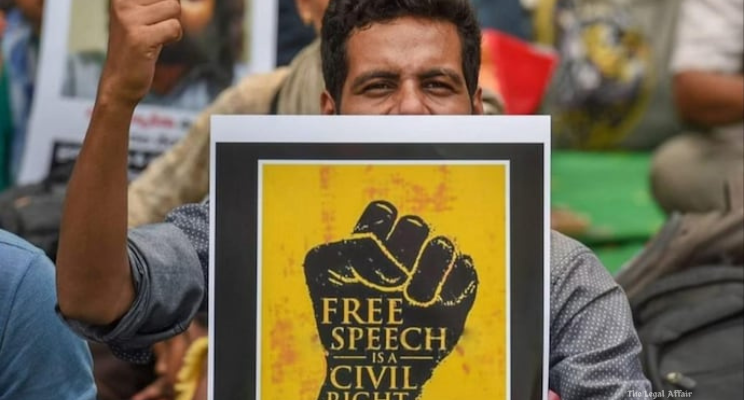
Introduction:
In a landmark ruling, the Supreme Court of India, led by Justices Abhay S Oka and Ujjal Bhuyan, quashes a criminal case against a professor, Professor Javed Ahmed Hajam, for his WhatsApp status criticizing the abrogation of Article 370. The court’s critical observation emphasizes the need to educate law enforcement on the fundamental right to freedom of speech and expression guaranteed by the Constitution.
Arguments:
The Bombay High Court had earlier refused to quash the FIR against Professor Hajam, citing concerns about promoting communal disharmony. However, the Supreme Court takes a different stance, recognizing the primacy of the right to freedom of speech and expression. The court argues that citizens have the right to criticize state actions, and expressions of dissent should not be deemed offensive under Section 153A of the IPC. It underscores the importance of safeguarding democratic values, stating that democracy won’t survive if every criticism is considered an offense.
Court’s Judgement:
The Supreme Court, while quashing the case, asserts that labeling the day of abrogation as a ‘Black Day’ is a legitimate expression of protest and anguish, protected by Article 19(1)(a). The court emphasizes that criticizing state actions is an essential aspect of freedom of speech and expression. It dismisses the notion that every criticism amounts to promoting disharmony and warns against stifling democracy through excessive legal actions.
Conclusion:
In a significant victory for freedom of speech, the Supreme Court’s ruling reaffirms citizens’ right to express dissent without fear of legal repercussions. The judgment underscores the importance of educating law enforcement on democratic values, ensuring a balance between individual freedoms and maintaining harmony. This verdict sets a precedent for protecting the core principles of democracy and free expression in India.