


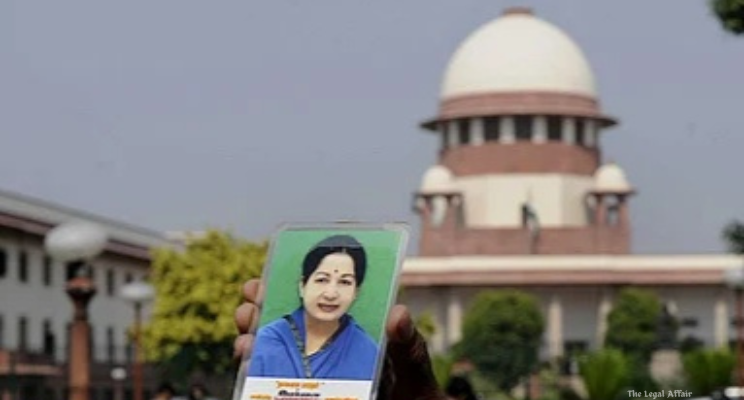
Introduction:
On February 14, 2025, the Supreme Court of India dismissed a petition filed by J. Deepa, the niece of former Tamil Nadu Chief Minister J. Jayalalithaa, seeking the return of properties confiscated in the disproportionate assets case against her late aunt. The bench, comprising Justice B.V. Nagarathna and Justice Satish Chandra Sharma, declined to interfere with the Karnataka High Court’s decision, which had previously refused to release Jayalalithaa’s assets to her legal heirs.
Background of the Case:
In September 2014, a special court convicted Jayalalithaa under the Prevention of Corruption Act, sentencing her to four years of simple imprisonment and imposing a fine of ₹100 crores. The conviction was based on allegations that she had amassed wealth disproportionate to her known sources of income during her tenure as Chief Minister from 1991 to 1996. Following her conviction, various properties and assets were seized as part of the legal proceedings.
In May 2015, the Karnataka High Court acquitted Jayalalithaa, overturning the trial court’s verdict. However, the State of Karnataka challenged this acquittal in the Supreme Court. While the appeal was pending, Jayalalithaa passed away in December 2016. In February 2017, the Supreme Court abated the proceedings against her due to her death but restored the conviction of her co-accused, including V.K. Sasikala. The apex court’s judgment led to the confiscation of the attached properties.
Petitioner’s Arguments:
J. Deepa, recognised by the Madras High Court as one of Jayalalithaa’s legal heirs, contended that since the criminal proceedings against her aunt were abated following her death, the confiscation orders should not apply to Jayalalithaa’s assets. She argued that the trial court’s direction for confiscation was limited to the co-accused and did not extend to Jayalalithaa herself. Deepa emphasised that the abatement of proceedings resulted in the nullification of the conviction against her aunt, thereby entitling the legal heirs to reclaim the seized properties.
Respondent’s Arguments:
The State, representing the prosecution, maintained that the Supreme Court’s 2017 judgment explicitly restored the trial court’s order in its entirety, including the confiscation of properties. They argued that the abatement of proceedings against Jayalalithaa did not equate to an acquittal and that the confiscation directives applied to all concerned parties, including the legal representatives of the deceased. The prosecution further contended that the assets in question were acquired through corrupt means and were thus liable for forfeiture, irrespective of Jayalalithaa’s demise.
Court’s Judgment:
After considering the submissions, the Supreme Court concluded that there was no merit in Deepa’s petition. The bench observed that the 2017 judgment had restored the trial court’s order in full, including the confiscation of assets. The court clarified that the abatement of proceedings due to Jayalalithaa’s death did not nullify the findings of guilt established by the trial court. Consequently, the confiscation orders remained valid and enforceable against her estate. The bench emphasised that the legal heirs could not claim ownership of properties that were deemed to be acquired through illicit means. Therefore, the petition was dismissed, and the confiscated assets were ordered to remain with the State.
Conclusion:
The Supreme Court’s decision underscores the principle that the abatement of criminal proceedings due to the death of an accused does not amount to an acquittal. In this case, the court affirmed that the confiscation of properties deemed to be acquired through corrupt practices remains valid, even against the estate of the deceased. This judgment reinforces the legal stance that assets obtained unlawfully are subject to forfeiture, irrespective of subsequent developments such as the death of the accused.