


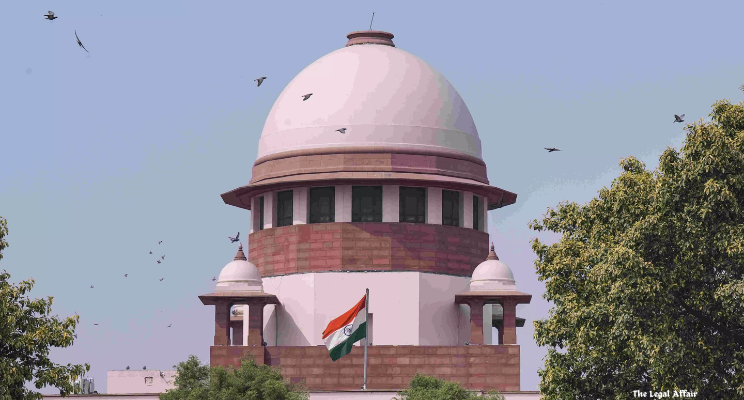
Introduction:
In the case AFTAB Versus THE STATE OF UTTAR PRADESH, MA 1086/2025 in Crl.A. No. 2295/2025, the Supreme Court of India on Wednesday came down heavily on the State of Uttar Pradesh and its prison authorities for failing to release a prisoner despite a bail order passed by the top court, citing a clerical omission in the order. The bench, comprising Justice KV Viswanathan and Justice NK Singh, was hearing an application related to the delayed release of the petitioner, Aftab, who was granted bail but remained incarcerated for 28 days in Ghaziabad jail. The accused had been arrested under Section 366 IPC and Sections 3 and 5(i) of the Uttar Pradesh Prohibition of Unlawful Conversion of Religion Act, 2021. The jail authorities, however, refused to release the petitioner on the ground that the bail order mentioned only “Section 5” instead of “Section 5(i)”—an omission the Court termed as a clerical error.
Arguments:
The petitioner, through his counsel, approached the Supreme Court seeking correction and enforcement of the bail order. The State of Uttar Pradesh, represented by Additional Advocate General Garima Prashad, argued that the failure to release the accused was based on procedural necessity, citing a requirement that all sub-sections must be correctly reflected in the release order to ensure clarity and prevent misuse, relying on a precedent from the Allahabad High Court concerning verification of forged bail orders. However, the bench rejected this justification outright, emphasizing that liberty cannot be held hostage to minor technicalities and “irrelevant errors.”
Judgement:
Justice Viswanathan sharply questioned the validity of relying on the omission of a sub-section to justify non-compliance with a Supreme Court order, stating that when the identity of the accused and the nature of charges were clearly established in both the bail and release orders, failure to act upon them amounted to serious dereliction of duty. The Court held that liberty, being a constitutional right, cannot be denied on the basis of “useless technicalities” and stressed the obligation of the authorities to act on the substance of a court order rather than fixate on trivial errors. The bench further reprimanded the prison authorities and the State for attempting to defend the indefensible. In a stern warning, the Court told the AAG that if such cavalier treatment of liberty continued, it would have no hesitation in increasing the compensation to ₹10 lakhs. Notably, the Court also made it clear that this case might be symptomatic of a larger systemic issue and asked whether similar lapses were occurring in other jails. This concern prompted the bench to not only direct a judicial inquiry into the delay but also to question the UP DIG (Prisons), who appeared virtually, about what mechanisms were in place to prevent recurrence of such incidents. The bench further recorded the assurance given by the DIG that all prison officers would be sensitized to the importance of liberty and correct interpretation of judicial orders. The Court stated that the explanation provided by the prison officials was not convincing and seemed “preposterous” and “unfortunate,” especially since the prisoner was released only on June 24—nearly a month after the release order dated May 27, and almost two months after the bail was granted on April 29. The bench noted that all stakeholders, including the jail authorities, were fully aware of the case number, the offences involved, and the identity of the prisoner. It expressed shock that, despite such clarity, the petitioner had to remain in custody due to a non-substantive clerical lapse. As a provisional remedy, the Court ordered the State of Uttar Pradesh to pay a compensation of ₹5 lakhs to the petitioner for his unlawful detention and asked for compliance by June 27. The Court clarified that this was only ad-hoc compensation and that the final liability could be adjusted after the conclusion of the judicial inquiry. The Principal District Judge of Ghaziabad was directed to conduct a thorough inquiry to ascertain the true cause behind the delay in release—whether it was merely the omission of a sub-section or if there were more sinister reasons or gross negligence behind the delay. The judicial inquiry was also expected to determine if any prison official was personally responsible, in which case recovery of compensation from such officials might be ordered. Importantly, the bench cautioned that an order of the Court, even if perceived by officials to be incomplete or erroneous, is binding and must be obeyed. Justice Viswanathan emphasized, “It is your primordial duty to obey the order of the Court, whether right or wrong.” The Court’s sharp rebuke of the State and its prison machinery serves as a powerful reminder of the paramount value of personal liberty under the Constitution. The failure to release a person granted bail—based on what the bench called a “non-issue”—not only violated the individual’s rights but also eroded trust in the legal and custodial system. By recording the assurance of future compliance and ordering judicial oversight, the Supreme Court took steps not only to secure justice for the individual petitioner but also to ensure institutional reform. The Court’s message was clear: prison authorities are custodians of liberty, not mere clerks tallying paperwork, and any dereliction in this duty will be met with serious consequences. The judgment reiterates that courts must be seen as protectors of constitutional rights and that administrative inertia cannot be permitted to defeat judicial directives. By holding the state accountable for failing to act on a clear bail order, the Supreme Court reaffirmed the doctrine that liberty is sacrosanct and cannot be overridden by bureaucratic oversight. The incident has now become a focal point in the ongoing conversation about prison reform, judicial implementation, and the need for sensitization of jail staff across India. The outcome of the judicial inquiry may further illuminate the systemic issues that need urgent redressal to prevent future occurrences. Until then, this case will stand as a stark reminder that even the smallest lapse in the administration of justice can have devastating consequences on the lives of individuals, and it is the Court’s solemn duty to vigilantly safeguard against such injustices.