


Introduction:
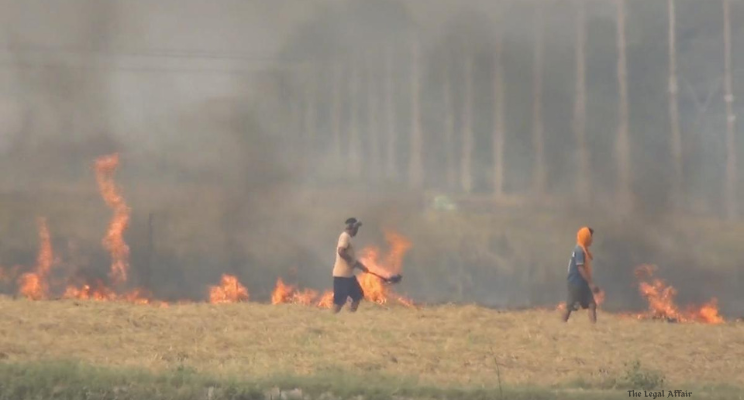
In a significant ruling addressing the persistent issue of air pollution caused by stubble burning in the northern states of Punjab and Haryana, the Supreme Court of India reaffirmed that the problem is not just a matter of legal violations but a blatant breach of citizens’ fundamental right to live in a pollution-free environment, as guaranteed under Article 21 of the Constitution. The case was heard by a bench comprising Justices Abhay Oka, Ahsanuddin Amanullah, and Augustine George Masih, in connection with the long-standing environmental litigation brought forth by environmental activist M.C. Mehta against the Union of India. The Court’s observations come as part of a larger discourse on environmental degradation, government inaction, and the prioritization of public health over political and economic pressures.
Petitioners’ Argument:
The petitioners, led by senior advocate and environmentalist M.C. Mehta, contended that despite several existing laws and commissions formed to address air pollution in the Delhi-NCR region, stubble burning continues to be a major contributor to the deteriorating air quality. The petitioners emphasized that air pollution due to stubble burning is a recurring issue, and no substantial or consistent action has been taken to prevent it. They argued that the failure to control stubble burning, especially during the winter months, results in hazardous levels of pollution, severely impacting the right to life under Article 21, which includes the right to breathe clean air.
The petitioners pointed out that the governments of Punjab and Haryana had repeatedly failed to implement the directives of the Commission for Air Quality Management (CAQM) and had resorted to lenient measures, such as nominal fines and selective prosecution. They criticized the state’s failure to take firm legal action against violators, which has emboldened farmers and other stakeholders to continue this harmful practice without fear of serious consequences.
M.C. Mehta also highlighted the economic disparity between large and small farmers, arguing that while financial constraints might prevent smaller farmers from adopting sustainable alternatives, large landowners are equally responsible yet face minimal penalties for violating environmental laws. The petitioners stressed that the government must focus on providing viable alternatives to stubble burning, such as subsidies for machinery and better access to eco-friendly disposal methods.
Respondents’ (State Governments of Punjab and Haryana) Argument:
In defense, the Chief Secretaries of Punjab and Haryana contended that they had taken significant steps to mitigate stubble burning. The Chief Secretary of Haryana claimed that the number of stubble-burning incidents had significantly reduced, with a drop from 9,800 in previous years to 655 this year. He also mentioned that 5,153 Nodal Officers had been appointed to monitor and implement the CAQM’s directives at different administrative levels. Of the 655 reported cases of stubble burning, he claimed that 200 were found to be false upon further inspection, with FIRs being filed against 93 violators. The Haryana government argued that these measures reflected a sincere effort to enforce the law and reduce pollution levels.
Punjab, on the other hand, faced scrutiny for failing to present a clear action plan for implementing the CAQM’s June 2021 order. The state’s Chief Secretary and Advocate General claimed that compensation had been recovered in several cases and that they were working on providing financial and technical support to farmers. However, the Court observed that while Punjab reported 1,084 cases of stubble burning, compensation had only been recovered from 473 persons, raising concerns about selective enforcement.
In an earlier hearing, Punjab had claimed to have sent a proposal to the central government seeking funds for tractors and other equipment to help farmers dispose of stubble without burning it. However, it was revealed during the hearing on October 16 that no such proposal had been submitted. The state later admitted its mistake and informed the Court that the proposal had now been sent to the Centre.
Both states also pointed out the socio-political sensitivities surrounding the issue. They argued that prosecuting farmers, many of whom are already burdened by economic challenges, could lead to unrest. Additionally, the states argued that penal provisions under the Environment Protection Act (EPA) had been used to collect fines, but harsher measures were politically difficult to implement, especially when small farmers were involved.
Union Government’s Position:
The Union Government, through the Commission for Air Quality Management, has also come under scrutiny for failing to enforce its own orders adequately. The Supreme Court expressed dissatisfaction with the CAQM’s limited role in implementing its directives, suggesting that the Commission’s efforts were insufficient to address the gravity of the situation.
While the Union Government did not present extensive arguments during this hearing, the Court urged the Centre to respond swiftly to the request for funds from Punjab. The Court made it clear that the Union Government had a responsibility to provide support, especially in facilitating sustainable alternatives to stubble burning for farmers. The need for financial aid to provide machinery, such as tractors and stubble management tools, was acknowledged as crucial for mitigating the problem at its root.
Court’s Observations and Criticism:
- Failure to Protect Fundamental Rights:
The Supreme Court expressed deep concern over the violation of citizens’ fundamental rights under Article 21, stating that the issue of stubble burning transcends mere legal breaches. Justice Abhay Oka, speaking for the bench, emphasized that the right to live in a pollution-free environment is an essential part of the right to life, and the government’s failure to address stubble burning amounted to a violation of this right. The Court observed that both state governments, despite being fully aware of the grave environmental and public health risks posed by stubble burning, had not taken consistent and effective actions to curb the practice.
The Court criticized the selective enforcement of penalties, pointing out that only a handful of violators were subjected to FIRs while most were let off with nominal fines. Justice Oka remarked that such leniency essentially “gives a license” to people to break the law without fearing serious consequences. The bench underscored that the minimal environmental compensation recovered from violators demonstrated a lack of seriousness in tackling the issue.
- Inconsistent Action and Political Reluctance:
One of the Court’s major criticisms was directed at the selective nature of enforcement, where the states of Punjab and Haryana were seen to be inconsistent in their actions against stubble-burning offenders. While compensation had been collected in some cases, FIRs were filed in very few, and the majority of violators were fined nominal amounts. The Court noted that Punjab had identified 1,084 cases of stubble burning, yet compensation was recovered from only 473 violators, while Haryana reported 419 cases, with FIRs lodged against only 93 individuals. This selective prosecution, the Court said, undermines the deterrence value of the law.
The Court also raised the issue of political reluctance to take firm action against farmers, especially small and marginal ones, who are most often the violators. Justice Oka noted that the Advocate General of Punjab had previously indicated that political reasons might make it difficult for the state to enforce stringent penalties against farmers. The Court acknowledged that while the economic plight of small farmers must be considered, the law must be applied equally to ensure fairness and justice. Political hesitation, the Court suggested, cannot justify a failure to uphold fundamental rights and environmental laws.
- Lack of Machinery and Proactive Policy:
The Court also addressed the issue of insufficient infrastructure and policy measures to support farmers in avoiding stubble burning. Justice Oka highlighted that there appeared to be no effective machinery in place under the amended Section 15 of the Environmental Protection Act (EPA). The compensation system, the Court observed, seemed to be designed in a way that allowed violators to appeal and get their fines quashed later. The Court described this approach as mere “eyewash,” suggesting that it was a deliberate strategy to appear compliant with the law while doing little to enforce it meaningfully.
The bench asked the governments of Punjab and Haryana to devise more comprehensive policies to support farmers, particularly by providing alternatives to stubble burning, such as equipment for crop residue management. The Court expressed scepticism over the states’ claims of having made efforts in this regard, noting that the necessary financial and logistical proposals had either been delayed or only partially implemented. For instance, the Court was critical of the Punjab government’s false statement in the previous hearing, where it claimed to have sent a proposal to the Centre for funding tractors and drivers for farmers. It was later revealed that no such proposal had been sent until after the October 16 hearing.
- Role of the Union Government:
The bench further directed the Union Government to take swift action on the funding proposal submitted by the Punjab government. The Court emphasized the need for the Centre to provide the necessary resources for implementing alternatives to stubble burning, especially for small farmers who lack the means to purchase expensive machinery on their own. The Centre was given two weeks to respond to the proposal, and the Court made it clear that a timely decision was crucial to ensuring that farmers have access to these resources before the next farming season.
- Court’s Interim Directions:
Stringent Action Required: The Court directed both Punjab and Haryana to take consistent and stringent action against all violators of the stubble burning ban, without selective enforcement. FIRs should be registered against all offenders, and nominal fines should not be the default response to violations.
- Policy Implementation:
Both states were ordered to submit a detailed action plan for implementing the CAQM’s 2021 order, with specific timelines and mechanisms for enforcement. The Court also asked the states to propose stronger mechanisms for monitoring and penalizing offenders.
- Centre’s Role:
The Union Government was instructed to address Punjab’s funding proposal for providing tractors and machinery to farmers. The Court set a two-week deadline for the Centre to take action on this request.
- Next Hearing Date:
The Court listed the matter for further hearing on November 4, 2024, by which time the governments are expected to report back on the steps taken to comply with the Court’s directions.