


Introduction:
The Supreme Court of India, while hearing a batch of petitions concerning alleged police brutality during student protests over the NEET examination paper leak and other irregularities, indicated that it may examine whether States and Union Territories have adequate protocols in place to ensure the safety of police personnel deployed during large public demonstrations. The matter was heard by a Bench comprising Chief Justice of India Surya Kant, Justice Joymalya Bagchi, and Justice V. Mohana.
The proceedings arose from multiple petitions filed after allegations surfaced that police personnel had used excessive force, including lathi charges, against students protesting the alleged irregularities in the NEET examination. The demonstrations, which took place in different parts of the country, particularly in Delhi and Bihar, triggered widespread public debate over the balance between maintaining public order and safeguarding the constitutional right to peaceful protest. Alongside these petitions, the Court also considered submissions made on behalf of families of police personnel who alleged that several officers had themselves become victims of violence during the demonstrations.
The controversy highlights an increasingly significant constitutional question concerning the obligations of the State while dealing with public protests. Article 19(1)(a) and Article 19(1)(b) of the Constitution guarantee citizens the rights to freedom of speech and peaceful assembly. However, these rights are subject to reasonable restrictions in the interests of public order and security. Consequently, law enforcement agencies often find themselves tasked with maintaining peace while ensuring that democratic rights are respected. The petitions before the Supreme Court therefore required the Court to examine not merely allegations of police excesses but also the broader institutional framework governing crowd-control measures across India.
The petitions gained additional importance because they were filed in the backdrop of nationwide outrage over the alleged NEET paper leak, which had led to student protests demanding accountability and transparency in the conduct of competitive examinations. While some petitioners sought an independent investigation into the alleged police violence against protesters, another petition, moved by Rajya Sabha Member of Parliament Manoj Jha, sought registration of First Information Reports against Bihar police officials for alleged firing on student protesters. Simultaneously, families of injured police personnel urged the Court to acknowledge that officers deployed for crowd management were also exposed to serious physical risks.
During the mentioning of the matters, the Supreme Court made it clear that the issue was not confined to one incident or one State. Instead, it recognised the need to examine whether India requires a uniform national protocol governing police deployment, protective equipment, crowd management practices, accountability mechanisms, and safeguards for both demonstrators and police personnel. The Court accordingly directed that all connected matters be listed together for further hearing.
Arguments of the Parties:
The petitioners challenging the alleged police action contended that students participating in demonstrations against the NEET examination irregularities were exercising their constitutionally protected right to peaceful protest. According to them, instead of facilitating peaceful assembly, police authorities resorted to disproportionate force, including lathi charges and other coercive measures, resulting in injuries to several demonstrators. They argued that such actions violated Articles 19 and 21 of the Constitution, which protect the freedoms of speech, peaceful assembly, and personal liberty.
The petitioners further submitted that democratic governance necessarily requires tolerance of peaceful dissent. They maintained that even where public gatherings become inconvenient for authorities, law enforcement agencies are expected to employ the least restrictive means available before resorting to force. They sought independent judicial scrutiny of the incidents to identify officers responsible for any excessive use of force and to ensure accountability. They also urged the Court to formulate comprehensive guidelines governing police conduct during protests so that similar incidents do not recur.
Rajya Sabha MP Manoj Jha, who separately approached the Supreme Court regarding the alleged firing by Bihar Police on NEET protesters, sought directions for registration of FIRs against police officials allegedly responsible for the incident. His petition emphasised that allegations involving unlawful use of force by public authorities require impartial investigation to maintain public confidence in the rule of law.
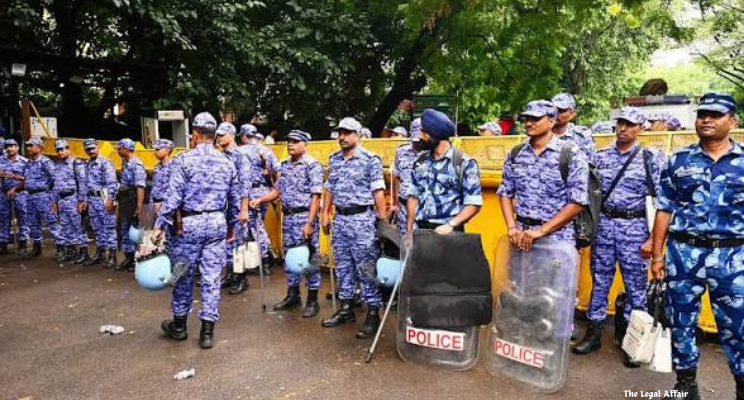
On the other hand, counsel appearing on behalf of families of police personnel highlighted that the narrative surrounding the protests was incomplete unless the injuries suffered by police officers were also acknowledged. They submitted before the Court that several officers deployed during the demonstrations had allegedly been assaulted, kicked, and subjected to violent attacks while performing their official duties. According to them, police personnel are often required to confront hostile crowds without adequate protective gear, exposing them to avoidable risks.
The families argued that governments have a corresponding obligation to ensure the safety of police personnel tasked with maintaining public order. They urged the Court to direct State authorities to provide appropriate protective equipment, including helmets and other safety gear, particularly during large demonstrations where violence cannot be ruled out.
Solicitor General Tushar Mehta, appearing for the Union, requested that all related matters be heard together to facilitate a comprehensive consideration of the issues involved. He assured the Court that the Union would assist the Bench objectively and without adopting an adversarial approach. The Solicitor General accepted that the issues raised transcended individual incidents and required balanced institutional solutions rather than a contest between opposing parties.
The submissions from all sides ultimately reflected a common concern that constitutional rights and public order should not be viewed as competing interests but as complementary objectives requiring careful balancing through appropriate legal safeguards and administrative protocols.
Court’s Judgment:
Although the matter remains pending and no final adjudication has yet been delivered, the Supreme Court made several important observations that are likely to influence the future legal framework governing public protests and police conduct across India.
Justice Joymalya Bagchi responded to submissions made on behalf of injured police personnel by observing that injuries suffered by any individual—whether a police officer or a protester—are equally significant from the perspective of constitutional governance. The Court emphasised that the protection of human dignity and personal safety cannot depend upon the identity or role of the individual concerned. This observation reflects the constitutional principle that the State owes equal protection to every person under Article 14.
Justice Bagchi further indicated that the Court may require State Governments and Union Territories to explain why adequate protective safeguards are not provided to police personnel deployed during large demonstrations. Specifically referring to protective helmets and similar safety equipment, the Court suggested that governments have a responsibility to ensure that officers entrusted with crowd-control duties are not unnecessarily exposed to physical harm. Such observations underline that effective policing must be accompanied by institutional preparedness rather than reliance solely on physical intervention by officers.
Chief Justice Surya Kant supplemented these observations by stressing that a proper protocol should exist for regulating public demonstrations. According to the Chief Justice, every citizen possesses the constitutional right to agitate peacefully on issues of public importance. The State must therefore provide appropriate spaces and reasonable opportunities for peaceful protest without imposing unnecessary restrictions. At the same time, he clarified that where anti-social elements infiltrate demonstrations or individuals engage in unlawful conduct, law enforcement authorities remain empowered to take action in accordance with law.
The Chief Justice thus reaffirmed an important constitutional distinction between peaceful protesters exercising democratic rights and individuals engaging in criminal acts under the cover of public demonstrations. The Court indicated that police action should target unlawful conduct without suppressing legitimate democratic expression.
Perhaps the most significant aspect of the hearing was the Chief Justice’s observation regarding allegations of excessive police force. He stated that wherever allegations of excesses arise, there should be an independent examination to identify those responsible, determine the nature of the alleged misconduct, and recommend preventive measures for the future. This approach reflects established constitutional principles requiring independent scrutiny whenever State action results in allegations of violation of fundamental rights.
The Court further observed that the issue extends beyond Delhi or any individual State. Instead, it concerns the absence of a uniform nationwide framework governing police response to public demonstrations. The Bench recognised that varying practices adopted by different States may create inconsistencies in the protection of both protesters and police personnel. Consequently, it indicated the need for uniform protocols capable of ensuring consistency across jurisdictions.
The observations also resonate with earlier judicial pronouncements recognising peaceful protest as an indispensable component of constitutional democracy. The Supreme Court has repeatedly held that while the State possesses authority to regulate assemblies in the interest of public order, such regulation must remain proportionate and cannot extinguish the underlying constitutional freedom itself. The Court’s earlier observations that peaceful protests cannot by themselves justify coercive police action formed an important backdrop to the present proceedings.
Another noteworthy aspect of the hearing was the Court’s emphasis on institutional reform rather than individual blame. Instead of immediately focusing solely on allegations against either protesters or police personnel, the Bench explored broader systemic issues such as crowd-management protocols, protective equipment, accountability mechanisms, and preventive guidelines. This reflects the judiciary’s increasing preference for structural solutions capable of preventing future constitutional violations.
The Chief Justice also remarked that democratic functioning requires a degree of “self-evolved discipline” among all stakeholders. This observation recognises that constitutional freedoms carry corresponding responsibilities. Protesters are expected to exercise their rights peacefully, while police authorities must discharge their duties with restraint, professionalism, and respect for constitutional guarantees.
The Court accepted the Solicitor General’s request to hear all connected petitions together and directed that the matters be listed for hearing the following day. By consolidating the cases, the Supreme Court signalled its intention to comprehensively examine the legal and institutional issues arising from allegations of police brutality during student protests, injuries to police personnel, and the broader need for nationally consistent crowd-management standards.
Although no final directions have yet been issued, the Court’s observations suggest that the proceedings may eventually result in important guidelines concerning police preparedness, accountability for excessive force, protection of peaceful demonstrations, and standardised operating procedures for handling large public gatherings across India. Such guidelines could significantly influence the future relationship between citizens exercising democratic rights and law enforcement agencies entrusted with maintaining public order.