


Introduction:
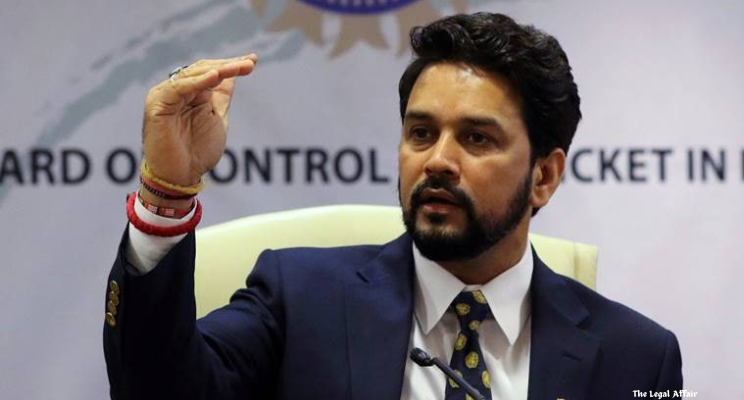
The Supreme Court of India, in Board of Control for Cricket in India v. Cricket Association of Bihar and Others (C.A. No. 4235/2014), delivered an important order lifting the long-standing ban imposed on BJP MP and former BCCI President Anurag Thakur from holding any office in the Board of Control for Cricket in India. The matter was heard by a Bench comprising Chief Justice of India Surya Kant and Justice Joymalya Bagchi, on an application filed by Anurag Thakur seeking recall of paragraph 25(ii) of the Supreme Court’s 2017 order. The impugned direction had flowed from the landmark judgment implementing the recommendations of the Justice R.M. Lodha Committee, where the Court had removed Anurag Thakur from the post of BCCI President and Ajay Shirke from the post of Secretary for continued defiance of court-mandated reforms. Paragraph 25(ii) of the 2017 order directed that both officials shall forthwith cease and desist from any work of the BCCI, which effectively operated as a bar on holding office. Nearly nine years later, the Court was called upon to examine whether such a prohibition was intended to be perpetual and whether its continued operation was justified in law, equity, and constitutional principles governing proportionality and fairness.
Arguments on Behalf of the Applicant:
Senior Advocate P.S. Patwalia, appearing for Anurag Thakur, submitted that the ban imposed by the Supreme Court in 2017 had already operated for close to nine years, which in itself constituted a severe civil consequence. It was argued that the direction under paragraph 25(ii) was never intended to function as a life-long or indefinite ban, but rather as a corrective and disciplinary measure to ensure immediate compliance with the Lodha Committee reforms. Counsel emphasized that Anurag Thakur had tendered an unconditional apology to the Supreme Court, accepting the authority of the Court and expressing regret for the conduct that led to his removal. It was further contended that the continued subsistence of the ban would lead to disproportionate hardship, not only impacting Thakur’s role in cricket administration but also undermining the rehabilitative and reformative intent of judicial sanctions. Drawing upon the doctrine of proportionality, the applicant argued that once the object of the punishment had been achieved and sufficient time had elapsed, the continuation of the ban would amount to an excessive and unreasonable restriction. The applicant also submitted that there was no subsequent finding of misconduct against Thakur after 2017, and therefore, denying him the opportunity to participate in BCCI affairs indefinitely would be contrary to principles of natural justice, fairness, and constitutional reasonableness.
Arguments on Behalf of the Opposing Side:
Senior Advocate Gopal Sankaranarayanan, appearing for the Secretary of the Lodha Committee, opposed the application and urged the Court to maintain the sanctity of its 2017 directions. It was argued that the removal of Anurag Thakur and Ajay Shirke was not a routine administrative action but a consequence of deliberate and continued defiance of binding Supreme Court orders relating to governance reforms in Indian cricket. Counsel submitted that the Lodha Committee reforms were introduced to clean up systemic failures, conflicts of interest, and opaque functioning within the BCCI, and any dilution of the consequences imposed for non-compliance could weaken the reform process. It was contended that paragraph 25(ii) was consciously framed in strong terms to send a clear message that constitutional courts would not tolerate institutional defiance. The opposing side cautioned that recalling the direction could set an undesirable precedent, allowing powerful office-bearers to wait out judicial sanctions and later seek restoration without demonstrating substantive corrective conduct beyond an apology. Therefore, it was argued that the application lacked sufficient grounds and that the balance of institutional integrity should weigh against lifting the ban.
Judgment:
After considering the rival submissions, the Supreme Court allowed the application and recalled paragraph 25(ii) of the 2017 order insofar as it applied to Anurag Thakur. The Bench observed that while the Court had been justified in issuing strict directions in 2017 to ensure implementation of the Lodha Committee reforms, the prohibition imposed was never meant to operate as a permanent or lifelong disqualification. Taking note of the unconditional apology tendered by Thakur and the fact that the ban had already operated for nearly nine years, the Court held that the principle of proportionality squarely applied. The Bench reasoned that judicial directions imposing civil consequences must bear a rational nexus to their purpose and must not outlive their utility. Once the object of ensuring compliance and accountability had been achieved, continuing the restriction would be punitive beyond measure. The Court clarified that recalling the direction did not amount to an endorsement of past conduct but was a recognition that punishment must be balanced, fair, and time-bound. Consequently, the Supreme Court held that Anurag Thakur was now free to participate in the affairs of the BCCI strictly in accordance with its rules and regulations and subject to applicable law. With this clarification, the Court restored his eligibility to hold office, reaffirming that constitutional adjudication must harmonize discipline with fairness and deterrence with proportionality.