


Introduction:
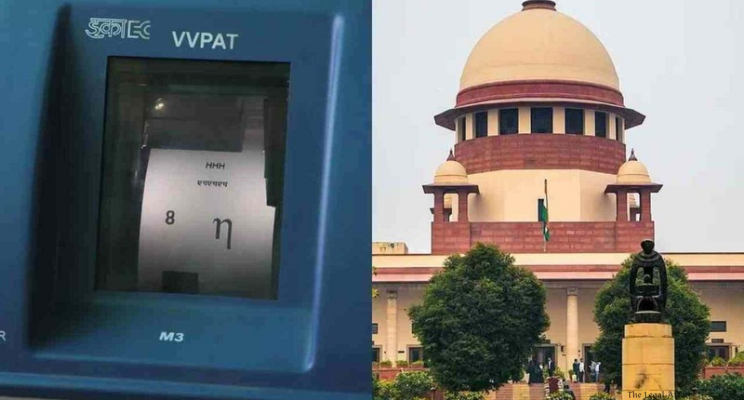
In the case of Association of Democratic Reforms v. Election Commission of India & Anr., the Supreme Court recently delivered a significant verdict on the contentious issue of Electronic Voting Machines (EVMs) and Voter Verifiable Paper Audit Trail (VVPAT) verification. The petitioners had sought 100% cross-verification of EVM data with VVPAT records, challenging the prevailing practice of verifying VVPATs in only 5 randomly selected polling stations per assembly constituency. The Election Commission opposed the pleas, arguing that such a process would be impractical and susceptible to errors. After careful consideration, the bench of Justices Sanjiv Khanna and Dipankar Datta rendered their judgments, addressing the technical aspects and data on record.
Arguments:
The petitioners contended that full verification of VVPATs is essential to ensure that votes are “recorded as cast” and “counted as recorded.” They raised concerns about the integrity and credibility of the electoral process, advocating for increased transparency and accountability. Conversely, the Election Commission defended the existing protocol, asserting that EVMs are tamper-proof and that manual verification of all VVPATs would be laborious and prone to human error.
Court’s Judgement:
The Supreme Court, while rejecting the pleas for comprehensive VVPAT verification, issued two significant directions. Firstly, it mandated the sealing and securing of Symbol Loading Units (SLUs) after the loading process, with provisions for inspection post-results declaration. Secondly, it ordered the verification of burnt memory semi-controllers in 5% of EVMs per assembly segment, upon written request from candidates. The court emphasized the importance of a critical yet constructive approach, highlighting the need to balance skepticism with evidence andreason.