


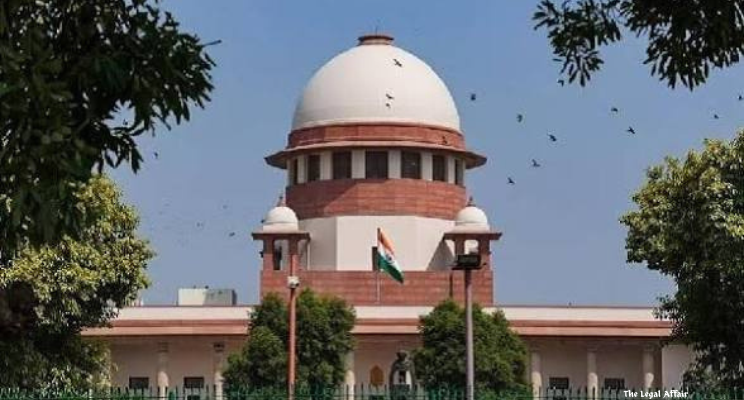
Introduction:
The Supreme Court has dismissed a batch of appeals filed by the State of Uttar Pradesh and the Uttar Pradesh Avas Evam Vikas Parishad (Housing Board), refusing to interfere with an Allahabad High Court judgment that had quashed a demand of approximately ₹388 crore raised against real estate developer M/s Gaursons India Pvt. Ltd. The Court held that the Housing Board could not treat the alternative land allotted to the developer as a fresh commercial allotment and demand the prevailing bulk sale rate, particularly when the land had been provided in substitution for previously acquired land for which no compensation had been paid.
A Division Bench comprising Justice P.S. Narasimha and Justice Alok Aradhe upheld the High Court’s decision setting aside the Chief Secretary’s order dated June 21, 2022, and the consequential demand notice issued by the Housing Board in September 2022. The Court found that the demand was inconsistent with the terms of the compromise recorded by the Supreme Court in 1995 and the subsequent registered Exchange Deed executed between the parties in 2016.
The dispute originated from the acquisition of approximately 12.047 acres of land belonging to the predecessors-in-interest of Gaursons for the Housing Board’s Vasundhara Scheme in Ghaziabad. The acquisition eventually led to litigation before the Supreme Court, which disposed of the Housing Board’s appeal in 1995 on the basis of a compromise between the concerned parties.
Under the terms of the compromise, the acquired land was to be adjusted within the Housing Board’s scheme. A portion of the land was intended for construction connected with water purification facilities, while the remaining area was to be kept open. Significantly, the compromise provided that neither party would be required to pay any monetary consideration or compensation for the exchange arrangement.
Subsequently, in 2004, the Housing Board executed an Exchange Deed under which two alternative parcels of land, identified as Khasra Nos. 948 and 1454 in Arthala village, were allotted to the predecessors-in-interest of Gaursons. However, the allotment later became problematic when it emerged that the District Magistrate had already resumed the land in 1994 for the purpose of establishing a bird sanctuary. Revenue records also reflected the land as lake and banjar land.
Consequently, the beneficiaries of the exchange arrangement were unable to obtain possession of the allotted parcels. The controversy eventually resulted in further litigation and, after several years, the Housing Board executed another registered Exchange Deed in 2016, providing alternative land to Gaursons in the Siddharth Vihar Yojana.
Before the execution of the second Exchange Deed, the original land had already been transferred to Gaursons through a sale deed executed in 2005. The Supreme Court later took note of the fact that the sale deed did not merely transfer the allotted land but also assigned the right to receive any alternative land that the Housing Board might subsequently provide in its place.
Following the 2016 arrangement, Gaursons paid approximately ₹32.45 crore towards land conversion charges and proceeded to develop the property. The developer constructed 2,476 general residential units and 450 houses falling under the Economically Weaker Sections (EWS) and Lower Income Groups (LIG) categories. These residential units were subsequently sold to homebuyers.
The controversy resurfaced following a Public Interest Litigation before the Allahabad High Court and an investigation conducted by a Special Investigation Team (SIT). Relying on the findings of the investigation, the Uttar Pradesh Government issued an order through the Chief Secretary on June 21, 2022, directing that the land allotted to Gaursons be charged at the prevailing bulk sale rate.
Acting upon the government’s direction, the Housing Board subsequently issued a demand notice seeking approximately ₹388 crore from the developer. The demand effectively treated the alternative land provided under the 2016 Exchange Deed as a fresh commercial allotment rather than a substitution for the originally acquired property.
Gaursons challenged the government’s decision before the Allahabad High Court. The High Court set aside conditions (ii) and (iii) of the Chief Secretary’s order, along with the consequential demand notice. Aggrieved by the decision, the State Government and the Housing Board approached the Supreme Court.
The central questions before the Supreme Court concerned the interpretation of the 1995 compromise, the legal effect of the 2004 and 2016 Exchange Deeds, the transfer of rights to Gaursons under the 2005 sale deed, and the legality of demanding additional consideration for land provided as an alternative to the originally acquired property.
Arguments of the Parties:
Appearing for the State of Uttar Pradesh, Attorney General R. Venkataramani and Additional Solicitor General Aishwarya Bhati, along with other counsel, challenged the Allahabad High Court’s judgment. Senior Advocate P.N. Misra represented the Housing Board in support of the appeals.
The appellants primarily contended that the High Court had failed to properly appreciate the terms of the Supreme Court’s 1995 compromise order and the restrictions subsequently incorporated into the 2004 Exchange Deed.
According to the State and the Housing Board, the original compromise contemplated the use of the acquired land for specific purposes connected with water purification facilities, with the remaining portion being maintained as open land. They argued that the restrictions arising from the compromise continued to govern the land exchanged in lieu of the acquired property.
Particular reliance was placed on Clause 4 of the 2004 Exchange Deed, which, according to the appellants, restricted the use of the alternative land in accordance with the original compromise. The appellants pointed out that although the land was allotted in 2004 subject to these conditions, the subsequent sale deed executed in favour of Gaursons in 2005 described the property as residential.
The State argued that the description of the property as residential and its subsequent transfer for development purposes were inconsistent with the restrictions governing the original exchange arrangement. It was further contended that the 2016 Exchange Deed had been executed without properly accounting for the covenants contained in the earlier deed and the restrictions flowing from the 1995 compromise.
The appellants also questioned the circumstances in which the 2016 Exchange Deed had been executed. They submitted that the SIT investigation had revealed circumstances suggesting collusion between certain Housing Board officials and Gaursons. According to them, the findings of the investigation justified reconsideration of the allotment and supported the government’s decision to impose charges at the prevailing bulk sale rate.
The State and the Housing Board therefore maintained that the developer could not claim an unconditional entitlement to the alternative land without complying with the restrictions and financial obligations arising from the earlier arrangements. They sought restoration of the Chief Secretary’s order and the consequential demand of ₹388 crore.
On the other hand, Gaursons, appearing as Respondent No. 1, opposed the appeals and supported the Allahabad High Court’s judgment.
The developer contended that the entire dispute had to be examined in the context of the original acquisition and the compromise recorded by the Supreme Court in 1995. It argued that the alternative land was not granted as an independent commercial allotment but was provided in substitution for the land belonging to its predecessors-in-interest that had been acquired by the Housing Board.
Gaursons emphasised that the Housing Board had retained the originally acquired land and commercially utilised it within the Vasundhara Scheme, which was an older and more valuable development project. Despite retaining and benefiting from that land, the Housing Board had not paid any compensation to the original landowners.
The developer argued that the Housing Board could not retain the benefit of the original acquisition without compensation and subsequently demand an additional commercial price for the alternative land provided in exchange. Such a demand, according to Gaursons, would defeat the very purpose of the compromise and the subsequent exchange arrangements.
It was further submitted that the 2004 Exchange Deed could not impose binding restrictions upon Gaursons because the original alternative parcels had already become unavailable due to the Housing Board’s failure to verify their legal and physical status before allotment. The land had been resumed by the District Magistrate for a bird sanctuary even before the 2004 allotment, making the exchange arrangement incapable of being implemented.
Gaursons also relied upon the 2016 registered Exchange Deed, arguing that it constituted a fresh agreement concerning a different parcel of land in a different housing scheme. The deed expressly described the substituted property as a residential freehold plot and permitted residential construction.
The developer further submitted that it had already paid ₹32.45 crore towards land conversion charges and had invested substantial resources in constructing residential units on the property. The construction included 450 EWS/LIG houses, apart from 2,476 general residential units, which had already been sold to homebuyers.
Accordingly, Gaursons maintained that the government’s attempt to impose a further financial liability of ₹388 crore was legally unsustainable and contrary to the contractual and equitable position arising from the successive exchange arrangements.
Court’s Judgment:
After examining the rival submissions, the Supreme Court found no merit in the appeals filed by the Uttar Pradesh Government and the Housing Board. The Bench undertook a detailed examination of the 1995 compromise order, the 2004 Exchange Deed, the 2005 sale deed and the subsequent 2016 Exchange Deed to determine whether the government was legally justified in imposing the additional demand.
The Court’s reasoning primarily rested on the proper interpretation of the original compromise, the consequences of the Housing Board’s defective allotment in 2004, the transfer of rights to Gaursons and the independent legal character of the 2016 Exchange Deed.
Interpretation of the 1995 Compromise Order
The Supreme Court first considered the terms of the compromise recorded in 1995 while disposing of the Housing Board’s appeal.
The appellants had argued that the restrictions contained in the compromise continued to govern the alternative land subsequently provided to the original landowners. However, the Bench rejected this interpretation after examining the language and context of the relevant clauses.
In particular, the Court examined the expression ‘said land’ appearing in Clause 3 of the compromise. It held that the expression referred specifically to the 12.047 acres of land originally acquired from the predecessors-in-interest of Gaursons. The clause contemplated adjustment of that acquired land within the Housing Board’s scheme and did not impose a perpetual restriction upon every alternative parcel that might subsequently be allotted.
The Court explained that the compromise was intended to resolve the dispute concerning the original acquisition and provide an arrangement for the exchange of land without requiring either party to pay monetary compensation or consideration.
Importantly, the compromise did not create an indefinite restriction that would automatically attach to any future parcel of land provided by the Housing Board as a substitute.
The Bench observed, “The compromise does not attach a perpetual restriction to whatever land the Housing Board might eventually give in exchange.”
This interpretation was significant because it distinguished between the land originally acquired and the alternative parcels subsequently provided by the Housing Board. The conditions governing the original acquired property could not automatically be extended to every substituted property without examining the terms of the subsequent exchange instruments.
Housing Board’s Failure to Exercise Due Diligence in the 2004 Allotment
The Court next examined the circumstances surrounding the execution of the 2004 Exchange Deed.
It noted that the Housing Board had an obligation under the original compromise to identify and allot alternative land that was legally available and free from encumbrances. However, the Housing Board allotted Khasra Nos. 948 and 1454 in Arthala village despite the fact that the District Magistrate had already passed an order in 1994 resuming the land for a bird sanctuary.
The Court also took note of the revenue records, which described the concerned parcels as lake and banjar land. These circumstances demonstrated that the Housing Board had failed to undertake the necessary verification before making the alternative allotment.
The Bench observed that the predecessors-in-interest of Gaursons were unable to obtain possession of the allotted land for reasons entirely attributable to the Housing Board. They had not contributed to the defective allotment and could not be made to suffer the consequences of the authority’s failure to exercise due diligence.
The Court accordingly agreed with the Allahabad High Court that the 2004 Exchange Deed had failed and that the Housing Board remained obligated to make an alternative arrangement in respect of the originally acquired land.
The Bench held that since the 2004 Exchange Deed could not survive due to the Housing Board’s failure to exercise caution while making the allotment, Clause 4 of that deed could not be enforced against Gaursons.
Consequently, the restriction contained in the 2004 deed could not be revived through the Chief Secretary’s subsequent order. The Supreme Court therefore found that the High Court was justified in setting aside condition (iii) of the Chief Secretary’s order dated June 21, 2022, which sought to reimpose the earlier restriction concerning the use of the land.
This part of the judgment reinforces the principle that an authority cannot take advantage of its own failure to discharge its obligations and subsequently impose the consequences of that failure upon an innocent beneficiary.
Right of Gaursons to Receive and Transfer the Alternative Land
The Supreme Court also rejected the State’s contention that the alternative land could not have been alienated or transferred for residential development.
The Bench clarified that the land allotted under the exchange arrangement had been provided in lieu of property belonging to the predecessors-in-interest of Gaursons, which had been acquired by the Housing Board.
In this context, the Court reiterated the settled principle that a person having valid title over property ordinarily possesses the right to transfer and alienate that property in favour of another person.
The Court observed, “It is trite law that a person possessing title over a property has the absolute right of transferring and alienating the same to a third person.”
The Bench then examined the 2005 sale deed through which the predecessors-in-interest transferred the allotted land to Gaursons.
Upon examining the document, the Court found that the transaction was not confined to transferring rights in the originally allotted parcels. It also expressly included an assignment of the right to receive any other land that the Housing Board might subsequently provide in exchange for those parcels.
The Supreme Court observed that the sale deed effected “not only an effective transfer of the allotted land but also an assignment of the right to receive any other land given by the Housing Board in lieu of the above land.”
Therefore, when the Housing Board subsequently provided alternative land under the 2016 Exchange Deed, the corresponding entitlement had already passed to Gaursons through the 2005 sale deed.
The Court thus rejected the argument that Gaursons lacked the necessary entitlement to receive the substituted property or that the subsequent exchange arrangement could be treated as an independent allotment unrelated to the original acquisition.
2016 Exchange Deed Constituted a Fresh Registered Instrument
One of the most important aspects of the judgment concerned the legal effect of the 2016 Exchange Deed.
The Supreme Court noted that the second exchange arrangement was not merely a continuation of the failed 2004 transaction. It was a fresh registered instrument executed with the no-objection of the State Government and concerned a different plot situated in a different housing scheme, namely Siddharth Vihar Yojana.
The Bench specifically observed that the 2016 deed described the substituted property as a residential freehold plot and expressly permitted residential construction.
This was particularly relevant because the State sought to rely upon Clause 4 of the 2004 Exchange Deed to impose restrictions upon the land allotted under the 2016 arrangement.
The Court, however, found that the terms of the later deed did not support such an interpretation.
It examined Clause 13 of the 2016 Exchange Deed and found that the parties had incorporated only the stipulation from the 1995 compromise concerning the absence of any payment of value or consideration for the exchange.
In other words, the parties had specifically chosen which aspect of the original compromise would govern the substituted property. They did not incorporate the use restrictions contained in Clause 4 of the failed 2004 Exchange Deed.
The Bench held that the parties’ decision to incorporate only the no-consideration stipulation was legally significant. It was not permissible to selectively import additional restrictions from an earlier deed that had already failed due to the Housing Board’s own defective allotment.
The Court accordingly held that binding Gaursons to the restrictions contained in the 2004 Exchange Deed was unsustainable.
This finding established that the 2016 Exchange Deed had to be interpreted according to its own express terms, rather than being burdened with conditions from an earlier arrangement that had become incapable of implementation.
No Legal Basis for the Additional Demand of ₹388 Crore
The Supreme Court thereafter considered whether the Chief Secretary was justified in directing the Housing Board to charge Gaursons at the prevailing bulk sale rate for the alternative land.
The Bench examined Clause 13 of the 2016 Exchange Deed, which preserved the original arrangement that no monetary consideration or value would be payable for the exchange.
The Court also considered the financial circumstances surrounding the transaction, including the fact that Gaursons had already paid approximately ₹32.45 crore towards land conversion charges.
Another important consideration was the difference in the value of the properties involved in the exchange arrangement.
The Housing Board had retained the originally acquired land and developed it as part of the Vasundhara Scheme, which was an older and more valuable housing project. It had done so without paying compensation to the predecessors-in-interest of Gaursons.
In contrast, the alternative land was provided in the Siddharth Vihar Scheme, where the applicable circle rates were lower.
The Court considered these circumstances together and found no justification for the Housing Board to demand any additional amount from the developer.
The Bench made it clear that the exchange arrangement could not be converted into a fresh commercial transaction merely beause the Housing Board had subsequently allotted a different parcel of land.
Th